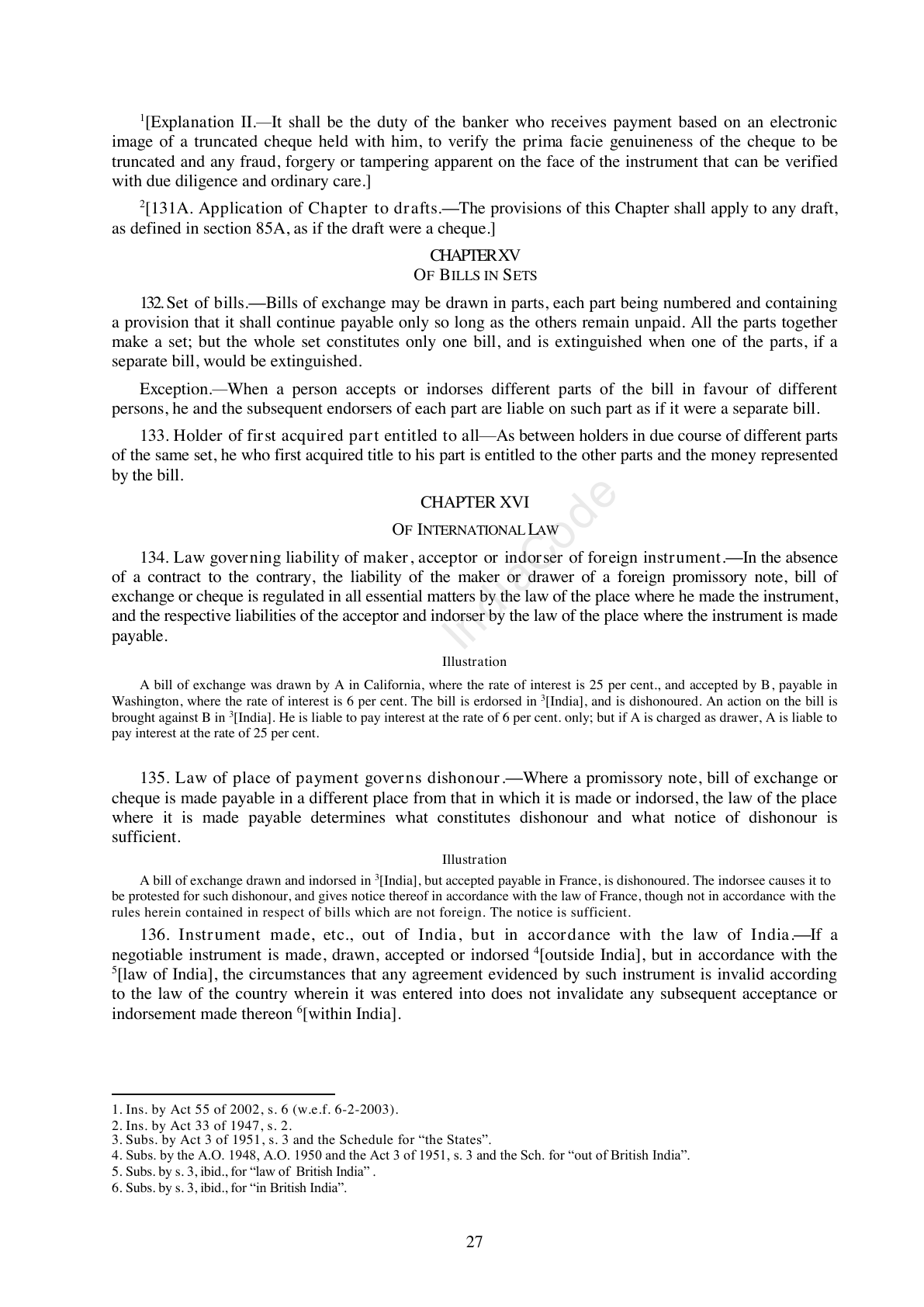
Full physical source page · unreviewed extraction
The Negotiable Instruments Act, 1881: page 27
The Negotiable Instruments Act, 1881, India Code delivered snapshot ed3e9db7f37052a1, physical page 27. Unreviewed extraction.
Source: official India Code PDF · catalog record. Fetched 2026-10-19T23:07:34Z. SHA-256 ed3e9db7f37052a1bc1cd665500910c5e123de888bce0375585e9a766bf38501.
Legal currency, territorial applicability and extraction fidelity are unverified. Catalog checksum/size differs from the delivered PDF; both identities are retained. Sections, state notes and footnotes share these physical pages. Compare the full original image.
Retained layout text
     1
     [Explanation II.—It shall be the duty of the banker who receives payment based on an electronic
image of a truncated cheque held with him, to verify the prima facie genuineness of the cheque to be
truncated and any fraud, forgery or tampering apparent on the face of the instrument that can be verified
with due diligence and ordinary care.]
     2
     [131A. Application of Chapter to drafts.—The provisions of this Chapter shall apply to any draft,
as defined in section 85A, as if the draft were a cheque.]
                                                          CHAPTERXV
                                                         OF B ILLS IN S ETS
    132. Set of bills.—Bills of exchange may be drawn in parts, each part being numbered and containing
a provision that it shall continue payable only so long as the others remain unpaid. All the parts together
make a set; but the whole set constitutes only one bill, and is extinguished when one of the parts, if a
separate bill, would be extinguished.
    Exception.—When a person accepts or indorses different parts of the bill in favour of different
persons, he and the subsequent endorsers of each part are liable on such part as if it were a separate bill.
     133. Holder of first acquired part entitled to all—As between holders in due course of different parts
of the same set, he who first acquired title to his part is entitled to the other parts and the money represented
by the bill.
                                                          CHAPTER XVI                 e
                                                     OF INTERNATIONAL LAW      od
    134. Law governing liability of maker, acceptor or indorser of foreign instrument.—In the absence
                                                                        aC
of a contract to the contrary, the liability of the maker or drawer of a foreign promissory note, bill of
exchange or cheque is regulated in all essential matters by the law of the place where he made the instrument,
                                                                 di
and the respective liabilities of the acceptor and indorser by the law of the place where the instrument is made
payable.                                                    InIllustration
     A bill of exchange was drawn by A in California, where the rate of interest is 25 per cent., and accepted by B, payable in
Washington, where the rate of interest is 6 per cent. The bill is erdorsed in 3[India], and is dishonoured. An action on the bill is
brought against B in 3[India]. He is liable to pay interest at the rate of 6 per cent. only; but if A is charged as drawer, A is liable to
pay interest at the rate of 25 per cent.


    135. Law of place of payment governs dishonour.—Where a promissory note, bill of exchange or
cheque is made payable in a different place from that in which it is made or indorsed, the law of the place
where it is made payable determines what constitutes dishonour and what notice of dishonour is
sufficient.
                                                            Illustration
     A bill of exchange drawn and indorsed in 3[India], but accepted payable in France, is dishonoured. The indorsee causes it to
be protested for such dishonour, and gives notice thereof in accordance with the law of France, though not in accordance with the
rules herein contained in respect of bills which are not foreign. The notice is sufficient.
     136. Instrument made, etc., out of India, but in accordance with the law of India.—If a
negotiable instrument is made, drawn, accepted or indorsed 4[outside India], but in accordance with the
5
  [law of India], the circumstances that any agreement evidenced by such instrument is invalid according
to the law of the country wherein it was entered into does not invalidate any subsequent acceptance or
indorsement made thereon 6[within India].


1. Ins. by Act 55 of 2002, s. 6 (w.e.f. 6-2-2003).
2. Ins. by Act 33 of 1947, s. 2.
3. Subs. by Act 3 of 1951, s. 3 and the Schedule for “the States”.
4. Subs. by the A.O. 1948, A.O. 1950 and the Act 3 of 1951, s. 3 and the Sch. for “out of British India”.
5. Subs. by s. 3, ibid., for “law of British India” .
6. Subs. by s. 3, ibid., for “in British India”.


                                                                   27
Compare original page image