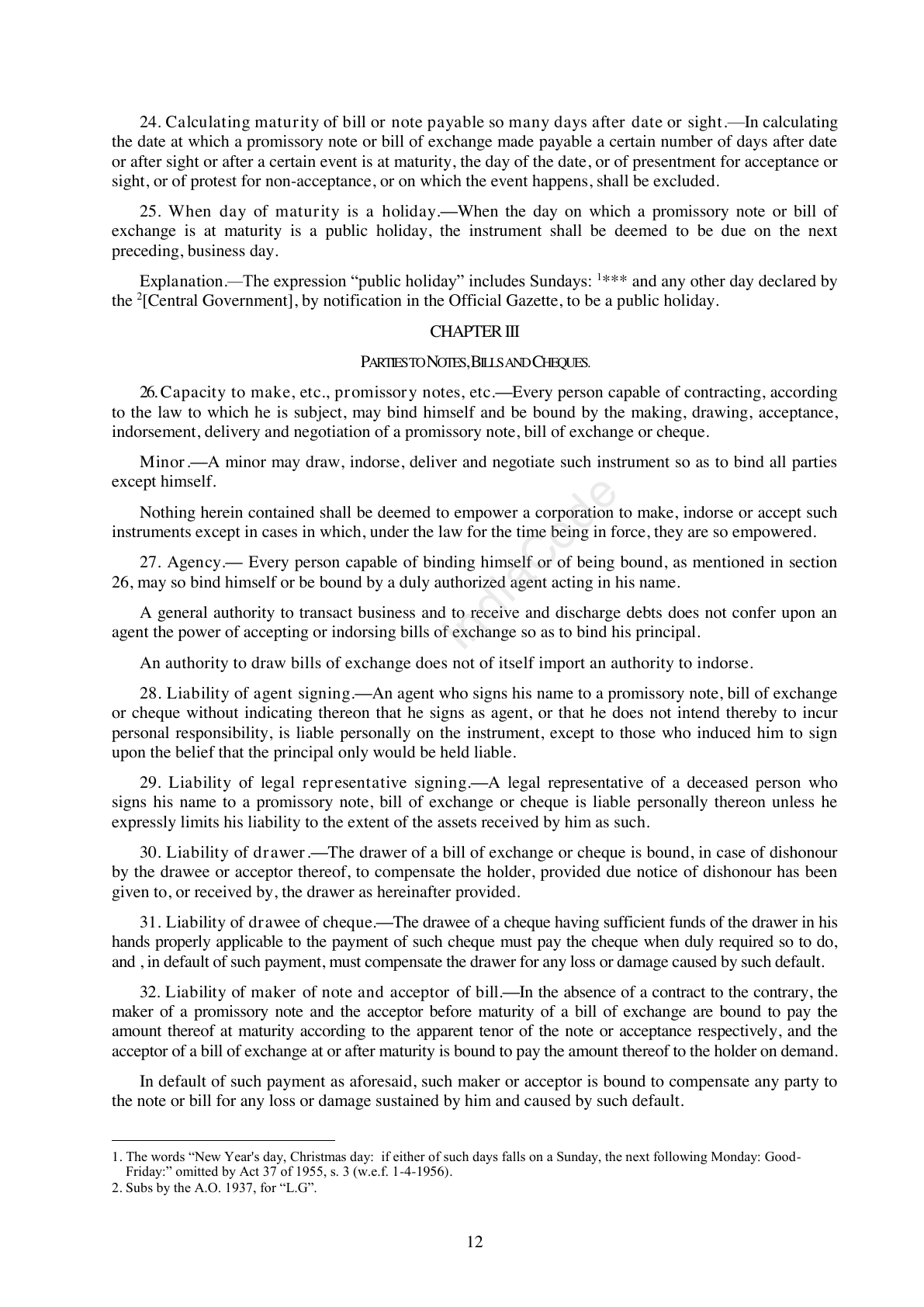
Full physical source page · unreviewed extraction
The Negotiable Instruments Act, 1881: page 12
The Negotiable Instruments Act, 1881, India Code delivered snapshot ed3e9db7f37052a1, physical page 12. Unreviewed extraction.
Source: official India Code PDF · catalog record. Fetched 2026-10-19T23:07:34Z. SHA-256 ed3e9db7f37052a1bc1cd665500910c5e123de888bce0375585e9a766bf38501.
Legal currency, territorial applicability and extraction fidelity are unverified. Catalog checksum/size differs from the delivered PDF; both identities are retained. Sections, state notes and footnotes share these physical pages. Compare the full original image.
Retained layout text
    24. Calculating maturity of bill or note payable so many days after date or sight.—In calculating
the date at which a promissory note or bill of exchange made payable a certain number of days after date
or after sight or after a certain event is at maturity, the day of the date, or of presentment for acceptance or
sight, or of protest for non-acceptance, or on which the event happens, shall be excluded.
    25. When day of maturity is a holiday.—When the day on which a promissory note or bill of
exchange is at maturity is a public holiday, the instrument shall be deemed to be due on the next
preceding, business day.
    Explanation.—The expression “public holiday” includes Sundays: 1*** and any other day declared by
    2
the [Central Government], by notification in the Official Gazette, to be a public holiday.
                                                      CHAPTER III
                                          PARTIESTO NOTES, BILLSAND CHEQUES.
    26. Capacity to make, etc., promissory notes, etc.—Every person capable of contracting, according
to the law to which he is subject, may bind himself and be bound by the making, drawing, acceptance,
indorsement, delivery and negotiation of a promissory note, bill of exchange or cheque.
    Minor.—A minor may draw, indorse, deliver and negotiate such instrument so as to bind all parties
except himself.
                                                                              e
     Nothing herein contained shall be deemed to empower a corporation to make, indorse or accept such
                                                                        od
instruments except in cases in which, under the law for the time being in force, they are so empowered.

                                                                  aC
    27. Agency.— Every person capable of binding himself or of being bound, as mentioned in section
26, may so bind himself or be bound by a duly authorized agent acting in his name.
                                                           di
    A general authority to transact business and to receive and discharge debts does not confer upon an
                                                      In
agent the power of accepting or indorsing bills of exchange so as to bind his principal.
    An authority to draw bills of exchange does not of itself import an authority to indorse.
    28. Liability of agent signing.—An agent who signs his name to a promissory note, bill of exchange
or cheque without indicating thereon that he signs as agent, or that he does not intend thereby to incur
personal responsibility, is liable personally on the instrument, except to those who induced him to sign
upon the belief that the principal only would be held liable.
    29. Liability of legal representative signing.—A legal representative of a deceased person who
signs his name to a promissory note, bill of exchange or cheque is liable personally thereon unless he
expressly limits his liability to the extent of the assets received by him as such.
    30. Liability of drawer.—The drawer of a bill of exchange or cheque is bound, in case of dishonour
by the drawee or acceptor thereof, to compensate the holder, provided due notice of dishonour has been
given to, or received by, the drawer as hereinafter provided.
    31. Liability of drawee of cheque.—The drawee of a cheque having sufficient funds of the drawer in his
hands properly applicable to the payment of such cheque must pay the cheque when duly required so to do,
and , in default of such payment, must compensate the drawer for any loss or damage caused by such default.
    32. Liability of maker of note and acceptor of bill.—In the absence of a contract to the contrary, the
maker of a promissory note and the acceptor before maturity of a bill of exchange are bound to pay the
amount thereof at maturity according to the apparent tenor of the note or acceptance respectively, and the
acceptor of a bill of exchange at or after maturity is bound to pay the amount thereof to the holder on demand.
    In default of such payment as aforesaid, such maker or acceptor is bound to compensate any party to
the note or bill for any loss or damage sustained by him and caused by such default.


1. The words “New Year's day, Christmas day: if either of such days falls on a Sunday, the next following Monday: Good-
   Friday:” omitted by Act 37 of 1955, s. 3 (w.e.f. 1-4-1956).
2. Subs by the A.O. 1937, for “L.G”.


                                                             12
Compare original page image