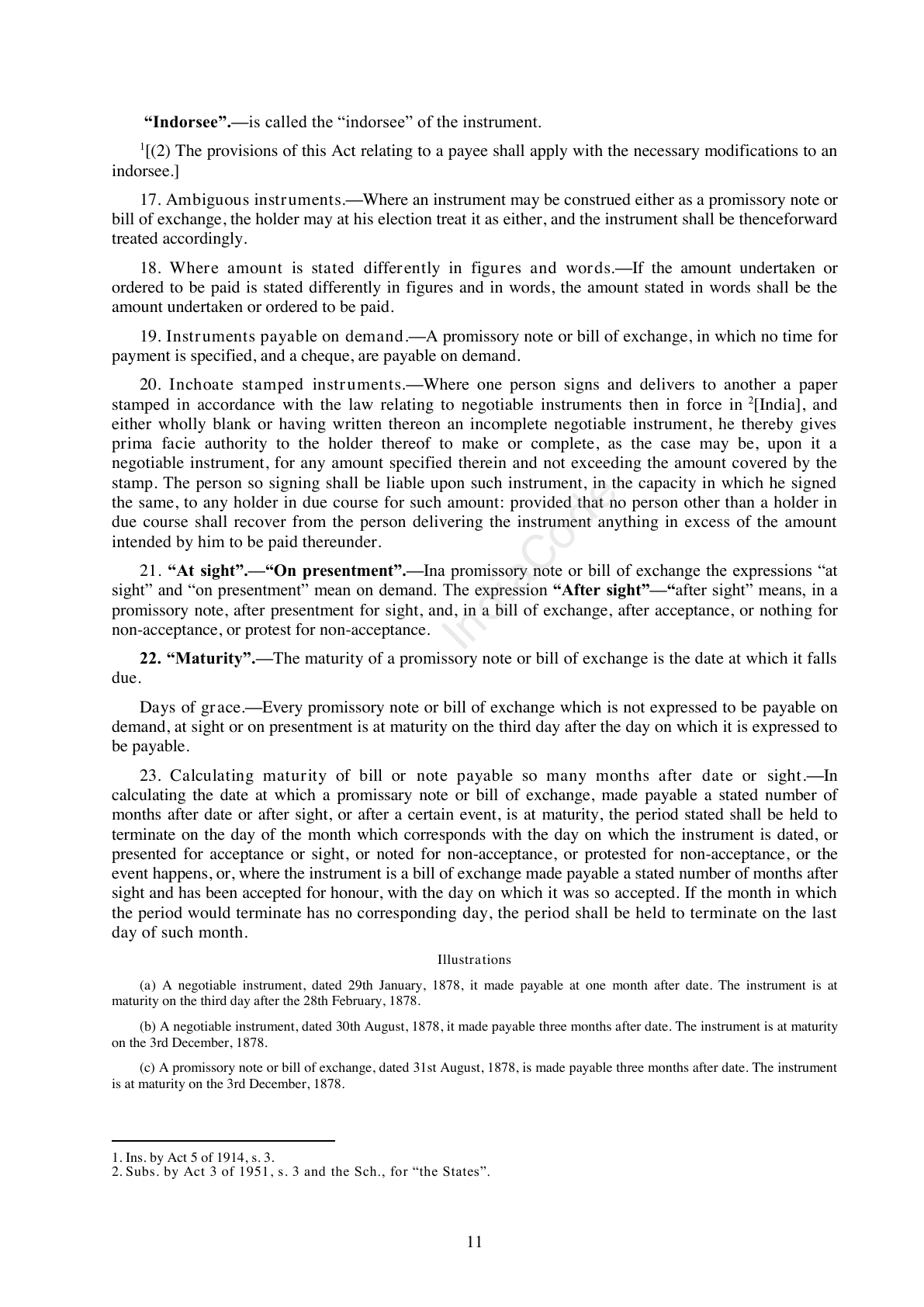
Full physical source page · unreviewed extraction
The Negotiable Instruments Act, 1881: page 11
The Negotiable Instruments Act, 1881, India Code delivered snapshot ed3e9db7f37052a1, physical page 11. Unreviewed extraction.
Source: official India Code PDF · catalog record. Fetched 2026-10-19T23:07:34Z. SHA-256 ed3e9db7f37052a1bc1cd665500910c5e123de888bce0375585e9a766bf38501.
Legal currency, territorial applicability and extraction fidelity are unverified. Catalog checksum/size differs from the delivered PDF; both identities are retained. Sections, state notes and footnotes share these physical pages. Compare the full original image.
Retained layout text
     “Indorsee”.—is called the “indorsee” of the instrument.
    1
     [(2) The provisions of this Act relating to a payee shall apply with the necessary modifications to an
indorsee.]
     17. Ambiguous instruments.—Where an instrument may be construed either as a promissory note or
bill of exchange, the holder may at his election treat it as either, and the instrument shall be thenceforward
treated accordingly.
    18. Where amount is stated differently in figures and words.—If the amount undertaken or
ordered to be paid is stated differently in figures and in words, the amount stated in words shall be the
amount undertaken or ordered to be paid.
   19. Instruments payable on demand.—A promissory note or bill of exchange, in which no time for
payment is specified, and a cheque, are payable on demand.
    20. Inchoate stamped instruments.—Where one person signs and delivers to another a paper
stamped in accordance with the law relating to negotiable instruments then in force in 2[India], and
either wholly blank or having written thereon an incomplete negotiable instrument, he thereby gives
prima facie authority to the holder thereof to make or complete, as the case may be, upon it a
negotiable instrument, for any amount specified therein and not exceeding the amount covered by the
stamp. The person so signing shall be liable upon such instrument, in the capacity in which he signed
                                                                                 e
the same, to any holder in due course for such amount: provided that no person other than a holder in
                                                                          od
due course shall recover from the person delivering the instrument anything in excess of the amount
intended by him to be paid thereunder.
                                                                    aC
    21. “At sight”.—“On presentment”.—Ina promissory note or bill of exchange the expressions “at
sight” and “on presentment” mean on demand. The expression “After sight”—“after sight” means, in a
                                                             di
promissory note, after presentment for sight, and, in a bill of exchange, after acceptance, or nothing for
non-acceptance, or protest for non-acceptance.          In
    22. “Maturity”.—The maturity of a promissory note or bill of exchange is the date at which it falls
due.
    Days of grace.—Every promissory note or bill of exchange which is not expressed to be payable on
demand, at sight or on presentment is at maturity on the third day after the day on which it is expressed to
be payable.
    23. Calculating maturity of bill or note payable so many months after date or sight.—In
calculating the date at which a promissary note or bill of exchange, made payable a stated number of
months after date or after sight, or after a certain event, is at maturity, the period stated shall be held to
terminate on the day of the month which corresponds with the day on which the instrument is dated, or
presented for acceptance or sight, or noted for non-acceptance, or protested for non-acceptance, or the
event happens, or, where the instrument is a bill of exchange made payable a stated number of months after
sight and has been accepted for honour, with the day on which it was so accepted. If the month in which
the period would terminate has no corresponding day, the period shall be held to terminate on the last
day of such month.
                                                         Illustrations
    (a) A negotiable instrument, dated 29th January, 1878, it made payable at one month after date. The instrument is at
maturity on the third day after the 28th February, 1878.
     (b) A negotiable instrument, dated 30th August, 1878, it made payable three months after date. The instrument is at maturity
on the 3rd December, 1878.
      (c) A promissory note or bill of exchange, dated 31st August, 1878, is made payable three months after date. The instrument
is at maturity on the 3rd December, 1878.


1. Ins. by Act 5 of 1914, s. 3.
2. Subs. by Act 3 of 1951, s. 3 and the Sch., for “the States”.


                                                               11
Compare original page image