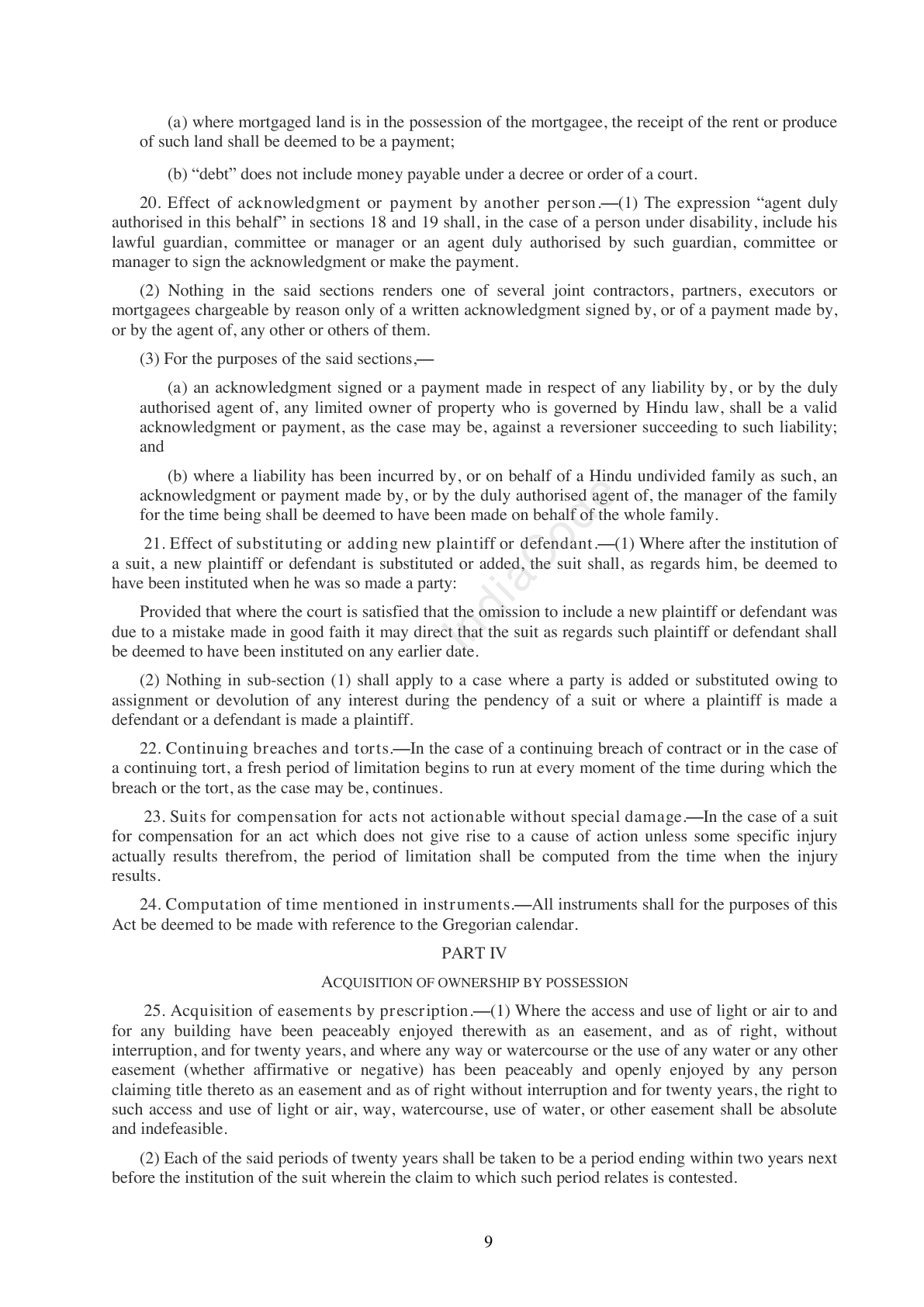
Full physical source page · unreviewed extraction
The Limitation Act, 1963: page 9
The Limitation Act, 1963, India Code delivered snapshot f04b51220f8f7ec9, physical page 9, typed edition 1dfeee3418fb3c6c2705c1f8efa27e957b9cd3bd696b85a8698dbfdedaa18092. Unreviewed extraction.
Source: official India Code PDF · catalog record. Fetched 2026-10-19T23:07:33Z. SHA-256 f04b51220f8f7ec97a1d7e8c73f14f37a91e8b300361db4b006b7d8226e31ed6.
Legal currency, territorial applicability and extraction fidelity are unverified. Catalog checksum/size differs from the delivered PDF; both identities are retained. Sections, state notes and footnotes share these physical pages. Compare the full original image.
Retained layout text
        (a) where mortgaged land is in the possession of the mortgagee, the receipt of the rent or produce
    of such land shall be deemed to be a payment;
        (b) “debt” does not include money payable under a decree or order of a court.
    20. Effect of acknowledgment or payment by another person.—(1) The expression “agent duly
authorised in this behalf” in sections 18 and 19 shall, in the case of a person under disability, include his
lawful guardian, committee or manager or an agent duly authorised by such guardian, committee or
manager to sign the acknowledgment or make the payment.
    (2) Nothing in the said sections renders one of several joint contractors, partners, executors or
mortgagees chargeable by reason only of a written acknowledgment signed by, or of a payment made by,
or by the agent of, any other or others of them.
    (3) For the purposes of the said sections,—
        (a) an acknowledgment signed or a payment made in respect of any liability by, or by the duly
    authorised agent of, any limited owner of property who is governed by Hindu law, shall be a valid
    acknowledgment or payment, as the case may be, against a reversioner succeeding to such liability;
    and
         (b) where a liability has been incurred by, or on behalf of a Hindu undivided family as such, an
    acknowledgment or payment made by, or by the duly authorised agent of, the manager of the family
                                                                    e
    for the time being shall be deemed to have been made on behalf of the whole family.
                                                              od
     21. Effect of substituting or adding new plaintiff or defendant.—(1) Where after the institution of
                                                        aC
a suit, a new plaintiff or defendant is substituted or added, the suit shall, as regards him, be deemed to
have been instituted when he was so made a party:
                                                   di
    Provided that where the court is satisfied that the omission to include a new plaintiff or defendant was
                                               In
due to a mistake made in good faith it may direct that the suit as regards such plaintiff or defendant shall
be deemed to have been instituted on any earlier date.
    (2) Nothing in sub-section (1) shall apply to a case where a party is added or substituted owing to
assignment or devolution of any interest during the pendency of a suit or where a plaintiff is made a
defendant or a defendant is made a plaintiff.
    22. Continuing breaches and torts.—In the case of a continuing breach of contract or in the case of
a continuing tort, a fresh period of limitation begins to run at every moment of the time during which the
breach or the tort, as the case may be, continues.
     23. Suits for compensation for acts not actionable without special damage.—In the case of a suit
for compensation for an act which does not give rise to a cause of action unless some specific injury
actually results therefrom, the period of limitation shall be computed from the time when the injury
results.
    24. Computation of time mentioned in instruments.—All instruments shall for the purposes of this
Act be deemed to be made with reference to the Gregorian calendar.
                                                  PART IV
                               ACQUISITION OF OWNERSHIP BY POSSESSION
     25. Acquisition of easements by prescription.—(1) Where the access and use of light or air to and
for any building have been peaceably enjoyed therewith as an easement, and as of right, without
interruption, and for twenty years, and where any way or watercourse or the use of any water or any other
easement (whether affirmative or negative) has been peaceably and openly enjoyed by any person
claiming title thereto as an easement and as of right without interruption and for twenty years, the right to
such access and use of light or air, way, watercourse, use of water, or other easement shall be absolute
and indefeasible.
    (2) Each of the said periods of twenty years shall be taken to be a period ending within two years next
before the institution of the suit wherein the claim to which such period relates is contested.


                                                       9
Compare original page image