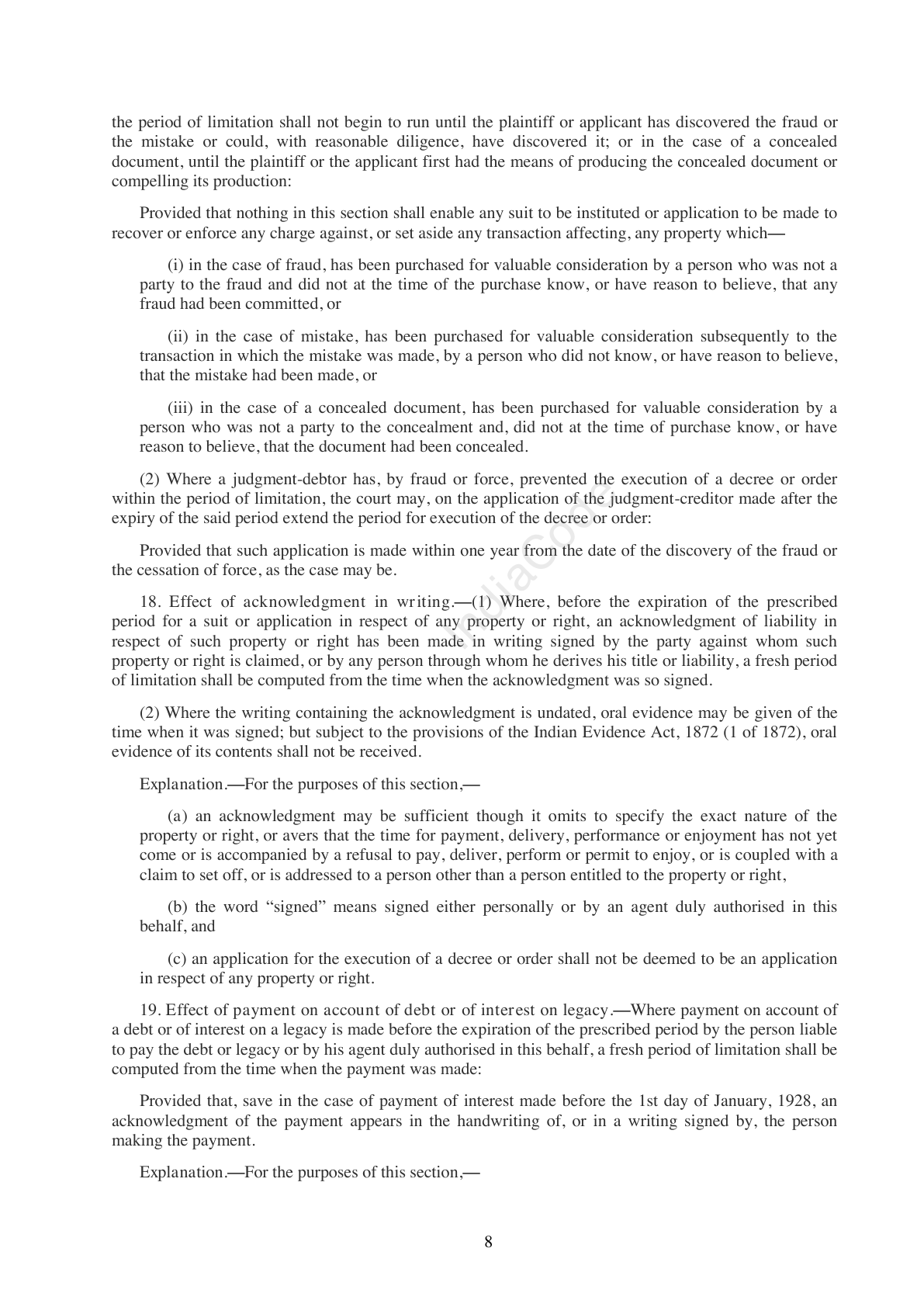
Full physical source page · unreviewed extraction
The Limitation Act, 1963: page 8
The Limitation Act, 1963, India Code delivered snapshot f04b51220f8f7ec9, physical page 8, typed edition 1dfeee3418fb3c6c2705c1f8efa27e957b9cd3bd696b85a8698dbfdedaa18092. Unreviewed extraction.
Source: official India Code PDF · catalog record. Fetched 2026-10-19T23:07:33Z. SHA-256 f04b51220f8f7ec97a1d7e8c73f14f37a91e8b300361db4b006b7d8226e31ed6.
Legal currency, territorial applicability and extraction fidelity are unverified. Catalog checksum/size differs from the delivered PDF; both identities are retained. Sections, state notes and footnotes share these physical pages. Compare the full original image.
Retained layout text
the period of limitation shall not begin to run until the plaintiff or applicant has discovered the fraud or
the mistake or could, with reasonable diligence, have discovered it; or in the case of a concealed
document, until the plaintiff or the applicant first had the means of producing the concealed document or
compelling its production:
    Provided that nothing in this section shall enable any suit to be instituted or application to be made to
recover or enforce any charge against, or set aside any transaction affecting, any property which—
        (i) in the case of fraud, has been purchased for valuable consideration by a person who was not a
    party to the fraud and did not at the time of the purchase know, or have reason to believe, that any
    fraud had been committed, or
         (ii) in the case of mistake, has been purchased for valuable consideration subsequently to the
    transaction in which the mistake was made, by a person who did not know, or have reason to believe,
    that the mistake had been made, or
        (iii) in the case of a concealed document, has been purchased for valuable consideration by a
    person who was not a party to the concealment and, did not at the time of purchase know, or have
    reason to believe, that the document had been concealed.
    (2) Where a judgment-debtor has, by fraud or force, prevented the execution of a decree or order
within the period of limitation, the court may, on the application of the judgment-creditor made after the
                                                                     e
expiry of the said period extend the period for execution of the decree or order:
                                                               od
    Provided that such application is made within one year from the date of the discovery of the fraud or
the cessation of force, as the case may be.              aC
                                                    di
     18. Effect of acknowledgment in writing.—(1) Where, before the expiration of the prescribed
period for a suit or application in respect of any property or right, an acknowledgment of liability in
                                                In
respect of such property or right has been made in writing signed by the party against whom such
property or right is claimed, or by any person through whom he derives his title or liability, a fresh period
of limitation shall be computed from the time when the acknowledgment was so signed.
    (2) Where the writing containing the acknowledgment is undated, oral evidence may be given of the
time when it was signed; but subject to the provisions of the Indian Evidence Act, 1872 (1 of 1872), oral
evidence of its contents shall not be received.
    Explanation.—For the purposes of this section,—
        (a) an acknowledgment may be sufficient though it omits to specify the exact nature of the
    property or right, or avers that the time for payment, delivery, performance or enjoyment has not yet
    come or is accompanied by a refusal to pay, deliver, perform or permit to enjoy, or is coupled with a
    claim to set off, or is addressed to a person other than a person entitled to the property or right,
       (b) the word “signed” means signed either personally or by an agent duly authorised in this
    behalf, and
         (c) an application for the execution of a decree or order shall not be deemed to be an application
    in respect of any property or right.
    19. Effect of payment on account of debt or of interest on legacy.—Where payment on account of
a debt or of interest on a legacy is made before the expiration of the prescribed period by the person liable
to pay the debt or legacy or by his agent duly authorised in this behalf, a fresh period of limitation shall be
computed from the time when the payment was made:
    Provided that, save in the case of payment of interest made before the 1st day of January, 1928, an
acknowledgment of the payment appears in the handwriting of, or in a writing signed by, the person
making the payment.
    Explanation.—For the purposes of this section,—


                                                        8
Compare original page image