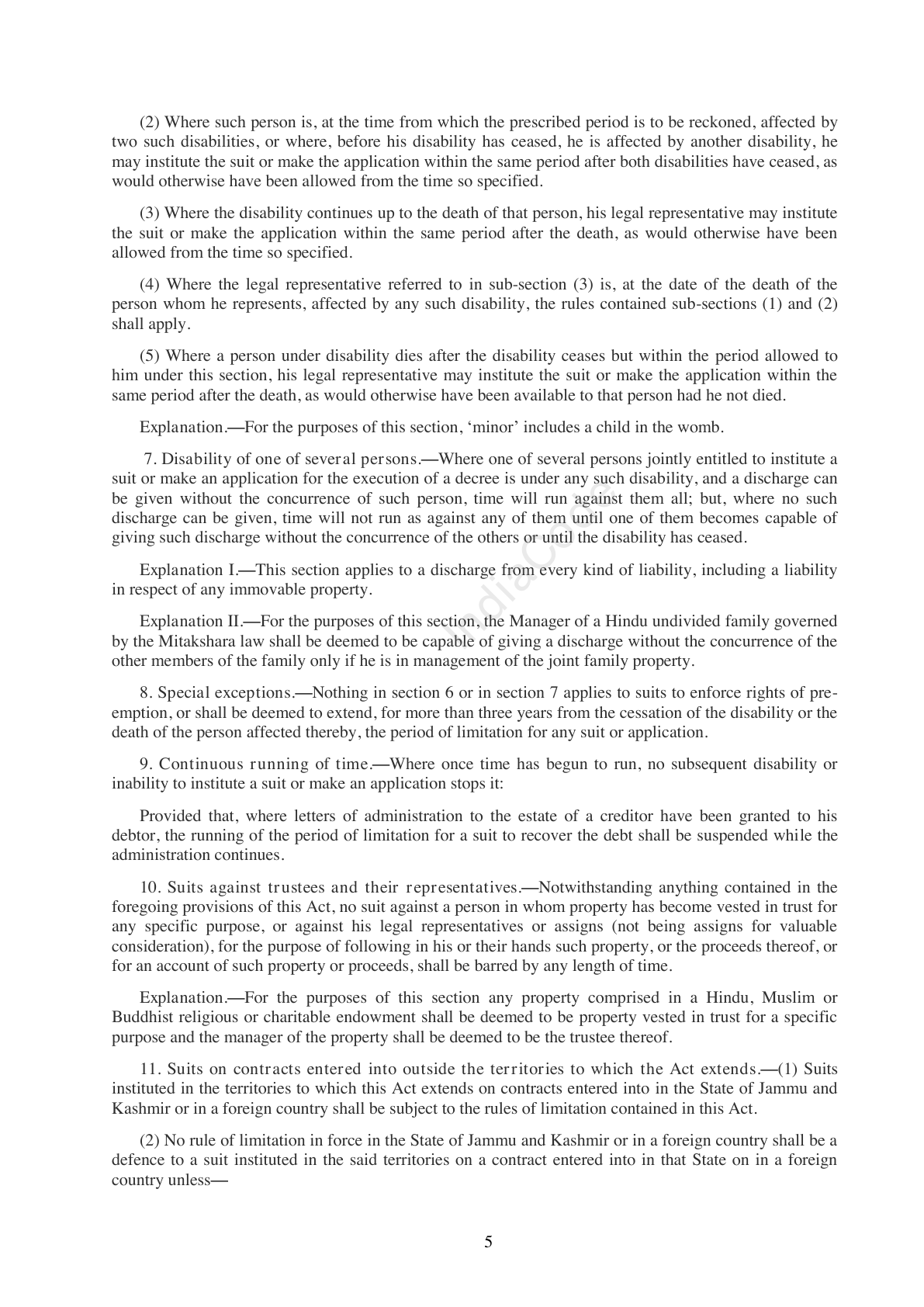
Full physical source page · unreviewed extraction
The Limitation Act, 1963: page 5
The Limitation Act, 1963, India Code delivered snapshot f04b51220f8f7ec9, physical page 5, typed edition 1dfeee3418fb3c6c2705c1f8efa27e957b9cd3bd696b85a8698dbfdedaa18092. Unreviewed extraction.
Source: official India Code PDF · catalog record. Fetched 2026-10-19T23:07:33Z. SHA-256 f04b51220f8f7ec97a1d7e8c73f14f37a91e8b300361db4b006b7d8226e31ed6.
Legal currency, territorial applicability and extraction fidelity are unverified. Catalog checksum/size differs from the delivered PDF; both identities are retained. Sections, state notes and footnotes share these physical pages. Compare the full original image.
Retained layout text
   (2) Where such person is, at the time from which the prescribed period is to be reckoned, affected by
two such disabilities, or where, before his disability has ceased, he is affected by another disability, he
may institute the suit or make the application within the same period after both disabilities have ceased, as
would otherwise have been allowed from the time so specified.
    (3) Where the disability continues up to the death of that person, his legal representative may institute
the suit or make the application within the same period after the death, as would otherwise have been
allowed from the time so specified.
    (4) Where the legal representative referred to in sub-section (3) is, at the date of the death of the
person whom he represents, affected by any such disability, the rules contained sub-sections (1) and (2)
shall apply.
   (5) Where a person under disability dies after the disability ceases but within the period allowed to
him under this section, his legal representative may institute the suit or make the application within the
same period after the death, as would otherwise have been available to that person had he not died.
    Explanation.—For the purposes of this section, ‘minor’ includes a child in the womb.
     7. Disability of one of several persons.—Where one of several persons jointly entitled to institute a
suit or make an application for the execution of a decree is under any such disability, and a discharge can
be given without the concurrence of such person, time will run against them all; but, where no such
                                                                    e
discharge can be given, time will not run as against any of them until one of them becomes capable of
                                                              od
giving such discharge without the concurrence of the others or until the disability has ceased.
                                                        aC
     Explanation I.—This section applies to a discharge from every kind of liability, including a liability
in respect of any immovable property.
                                                   di
    Explanation II.—For the purposes of this section, the Manager of a Hindu undivided family governed
                                               In
by the Mitakshara law shall be deemed to be capable of giving a discharge without the concurrence of the
other members of the family only if he is in management of the joint family property.
    8. Special exceptions.—Nothing in section 6 or in section 7 applies to suits to enforce rights of pre-
emption, or shall be deemed to extend, for more than three years from the cessation of the disability or the
death of the person affected thereby, the period of limitation for any suit or application.
    9. Continuous running of time.—Where once time has begun to run, no subsequent disability or
inability to institute a suit or make an application stops it:
    Provided that, where letters of administration to the estate of a creditor have been granted to his
debtor, the running of the period of limitation for a suit to recover the debt shall be suspended while the
administration continues.
    10. Suits against trustees and their representatives.—Notwithstanding anything contained in the
foregoing provisions of this Act, no suit against a person in whom property has become vested in trust for
any specific purpose, or against his legal representatives or assigns (not being assigns for valuable
consideration), for the purpose of following in his or their hands such property, or the proceeds thereof, or
for an account of such property or proceeds, shall be barred by any length of time.
    Explanation.—For the purposes of this section any property comprised in a Hindu, Muslim or
Buddhist religious or charitable endowment shall be deemed to be property vested in trust for a specific
purpose and the manager of the property shall be deemed to be the trustee thereof.
     11. Suits on contracts entered into outside the territories to which the Act extends.—(1) Suits
instituted in the territories to which this Act extends on contracts entered into in the State of Jammu and
Kashmir or in a foreign country shall be subject to the rules of limitation contained in this Act.
    (2) No rule of limitation in force in the State of Jammu and Kashmir or in a foreign country shall be a
defence to a suit instituted in the said territories on a contract entered into in that State on in a foreign
country unless—


                                                       5
Compare original page image