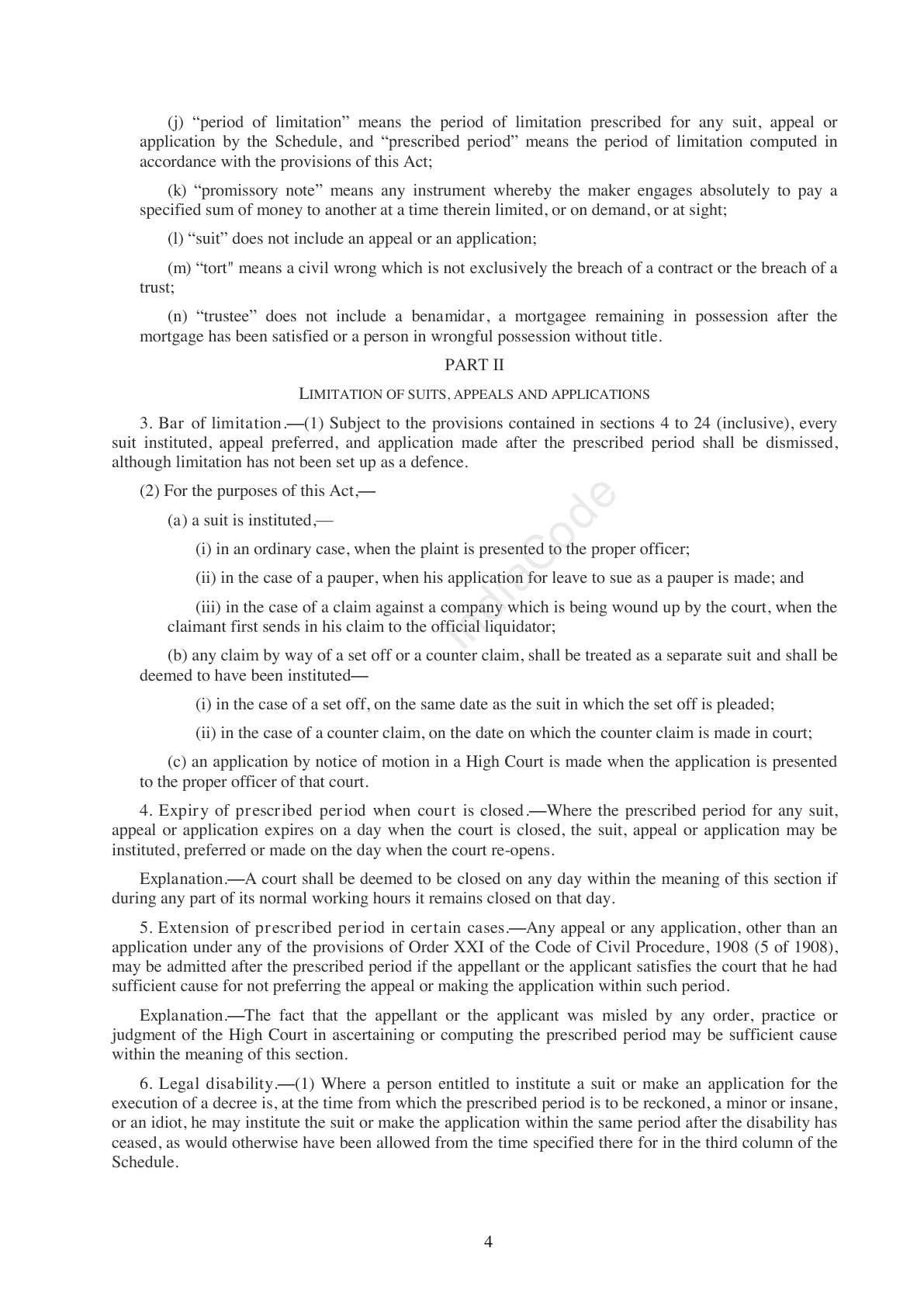
Full physical source page · unreviewed extraction
The Limitation Act, 1963: page 4
The Limitation Act, 1963, India Code delivered snapshot f04b51220f8f7ec9, physical page 4, typed edition 1dfeee3418fb3c6c2705c1f8efa27e957b9cd3bd696b85a8698dbfdedaa18092. Unreviewed extraction.
Source: official India Code PDF · catalog record. Fetched 2026-10-19T23:07:33Z. SHA-256 f04b51220f8f7ec97a1d7e8c73f14f37a91e8b300361db4b006b7d8226e31ed6.
Legal currency, territorial applicability and extraction fidelity are unverified. Catalog checksum/size differs from the delivered PDF; both identities are retained. Sections, state notes and footnotes share these physical pages. Compare the full original image.
Retained layout text
        (j) “period of limitation” means the period of limitation prescribed for any suit, appeal or
    application by the Schedule, and “prescribed period” means the period of limitation computed in
    accordance with the provisions of this Act;
        (k) “promissory note” means any instrument whereby the maker engages absolutely to pay a
    specified sum of money to another at a time therein limited, or on demand, or at sight;
        (l) “suit” does not include an appeal or an application;
        (m) “tort" means a civil wrong which is not exclusively the breach of a contract or the breach of a
    trust;
       (n) “trustee” does not include a benamidar, a mortgagee remaining in possession after the
    mortgage has been satisfied or a person in wrongful possession without title.
                                                   PART II
                            LIMITATION OF SUITS, APPEALS AND APPLICATIONS
    3. Bar of limitation.—(1) Subject to the provisions contained in sections 4 to 24 (inclusive), every
suit instituted, appeal preferred, and application made after the prescribed period shall be dismissed,
although limitation has not been set up as a defence.
    (2) For the purposes of this Act,—
                                                                      e
        (a) a suit is instituted,—                              od
            (i) in an ordinary case, when the plaint is presented to the proper officer;
                                                         aC
            (ii) in the case of a pauper, when his application for leave to sue as a pauper is made; and
                                                     di
            (iii) in the case of a claim against a company which is being wound up by the court, when the
        claimant first sends in his claim to the official liquidator;
                                                In
       (b) any claim by way of a set off or a counter claim, shall be treated as a separate suit and shall be
    deemed to have been instituted—
            (i) in the case of a set off, on the same date as the suit in which the set off is pleaded;
            (ii) in the case of a counter claim, on the date on which the counter claim is made in court;
         (c) an application by notice of motion in a High Court is made when the application is presented
    to the proper officer of that court.
     4. Expiry of prescribed period when court is closed.—Where the prescribed period for any suit,
appeal or application expires on a day when the court is closed, the suit, appeal or application may be
instituted, preferred or made on the day when the court re-opens.
    Explanation.—A court shall be deemed to be closed on any day within the meaning of this section if
during any part of its normal working hours it remains closed on that day.
    5. Extension of prescribed period in certain cases.—Any appeal or any application, other than an
application under any of the provisions of Order XXI of the Code of Civil Procedure, 1908 (5 of 1908),
may be admitted after the prescribed period if the appellant or the applicant satisfies the court that he had
sufficient cause for not preferring the appeal or making the application within such period.
    Explanation.—The fact that the appellant or the applicant was misled by any order, practice or
judgment of the High Court in ascertaining or computing the prescribed period may be sufficient cause
within the meaning of this section.
    6. Legal disability.—(1) Where a person entitled to institute a suit or make an application for the
execution of a decree is, at the time from which the prescribed period is to be reckoned, a minor or insane,
or an idiot, he may institute the suit or make the application within the same period after the disability has
ceased, as would otherwise have been allowed from the time specified there for in the third column of the
Schedule.


                                                         4
Compare original page image