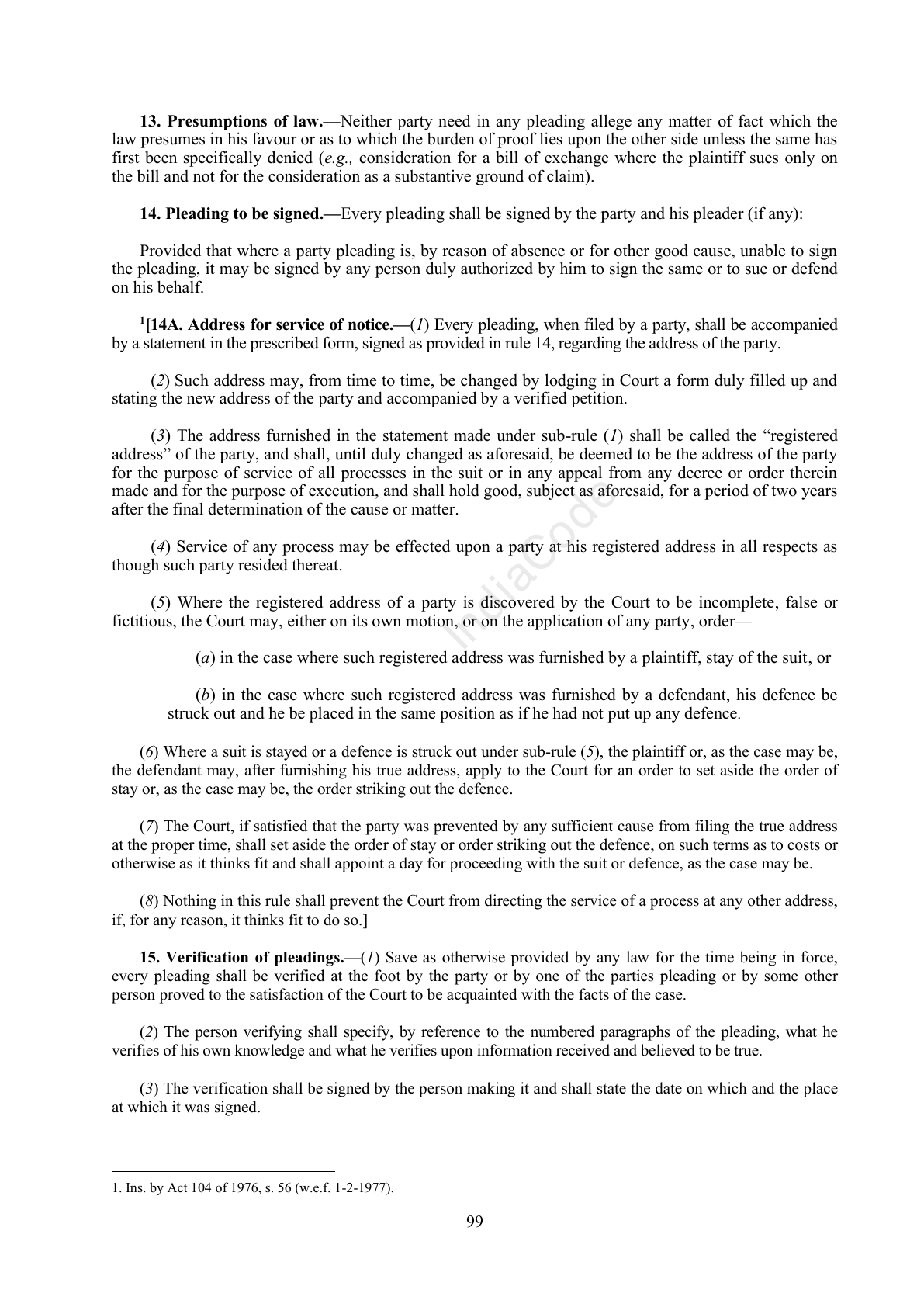
Full physical source page · unreviewed extraction
The Code of Civil Procedure, 1908: page 99
The Code of Civil Procedure, 1908, India Code delivered snapshot 393b8848fdfc476a, physical page 99, typed edition 77428589d4e341672ed6a3e5f663be7dec530c42d0600064ac1314302939267d. Unreviewed extraction.
Source: official India Code PDF · catalog record. Fetched 2026-10-19T23:06:46Z. SHA-256 393b8848fdfc476a21cc3abf4f0d3f510557e2dff6fc6914b1f379bea1730614.
Legal currency, territorial applicability and extraction fidelity are unverified. Catalog checksum/size differs from the delivered PDF; both identities are retained. Sections, state notes and footnotes share these physical pages. Compare the full original image.
Retained layout text
     13. Presumptions of law.—Neither party need in any pleading allege any matter of fact which the
law presumes in his favour or as to which the burden of proof lies upon the other side unless the same has
first been specifically denied (e.g., consideration for a bill of exchange where the plaintiff sues only on
the bill and not for the consideration as a substantive ground of claim).

     14. Pleading to be signed.—Every pleading shall be signed by the party and his pleader (if any):

    Provided that where a party pleading is, by reason of absence or for other good cause, unable to sign
the pleading, it may be signed by any person duly authorized by him to sign the same or to sue or defend
on his behalf.
     1
     [14A. Address for service of notice.—(1) Every pleading, when filed by a party, shall be accompanied
by a statement in the prescribed form, signed as provided in rule 14, regarding the address of the party.

      (2) Such address may, from time to time, be changed by lodging in Court a form duly filled up and
stating the new address of the party and accompanied by a verified petition.

       (3) The address furnished in the statement made under sub-rule (1) shall be called the “registered
address” of the party, and shall, until duly changed as aforesaid, be deemed to be the address of the party
for the purpose of service of all processes in the suit or in any appeal from any decree or order therein
made and for the purpose of execution, and shall hold good, subject as aforesaid, for a period of two years
after the final determination of the cause or matter.                    e
                                                                   od
     (4) Service of any process may be effected upon a party at his registered address in all respects as
though such party resided thereat.                            aC
       (5) Where the registered address of a party is discovered by the Court to be incomplete, false or
                                                        di
fictitious, the Court may, either on its own motion, or on the application of any party, order—
                                                       In
               (a) in the case where such registered address was furnished by a plaintiff, stay of the suit, or

              (b) in the case where such registered address was furnished by a defendant, his defence be
          struck out and he be placed in the same position as if he had not put up any defence.

    (6) Where a suit is stayed or a defence is struck out under sub-rule (5), the plaintiff or, as the case may be,
the defendant may, after furnishing his true address, apply to the Court for an order to set aside the order of
stay or, as the case may be, the order striking out the defence.

     (7) The Court, if satisfied that the party was prevented by any sufficient cause from filing the true address
at the proper time, shall set aside the order of stay or order striking out the defence, on such terms as to costs or
otherwise as it thinks fit and shall appoint a day for proceeding with the suit or defence, as the case may be.

      (8) Nothing in this rule shall prevent the Court from directing the service of a process at any other address,
if, for any reason, it thinks fit to do so.]

    15. Verification of pleadings.—(1) Save as otherwise provided by any law for the time being in force,
every pleading shall be verified at the foot by the party or by one of the parties pleading or by some other
person proved to the satisfaction of the Court to be acquainted with the facts of the case.

     (2) The person verifying shall specify, by reference to the numbered paragraphs of the pleading, what he
verifies of his own knowledge and what he verifies upon information received and believed to be true.

    (3) The verification shall be signed by the person making it and shall state the date on which and the place
at which it was signed.


1. Ins. by Act 104 of 1976, s. 56 (w.e.f. 1-2-1977).

                                                         99
Compare original page image