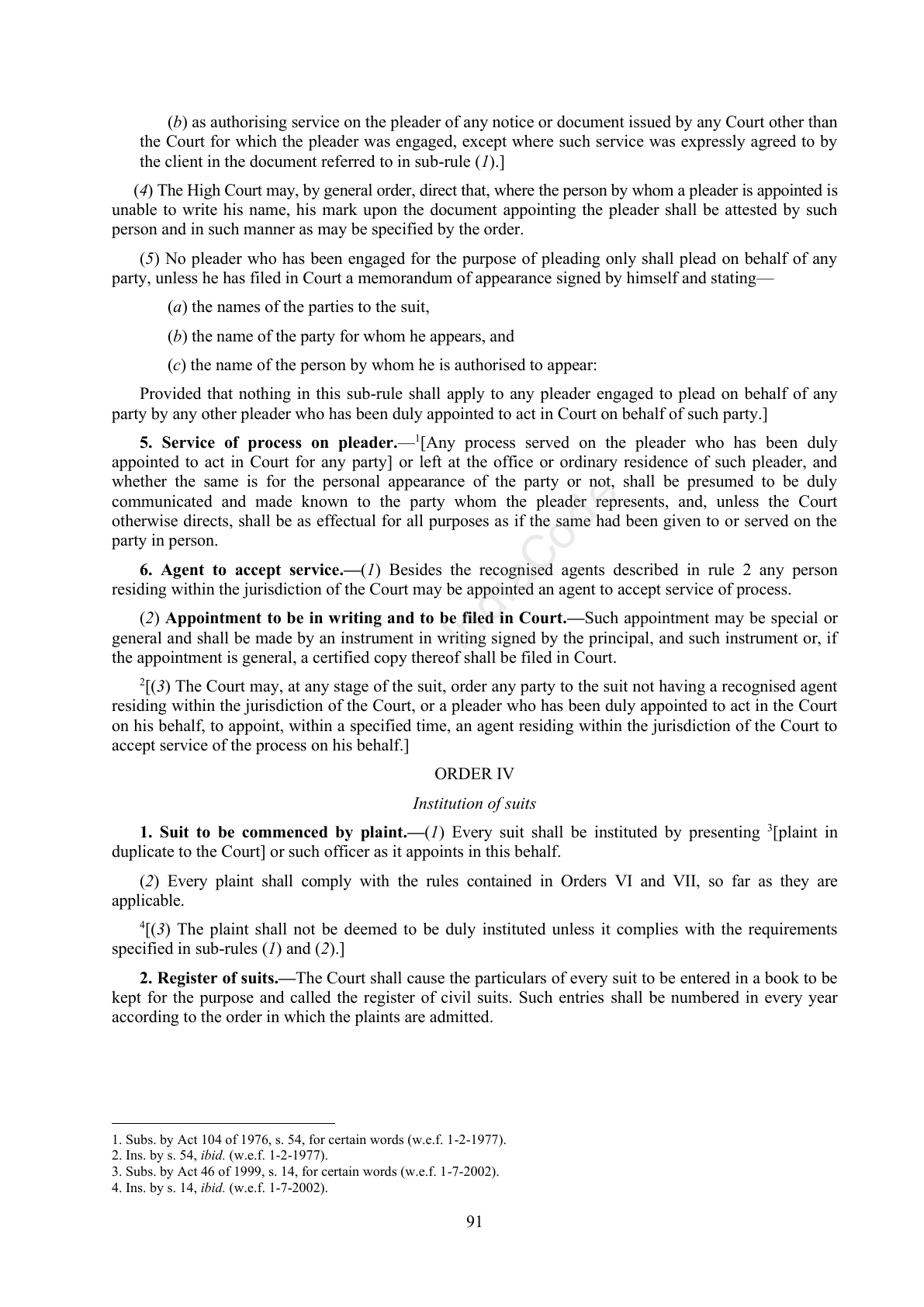
Full physical source page · unreviewed extraction
The Code of Civil Procedure, 1908: page 91
The Code of Civil Procedure, 1908, India Code delivered snapshot 393b8848fdfc476a, physical page 91, typed edition 77428589d4e341672ed6a3e5f663be7dec530c42d0600064ac1314302939267d. Unreviewed extraction.
Source: official India Code PDF · catalog record. Fetched 2026-10-19T23:06:46Z. SHA-256 393b8848fdfc476a21cc3abf4f0d3f510557e2dff6fc6914b1f379bea1730614.
Legal currency, territorial applicability and extraction fidelity are unverified. Catalog checksum/size differs from the delivered PDF; both identities are retained. Sections, state notes and footnotes share these physical pages. Compare the full original image.
Retained layout text
         (b) as authorising service on the pleader of any notice or document issued by any Court other than
     the Court for which the pleader was engaged, except where such service was expressly agreed to by
     the client in the document referred to in sub-rule (1).]
   (4) The High Court may, by general order, direct that, where the person by whom a pleader is appointed is
unable to write his name, his mark upon the document appointing the pleader shall be attested by such
person and in such manner as may be specified by the order.
    (5) No pleader who has been engaged for the purpose of pleading only shall plead on behalf of any
party, unless he has filed in Court a memorandum of appearance signed by himself and stating—
          (a) the names of the parties to the suit,
          (b) the name of the party for whom he appears, and
          (c) the name of the person by whom he is authorised to appear:
    Provided that nothing in this sub-rule shall apply to any pleader engaged to plead on behalf of any
party by any other pleader who has been duly appointed to act in Court on behalf of such party.]
    5. Service of process on pleader.—1[Any process served on the pleader who has been duly
appointed to act in Court for any party] or left at the office or ordinary residence of such pleader, and
whether the same is for the personal appearance of the party or not, shall be presumed to be duly
communicated and made known to the party whom the pleader represents, and, unless the Court
                                                                             e
otherwise directs, shall be as effectual for all purposes as if the same had been given to or served on the
                                                                           od
party in person.
                                                                     aC
    6. Agent to accept service.—(1) Besides the recognised agents described in rule 2 any person
residing within the jurisdiction of the Court may be appointed an agent to accept service of process.
                                                               di
    (2) Appointment to be in writing and to be filed in Court.—Such appointment may be special or
                                                         In
general and shall be made by an instrument in writing signed by the principal, and such instrument or, if
the appointment is general, a certified copy thereof shall be filed in Court.
     2
     [(3) The Court may, at any stage of the suit, order any party to the suit not having a recognised agent
residing within the jurisdiction of the Court, or a pleader who has been duly appointed to act in the Court
on his behalf, to appoint, within a specified time, an agent residing within the jurisdiction of the Court to
accept service of the process on his behalf.]
                                                          ORDER IV
                                                      Institution of suits
   1. Suit to be commenced by plaint.—(1) Every suit shall be instituted by presenting 3[plaint in
duplicate to the Court] or such officer as it appoints in this behalf.
    (2) Every plaint shall comply with the rules contained in Orders VI and VII, so far as they are
applicable.
     4
     [(3) The plaint shall not be deemed to be duly instituted unless it complies with the requirements
specified in sub-rules (1) and (2).]
    2. Register of suits.—The Court shall cause the particulars of every suit to be entered in a book to be
kept for the purpose and called the register of civil suits. Such entries shall be numbered in every year
according to the order in which the plaints are admitted.


1. Subs. by Act 104 of 1976, s. 54, for certain words (w.e.f. 1-2-1977).
2. Ins. by s. 54, ibid. (w.e.f. 1-2-1977).
3. Subs. by Act 46 of 1999, s. 14, for certain words (w.e.f. 1-7-2002).
4. Ins. by s. 14, ibid. (w.e.f. 1-7-2002).

                                                                91
Compare original page image