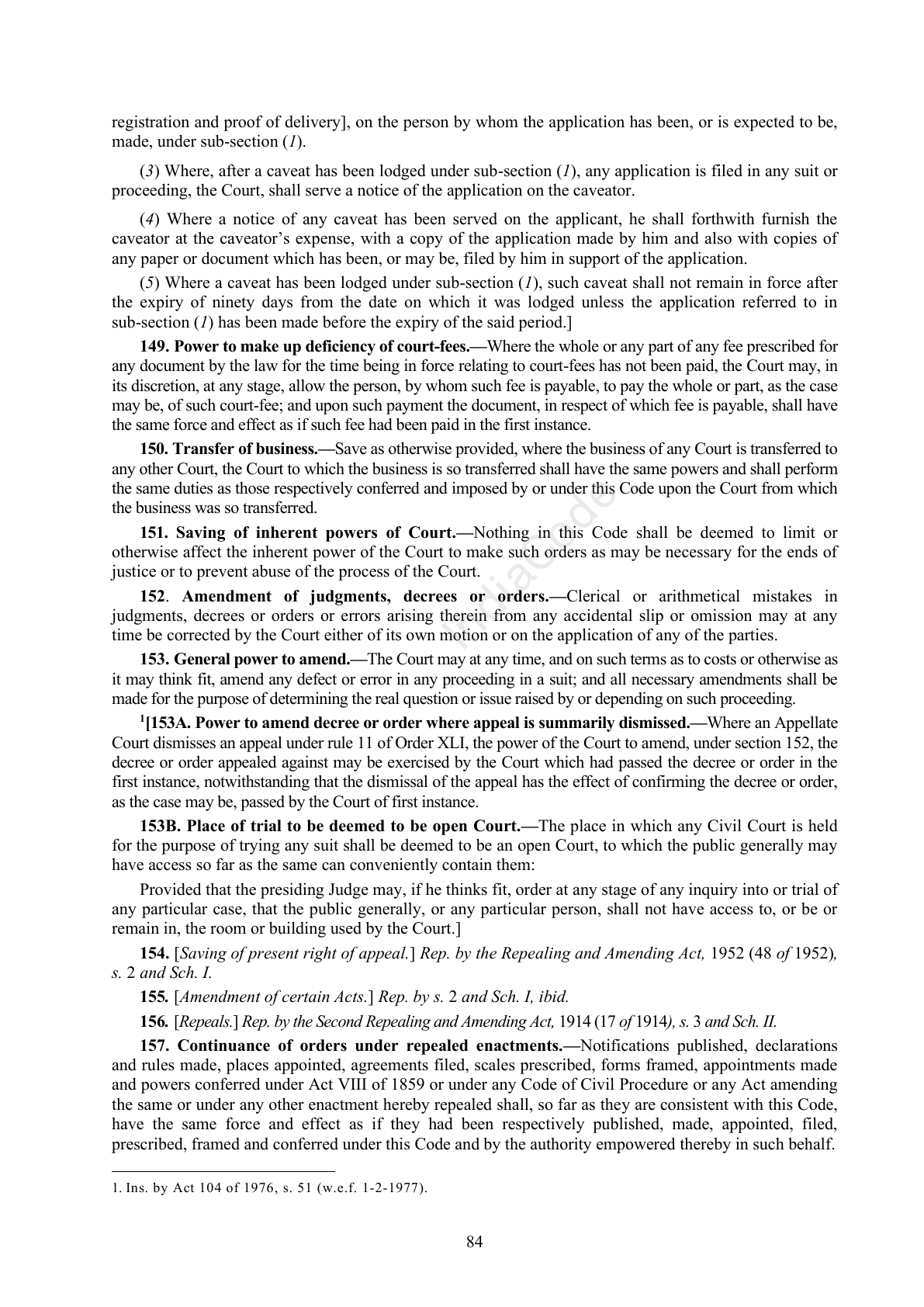
Full physical source page · unreviewed extraction
The Code of Civil Procedure, 1908: page 84
The Code of Civil Procedure, 1908, India Code delivered snapshot 393b8848fdfc476a, physical page 84, typed edition 77428589d4e341672ed6a3e5f663be7dec530c42d0600064ac1314302939267d. Unreviewed extraction.
Source: official India Code PDF · catalog record. Fetched 2026-10-19T23:06:46Z. SHA-256 393b8848fdfc476a21cc3abf4f0d3f510557e2dff6fc6914b1f379bea1730614.
Legal currency, territorial applicability and extraction fidelity are unverified. Catalog checksum/size differs from the delivered PDF; both identities are retained. Sections, state notes and footnotes share these physical pages. Compare the full original image.
Retained layout text
registration and proof of delivery], on the person by whom the application has been, or is expected to be,
made, under sub-section (1).
    (3) Where, after a caveat has been lodged under sub-section (1), any application is filed in any suit or
proceeding, the Court, shall serve a notice of the application on the caveator.
     (4) Where a notice of any caveat has been served on the applicant, he shall forthwith furnish the
caveator at the caveator’s expense, with a copy of the application made by him and also with copies of
any paper or document which has been, or may be, filed by him in support of the application.
     (5) Where a caveat has been lodged under sub-section (1), such caveat shall not remain in force after
the expiry of ninety days from the date on which it was lodged unless the application referred to in
sub-section (1) has been made before the expiry of the said period.]
     149. Power to make up deficiency of court-fees.—Where the whole or any part of any fee prescribed for
any document by the law for the time being in force relating to court-fees has not been paid, the Court may, in
its discretion, at any stage, allow the person, by whom such fee is payable, to pay the whole or part, as the case
may be, of such court-fee; and upon such payment the document, in respect of which fee is payable, shall have
the same force and effect as if such fee had been paid in the first instance.
     150. Transfer of business.—Save as otherwise provided, where the business of any Court is transferred to
any other Court, the Court to which the business is so transferred shall have the same powers and shall perform
the same duties as those respectively conferred and imposed by or under this Code upon the Court from which
the business was so transferred.                                       e
                                                                 od
     151. Saving of inherent powers of Court.—Nothing in this Code shall be deemed to limit or
otherwise affect the inherent power of the Court to make such orders as may be necessary for the ends of
justice or to prevent abuse of the process of the Court.     aC
     152. Amendment of judgments, decrees or orders.—Clerical or arithmetical mistakes in
                                                        di
judgments, decrees or orders or errors arising therein from any accidental slip or omission may at any
                                                       In
time be corrected by the Court either of its own motion or on the application of any of the parties.
     153. General power to amend.—The Court may at any time, and on such terms as to costs or otherwise as
it may think fit, amend any defect or error in any proceeding in a suit; and all necessary amendments shall be
made for the purpose of determining the real question or issue raised by or depending on such proceeding.
     1
       [153A. Power to amend decree or order where appeal is summarily dismissed.—Where an Appellate
Court dismisses an appeal under rule 11 of Order XLI, the power of the Court to amend, under section 152, the
decree or order appealed against may be exercised by the Court which had passed the decree or order in the
first instance, notwithstanding that the dismissal of the appeal has the effect of confirming the decree or order,
as the case may be, passed by the Court of first instance.
     153B. Place of trial to be deemed to be open Court.—The place in which any Civil Court is held
for the purpose of trying any suit shall be deemed to be an open Court, to which the public generally may
have access so far as the same can conveniently contain them:
     Provided that the presiding Judge may, if he thinks fit, order at any stage of any inquiry into or trial of
any particular case, that the public generally, or any particular person, shall not have access to, or be or
remain in, the room or building used by the Court.]
     154. [Saving of present right of appeal.] Rep. by the Repealing and Amending Act, 1952 (48 of 1952),
s. 2 and Sch. I.
     155. [Amendment of certain Acts.] Rep. by s. 2 and Sch. I, ibid.
     156. [Repeals.] Rep. by the Second Repealing and Amending Act, 1914 (17 of 1914), s. 3 and Sch. II.
     157. Continuance of orders under repealed enactments.—Notifications published, declarations
and rules made, places appointed, agreements filed, scales prescribed, forms framed, appointments made
and powers conferred under Act VIII of 1859 or under any Code of Civil Procedure or any Act amending
the same or under any other enactment hereby repealed shall, so far as they are consistent with this Code,
have the same force and effect as if they had been respectively published, made, appointed, filed,
prescribed, framed and conferred under this Code and by the authority empowered thereby in such behalf.

1. Ins. by Act 104 of 1976, s. 51 (w.e.f. 1-2-1977).


                                                        84
Compare original page image