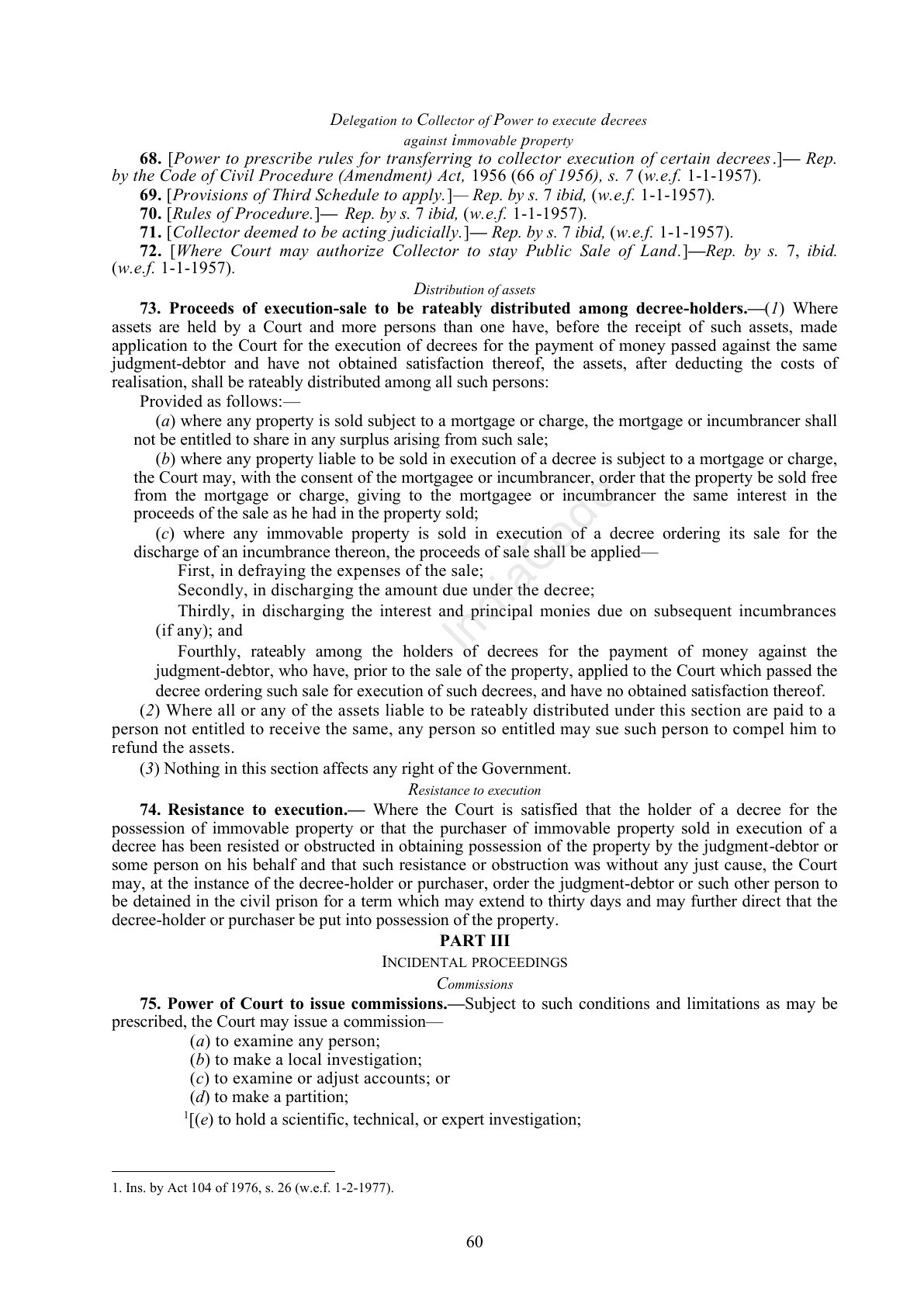
Full physical source page · unreviewed extraction
The Code of Civil Procedure, 1908: page 60
The Code of Civil Procedure, 1908, India Code delivered snapshot 393b8848fdfc476a, physical page 60, typed edition 77428589d4e341672ed6a3e5f663be7dec530c42d0600064ac1314302939267d. Unreviewed extraction.
Source: official India Code PDF · catalog record. Fetched 2026-10-19T23:06:46Z. SHA-256 393b8848fdfc476a21cc3abf4f0d3f510557e2dff6fc6914b1f379bea1730614.
Legal currency, territorial applicability and extraction fidelity are unverified. Catalog checksum/size differs from the delivered PDF; both identities are retained. Sections, state notes and footnotes share these physical pages. Compare the full original image.
Retained layout text
                                    Delegation to Collector of Power to execute decrees
                                                against i mmovable property
    68. [Power to prescribe rules for transferring to collector execution of certain decrees .]— Rep.
by the Code of Civil Procedure (Amendment) Act, 1956 (66 of 1956), s. 7 (w.e.f. 1-1-1957).
    69. [Provisions of Third Schedule to apply.]— Rep. by s. 7 ibid, (w.e.f. 1-1-1957).
    70. [Rules of Procedure.]— Rep. by s. 7 ibid, (w.e.f. 1-1-1957).
    71. [Collector deemed to be acting judicially.]— Rep. by s. 7 ibid, (w.e.f. 1-1-1957).
    72. [Where Court may authorize Collector to stay Public Sale of Land.]—Rep. by s. 7, ibid.
(w.e.f. 1-1-1957).
                                                  Distribution of assets
    73. Proceeds of execution-sale to be rateably distributed among decree-holders.—(1) Where
assets are held by a Court and more persons than one have, before the receipt of such assets, made
application to the Court for the execution of decrees for the payment of money passed against the same
judgment-debtor and have not obtained satisfaction thereof, the assets, after deducting the costs of
realisation, shall be rateably distributed among all such persons:
    Provided as follows:—
       (a) where any property is sold subject to a mortgage or charge, the mortgage or incumbrancer shall
   not be entitled to share in any surplus arising from such sale;
       (b) where any property liable to be sold in execution of a decree is subject to a mortgage or charge,
   the Court may, with the consent of the mortgagee or incumbrancer, order that the property be sold free
   from the mortgage or charge, giving to the mortgagee or incumbrancer the same interest in the
                                                                    e
   proceeds of the sale as he had in the property sold;
                                                              od
       (c) where any immovable property is sold in execution of a decree ordering its sale for the
   discharge of an incumbrance thereon, the proceeds of sale shall be applied—
           First, in defraying the expenses of the sale;     aC
           Secondly, in discharging the amount due under the decree;
                                                        di
           Thirdly, in discharging the interest and principal monies due on subsequent incumbrances
       (if any); and                                   In
           Fourthly, rateably among the holders of decrees for the payment of money against the
       judgment-debtor, who have, prior to the sale of the property, applied to the Court which passed the
       decree ordering such sale for execution of such decrees, and have no obtained satisfaction thereof.
    (2) Where all or any of the assets liable to be rateably distributed under this section are paid to a
person not entitled to receive the same, any person so entitled may sue such person to compel him to
refund the assets.
    (3) Nothing in this section affects any right of the Government.
                                                 Resistance to execution
    74. Resistance to execution.— Where the Court is satisfied that the holder of a decree for the
possession of immovable property or that the purchaser of immovable property sold in execution of a
decree has been resisted or obstructed in obtaining possession of the property by the judgment-debtor or
some person on his behalf and that such resistance or obstruction was without any just cause, the Court
may, at the instance of the decree-holder or purchaser, order the judgment-debtor or such other person to
be detained in the civil prison for a term which may extend to thirty days and may further direct that the
decree-holder or purchaser be put into possession of the property.
                                                      PART III
                                            INCIDENTAL PROCEEDINGS
                                                     Commissions
    75. Power of Court to issue commissions.—Subject to such conditions and limitations as may be
prescribed, the Court may issue a commission—
              (a) to examine any person;
              (b) to make a local investigation;
              (c) to examine or adjust accounts; or
              (d) to make a partition;
            1
             [(e) to hold a scientific, technical, or expert investigation;


1. Ins. by Act 104 of 1976, s. 26 (w.e.f. 1-2-1977).


                                                        60
Compare original page image