Full physical source page · unreviewed extraction
The Code of Civil Procedure, 1908: page 55
The Code of Civil Procedure, 1908, India Code delivered snapshot 393b8848fdfc476a, physical page 55, typed edition 77428589d4e341672ed6a3e5f663be7dec530c42d0600064ac1314302939267d. Unreviewed extraction.
Source: official India Code PDF · catalog record. Fetched 2026-10-19T23:06:46Z. SHA-256 393b8848fdfc476a21cc3abf4f0d3f510557e2dff6fc6914b1f379bea1730614.
Legal currency, territorial applicability and extraction fidelity are unverified. Catalog checksum/size differs from the delivered PDF; both identities are retained. Sections, state notes and footnotes share these physical pages. Compare the full original image.
Retained layout text
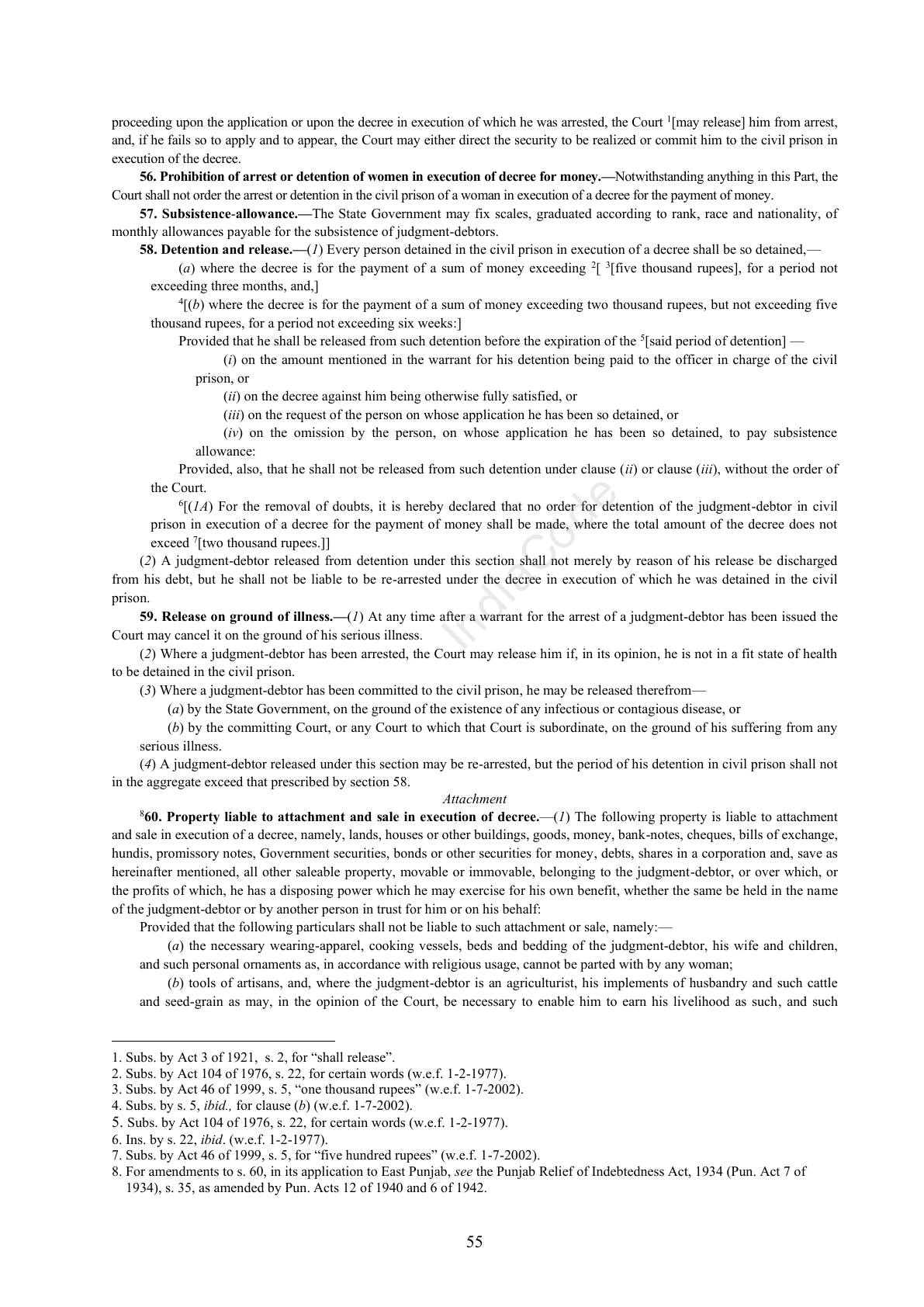
proceeding upon the application or upon the decree in execution of which he was arrested, the Court 1[may release] him from arrest,
and, if he fails so to apply and to appear, the Court may either direct the security to be realized or commit him to the civil prison in
execution of the decree.
     56. Prohibition of arrest or detention of women in execution of decree for money.—Notwithstanding anything in this Part, the
Court shall not order the arrest or detention in the civil prison of a woman in execution of a decree for the payment of money.
     57. Subsistence-allowance.—The State Government may fix scales, graduated according to rank, race and nationality, of
monthly allowances payable for the subsistence of judgment-debtors.
     58. Detention and release.—(1) Every person detained in the civil prison in execution of a decree shall be so detained,—
             (a) where the decree is for the payment of a sum of money exceeding 2[ 3[five thousand rupees], for a period not
        exceeding three months, and,]
             4[(b) where the decree is for the payment of a sum of money exceeding two thousand rupees, but not exceeding five

        thousand rupees, for a period not exceeding six weeks:]
             Provided that he shall be released from such detention before the expiration of the 5[said period of detention] —
                       (i) on the amount mentioned in the warrant for his detention being paid to the officer in charge of the civil
                 prison, or
                       (ii) on the decree against him being otherwise fully satisfied, or
                       (iii) on the request of the person on whose application he has been so detained, or
                       (iv) on the omission by the person, on whose application he has been so detained, to pay subsistence
                 allowance:
             Provided, also, that he shall not be released from such detention under clause (ii) or clause (iii), without the order of
        the Court.
                                                                                     e
             6[(1A) For the removal of doubts, it is hereby declared that no order for detention of the judgment-debtor in civil

                                                                              od
        prison in execution of a decree for the payment of money shall be made, where the total amount of the decree does not
        exceed 7[two thousand rupees.]]

                                                                       aC
     (2) A judgment-debtor released from detention under this section shall not merely by reason of his release be discharged
from his debt, but he shall not be liable to be re-arrested under the decree in execution of which he was detained in the civil
prison.
                                                                di
     59. Release on ground of illness.—(1) At any time after a warrant for the arrest of a judgment-debtor has been issued the
Court may cancel it on the ground of his serious illness.  In
     (2) Where a judgment-debtor has been arrested, the Court may release him if, in its opinion, he is not in a fit state of health
to be detained in the civil prison.
     (3) Where a judgment-debtor has been committed to the civil prison, he may be released therefrom—
           (a) by the State Government, on the ground of the existence of any infectious or contagious disease, or
           (b) by the committing Court, or any Court to which that Court is subordinate, on the ground of his suffering from any
     serious illness.
     (4) A judgment-debtor released under this section may be re-arrested, but the period of his detention in civil prison shall not
in the aggregate exceed that prescribed by section 58.
                                                                   Attachment
     860. Property liable to attachment and sale in execution of decree.—(1) The following property is liable to attachment

and sale in execution of a decree, namely, lands, houses or other buildings, goods, money, bank-notes, cheques, bills of exchange,
hundis, promissory notes, Government securities, bonds or other securities for money, debts, shares in a corporation and, save as
hereinafter mentioned, all other saleable property, movable or immovable, belonging to the judgment-debtor, or over which, or
the profits of which, he has a disposing power which he may exercise for his own benefit, whether the same be held in the name
of the judgment-debtor or by another person in trust for him or on his behalf:
     Provided that the following particulars shall not be liable to such attachment or sale, namely:—
           (a) the necessary wearing-apparel, cooking vessels, beds and bedding of the judgment-debtor, his wife and children,
     and such personal ornaments as, in accordance with religious usage, cannot be parted with by any woman;
           (b) tools of artisans, and, where the judgment-debtor is an agriculturist, his implements of husbandry and such cattle
     and seed-grain as may, in the opinion of the Court, be necessary to enable him to earn his livelihood as such, and such


1. Subs. by Act 3 of 1921, s. 2, for “shall release”.
2. Subs. by Act 104 of 1976, s. 22, for certain words (w.e.f. 1-2-1977).
3. Subs. by Act 46 of 1999, s. 5, “one thousand rupees” (w.e.f. 1-7-2002).
4. Subs. by s. 5, ibid., for clause (b) (w.e.f. 1-7-2002).
5. Subs. by Act 104 of 1976, s. 22, for certain words (w.e.f. 1-2-1977).
6. Ins. by s. 22, ibid. (w.e.f. 1-2-1977).
7. Subs. by Act 46 of 1999, s. 5, for “five hundred rupees” (w.e.f. 1-7-2002).
8. For amendments to s. 60, in its application to East Punjab, see the Punjab Relief of Indebtedness Act, 1934 (Pun. Act 7 of
   1934), s. 35, as amended by Pun. Acts 12 of 1940 and 6 of 1942.


                                                                  55
Compare original page image