Full physical source page · unreviewed extraction
The Code of Civil Procedure, 1908: page 53
The Code of Civil Procedure, 1908, India Code delivered snapshot 393b8848fdfc476a, physical page 53, typed edition 77428589d4e341672ed6a3e5f663be7dec530c42d0600064ac1314302939267d. Unreviewed extraction.
Source: official India Code PDF · catalog record. Fetched 2026-10-19T23:06:46Z. SHA-256 393b8848fdfc476a21cc3abf4f0d3f510557e2dff6fc6914b1f379bea1730614.
Legal currency, territorial applicability and extraction fidelity are unverified. Catalog checksum/size differs from the delivered PDF; both identities are retained. Sections, state notes and footnotes share these physical pages. Compare the full original image.
Retained layout text
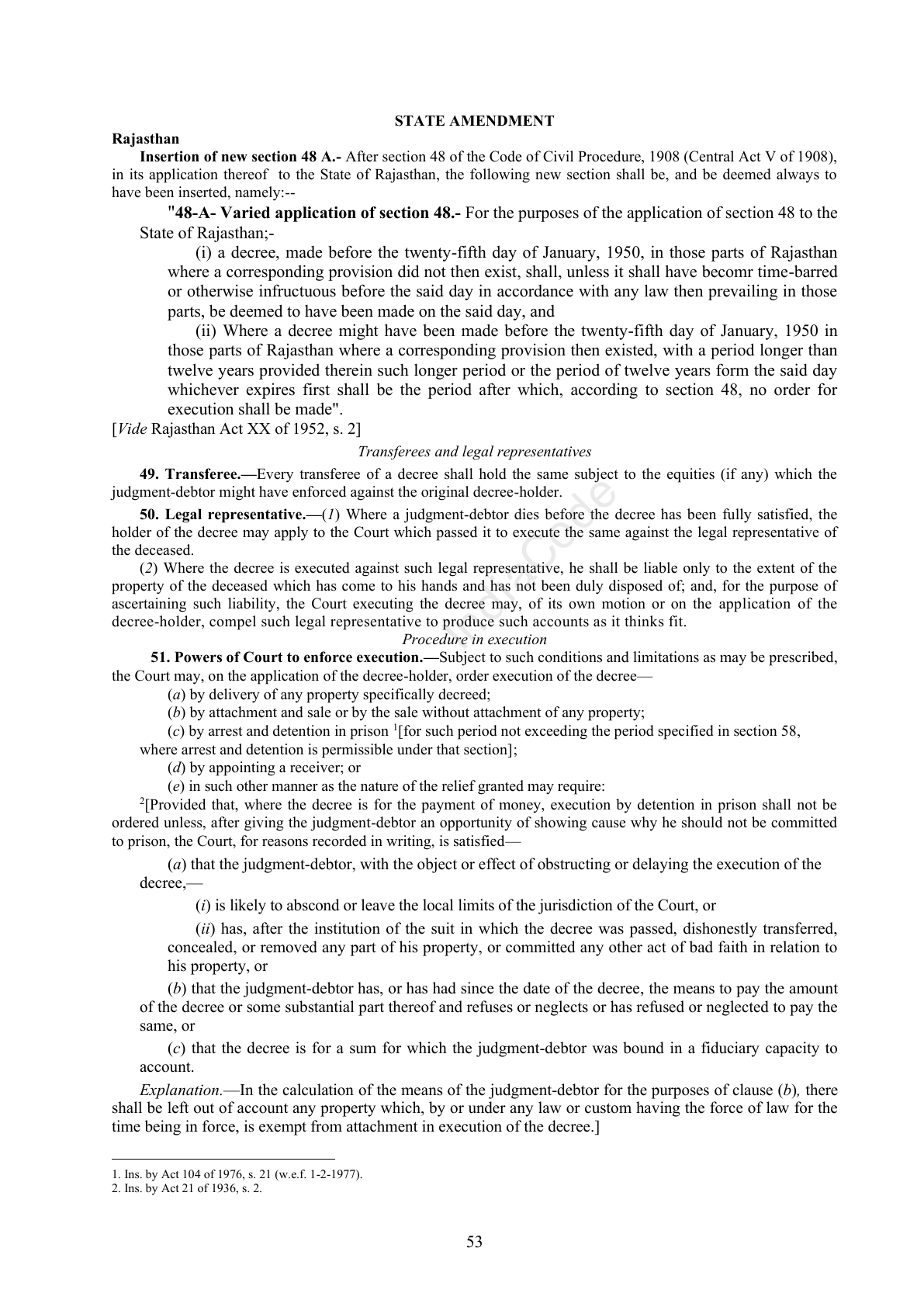
                                              STATE AMENDMENT
Rajasthan
     Insertion of new section 48 A.- After section 48 of the Code of Civil Procedure, 1908 (Central Act V of 1908),
in its application thereof to the State of Rajasthan, the following new section shall be, and be deemed always to
have been inserted, namely:--
        "48-A- Varied application of section 48.- For the purposes of the application of section 48 to the
    State of Rajasthan;-
             (i) a decree, made before the twenty-fifth day of January, 1950, in those parts of Rajasthan
        where a corresponding provision did not then exist, shall, unless it shall have becomr time-barred
        or otherwise infructuous before the said day in accordance with any law then prevailing in those
        parts, be deemed to have been made on the said day, and
             (ii) Where a decree might have been made before the twenty-fifth day of January, 1950 in
        those parts of Rajasthan where a corresponding provision then existed, with a period longer than
        twelve years provided therein such longer period or the period of twelve years form the said day
        whichever expires first shall be the period after which, according to section 48, no order for
        execution shall be made".
[Vide Rajasthan Act XX of 1952, s. 2]
                                           Transferees and legal representatives
     49. Transferee.—Every transferee of a decree shall hold the same subject to the equities (if any) which the
judgment-debtor might have enforced against the original decree-holder.
                                                                         e
     50. Legal representative.—(1) Where a judgment-debtor dies before the decree has been fully satisfied, the
                                                                   od
holder of the decree may apply to the Court which passed it to execute the same against the legal representative of
the deceased.
                                                              aC
     (2) Where the decree is executed against such legal representative, he shall be liable only to the extent of the
property of the deceased which has come to his hands and has not been duly disposed of; and, for the purpose of
                                                        di
ascertaining such liability, the Court executing the decree may, of its own motion or on the application of the
decree-holder, compel such legal representative to produce such accounts as it thinks fit.
                                                       In
                                                   Procedure in execution
        51. Powers of Court to enforce execution.—Subject to such conditions and limitations as may be prescribed,
the Court may, on the application of the decree-holder, order execution of the decree—
           (a) by delivery of any property specifically decreed;
           (b) by attachment and sale or by the sale without attachment of any property;
           (c) by arrest and detention in prison 1[for such period not exceeding the period specified in section 58,
     where arrest and detention is permissible under that section];
           (d) by appointing a receiver; or
           (e) in such other manner as the nature of the relief granted may require:
     2
       [Provided that, where the decree is for the payment of money, execution by detention in prison shall not be
ordered unless, after giving the judgment-debtor an opportunity of showing cause why he should not be committed
to prison, the Court, for reasons recorded in writing, is satisfied—
         (a) that the judgment-debtor, with the object or effect of obstructing or delaying the execution of the
    decree,—
              (i) is likely to abscond or leave the local limits of the jurisdiction of the Court, or
              (ii) has, after the institution of the suit in which the decree was passed, dishonestly transferred,
         concealed, or removed any part of his property, or committed any other act of bad faith in relation to
         his property, or
         (b) that the judgment-debtor has, or has had since the date of the decree, the means to pay the amount
    of the decree or some substantial part thereof and refuses or neglects or has refused or neglected to pay the
    same, or
         (c) that the decree is for a sum for which the judgment-debtor was bound in a fiduciary capacity to
    account.
    Explanation.—In the calculation of the means of the judgment-debtor for the purposes of clause (b), there
shall be left out of account any property which, by or under any law or custom having the force of law for the
time being in force, is exempt from attachment in execution of the decree.]

1. Ins. by Act 104 of 1976, s. 21 (w.e.f. 1-2-1977).
2. Ins. by Act 21 of 1936, s. 2.


                                                         53
Compare original page image