Full physical source page · unreviewed extraction
The Code of Civil Procedure, 1908: page 42
The Code of Civil Procedure, 1908, India Code delivered snapshot 393b8848fdfc476a, physical page 42, typed edition 77428589d4e341672ed6a3e5f663be7dec530c42d0600064ac1314302939267d. Unreviewed extraction.
Source: official India Code PDF · catalog record. Fetched 2026-10-19T23:06:46Z. SHA-256 393b8848fdfc476a21cc3abf4f0d3f510557e2dff6fc6914b1f379bea1730614.
Legal currency, territorial applicability and extraction fidelity are unverified. Catalog checksum/size differs from the delivered PDF; both identities are retained. Sections, state notes and footnotes share these physical pages. Compare the full original image.
Retained layout text
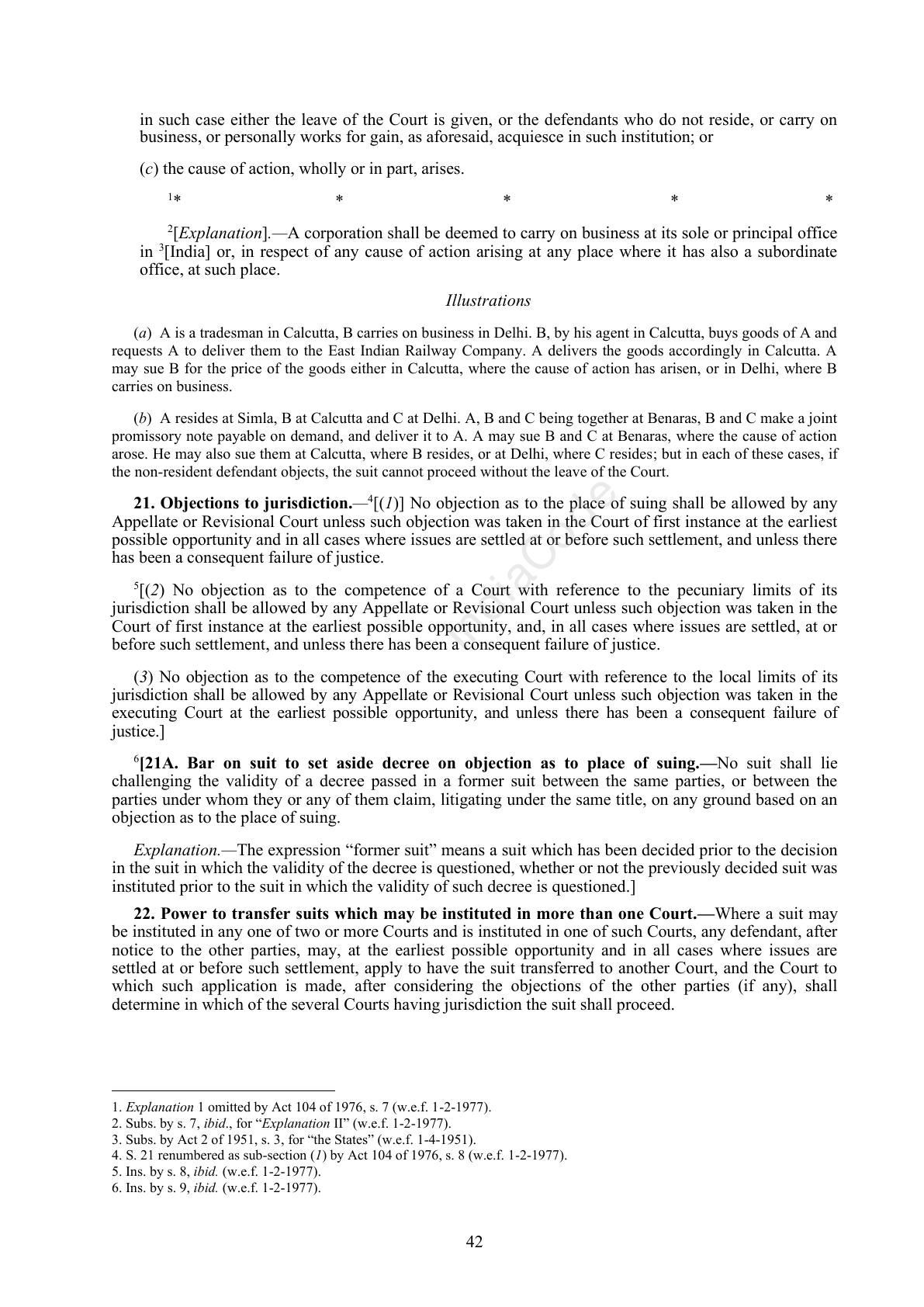
       in such case either the leave of the Court is given, or the defendants who do not reside, or carry on
       business, or personally works for gain, as aforesaid, acquiesce in such institution; or
       (c) the cause of action, wholly or in part, arises.
              1
               *                        *                             *                   *                         *
              2
            [Explanation].—A corporation shall be deemed to carry on business at its sole or principal office
          3
       in [India] or, in respect of any cause of action arising at any place where it has also a subordinate
       office, at such place.
                                                            Illustrations
    (a) A is a tradesman in Calcutta, B carries on business in Delhi. B, by his agent in Calcutta, buys goods of A and
requests A to deliver them to the East Indian Railway Company. A delivers the goods accordingly in Calcutta. A
may sue B for the price of the goods either in Calcutta, where the cause of action has arisen, or in Delhi, where B
carries on business.

    (b) A resides at Simla, B at Calcutta and C at Delhi. A, B and C being together at Benaras, B and C make a joint
promissory note payable on demand, and deliver it to A. A may sue B and C at Benaras, where the cause of action
arose. He may also sue them at Calcutta, where B resides, or at Delhi, where C resides; but in each of these cases, if
the non-resident defendant objects, the suit cannot proceed without the leave of the Court.

   21. Objections to jurisdiction.—4[(1)] No objection as to the place of suing shall be allowed by any
                                                                                     e
Appellate or Revisional Court unless such objection was taken in the Court of first instance at the earliest
                                                                           od
possible opportunity and in all cases where issues are settled at or before such settlement, and unless there
has been a consequent failure of justice.
   5
                                                                    aC
     [(2) No objection as to the competence of a Court with reference to the pecuniary limits of its
                                                              di
jurisdiction shall be allowed by any Appellate or Revisional Court unless such objection was taken in the
Court of first instance at the earliest possible opportunity, and, in all cases where issues are settled, at or
                                                        In
before such settlement, and unless there has been a consequent failure of justice.
    (3) No objection as to the competence of the executing Court with reference to the local limits of its
jurisdiction shall be allowed by any Appellate or Revisional Court unless such objection was taken in the
executing Court at the earliest possible opportunity, and unless there has been a consequent failure of
justice.]
   6
    [21A. Bar on suit to set aside decree on objection as to place of suing.—No suit shall lie
challenging the validity of a decree passed in a former suit between the same parties, or between the
parties under whom they or any of them claim, litigating under the same title, on any ground based on an
objection as to the place of suing.
    Explanation.—The expression “former suit” means a suit which has been decided prior to the decision
in the suit in which the validity of the decree is questioned, whether or not the previously decided suit was
instituted prior to the suit in which the validity of such decree is questioned.]
    22. Power to transfer suits which may be instituted in more than one Court.—Where a suit may
be instituted in any one of two or more Courts and is instituted in one of such Courts, any defendant, after
notice to the other parties, may, at the earliest possible opportunity and in all cases where issues are
settled at or before such settlement, apply to have the suit transferred to another Court, and the Court to
which such application is made, after considering the objections of the other parties (if any), shall
determine in which of the several Courts having jurisdiction the suit shall proceed.


1. Explanation 1 omitted by Act 104 of 1976, s. 7 (w.e.f. 1-2-1977).
2. Subs. by s. 7, ibid., for “Explanation II” (w.e.f. 1-2-1977).
3. Subs. by Act 2 of 1951, s. 3, for “the States” (w.e.f. 1-4-1951).
4. S. 21 renumbered as sub-section (1) by Act 104 of 1976, s. 8 (w.e.f. 1-2-1977).
5. Ins. by s. 8, ibid. (w.e.f. 1-2-1977).
6. Ins. by s. 9, ibid. (w.e.f. 1-2-1977).


                                                               42
Compare original page image