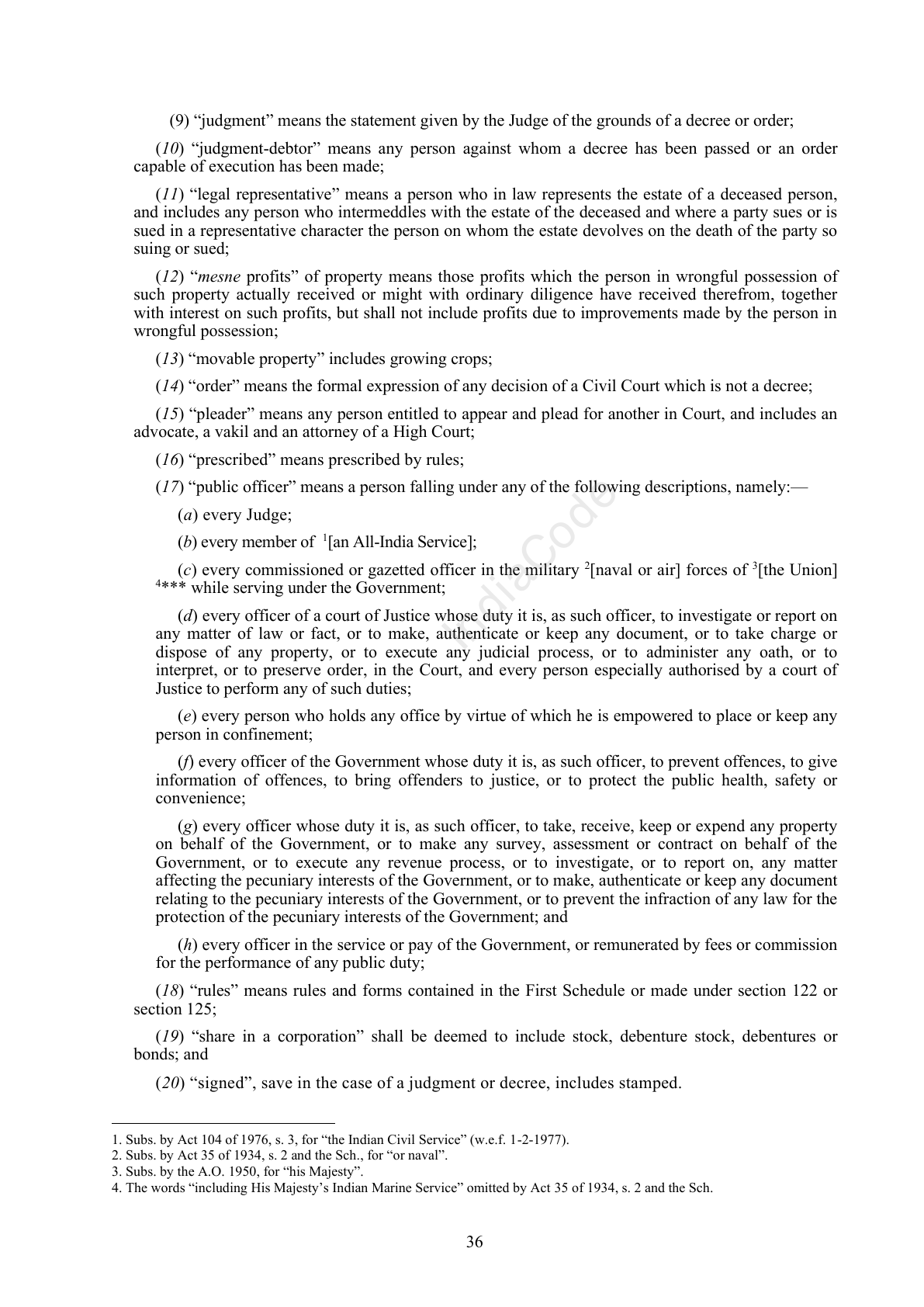
Full physical source page · unreviewed extraction
The Code of Civil Procedure, 1908: page 36
The Code of Civil Procedure, 1908, India Code delivered snapshot 393b8848fdfc476a, physical page 36, typed edition 77428589d4e341672ed6a3e5f663be7dec530c42d0600064ac1314302939267d. Unreviewed extraction.
Source: official India Code PDF · catalog record. Fetched 2026-10-19T23:06:46Z. SHA-256 393b8848fdfc476a21cc3abf4f0d3f510557e2dff6fc6914b1f379bea1730614.
Legal currency, territorial applicability and extraction fidelity are unverified. Catalog checksum/size differs from the delivered PDF; both identities are retained. Sections, state notes and footnotes share these physical pages. Compare the full original image.
Retained layout text
           (9) “judgment” means the statement given by the Judge of the grounds of a decree or order;
      (10) “judgment-debtor” means any person against whom a decree has been passed or an order
   capable of execution has been made;
      (11) “legal representative” means a person who in law represents the estate of a deceased person,
   and includes any person who intermeddles with the estate of the deceased and where a party sues or is
   sued in a representative character the person on whom the estate devolves on the death of the party so
   suing or sued;
      (12) “mesne profits” of property means those profits which the person in wrongful possession of
   such property actually received or might with ordinary diligence have received therefrom, together
   with interest on such profits, but shall not include profits due to improvements made by the person in
   wrongful possession;
       (13) “movable property” includes growing crops;
       (14) “order” means the formal expression of any decision of a Civil Court which is not a decree;
      (15) “pleader” means any person entitled to appear and plead for another in Court, and includes an
   advocate, a vakil and an attorney of a High Court;
       (16) “prescribed” means prescribed by rules;
       (17) “public officer” means a person falling under any of the following descriptions, namely:—
            (a) every Judge;
                                                                               e
            (b) every member of 1[an All-India Service];
                                                                        od
       4
                                                                  aC
          (c) every commissioned or gazetted officer in the military 2[naval or air] forces of 3[the Union]
        *** while serving under the Government;
                                                            di
           (d) every officer of a court of Justice whose duty it is, as such officer, to investigate or report on
       any matter of law or fact, or to make, authenticate or keep any document, or to take charge or
                                                       In
       dispose of any property, or to execute any judicial process, or to administer any oath, or to
       interpret, or to preserve order, in the Court, and every person especially authorised by a court of
       Justice to perform any of such duties;
          (e) every person who holds any office by virtue of which he is empowered to place or keep any
       person in confinement;
          (f) every officer of the Government whose duty it is, as such officer, to prevent offences, to give
       information of offences, to bring offenders to justice, or to protect the public health, safety or
       convenience;
           (g) every officer whose duty it is, as such officer, to take, receive, keep or expend any property
       on behalf of the Government, or to make any survey, assessment or contract on behalf of the
       Government, or to execute any revenue process, or to investigate, or to report on, any matter
       affecting the pecuniary interests of the Government, or to make, authenticate or keep any document
       relating to the pecuniary interests of the Government, or to prevent the infraction of any law for the
       protection of the pecuniary interests of the Government; and
           (h) every officer in the service or pay of the Government, or remunerated by fees or commission
       for the performance of any public duty;
      (18) “rules” means rules and forms contained in the First Schedule or made under section 122 or
   section 125;
      (19) “share in a corporation” shall be deemed to include stock, debenture stock, debentures or
   bonds; and
       (20) “signed”, save in the case of a judgment or decree, includes stamped.


1. Subs. by Act 104 of 1976, s. 3, for “the Indian Civil Service” (w.e.f. 1-2-1977).
2. Subs. by Act 35 of 1934, s. 2 and the Sch., for “or naval”.
3. Subs. by the A.O. 1950, for “his Majesty”.
4. The words “including His Majesty’s Indian Marine Service” omitted by Act 35 of 1934, s. 2 and the Sch.


                                                             36
Compare original page image