Full physical source page · unreviewed extraction
The Code of Civil Procedure, 1908: page 342
The Code of Civil Procedure, 1908, India Code delivered snapshot 393b8848fdfc476a, physical page 342, typed edition 77428589d4e341672ed6a3e5f663be7dec530c42d0600064ac1314302939267d. Unreviewed extraction.
Source: official India Code PDF · catalog record. Fetched 2026-10-19T23:06:46Z. SHA-256 393b8848fdfc476a21cc3abf4f0d3f510557e2dff6fc6914b1f379bea1730614.
Legal currency, territorial applicability and extraction fidelity are unverified. Catalog checksum/size differs from the delivered PDF; both identities are retained. Sections, state notes and footnotes share these physical pages. Compare the full original image.
Retained layout text
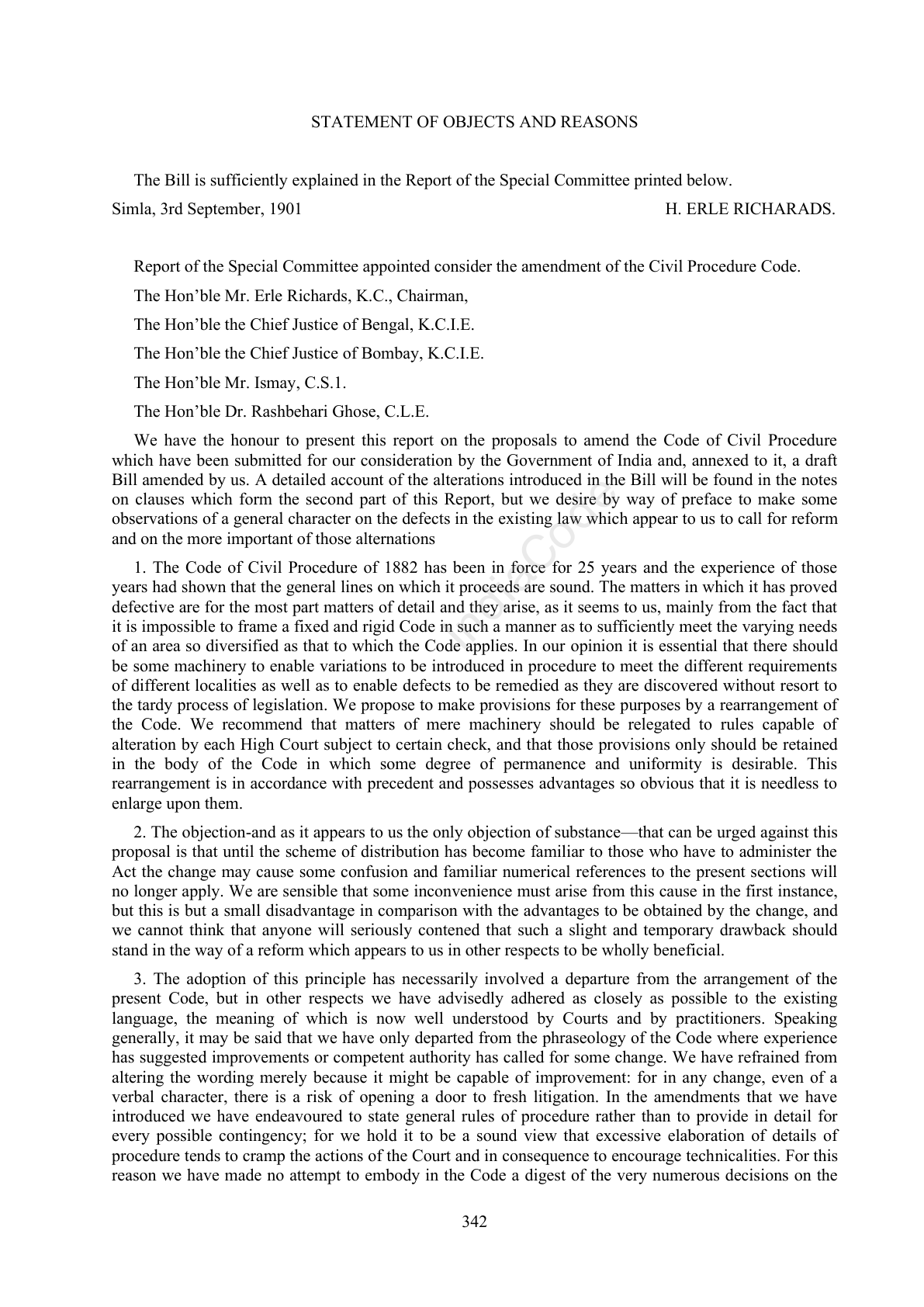
                              STATEMENT OF OBJECTS AND REASONS


   The Bill is sufficiently explained in the Report of the Special Committee printed below.
Simla, 3rd September, 1901                                                         H. ERLE RICHARADS.


   Report of the Special Committee appointed consider the amendment of the Civil Procedure Code.
   The Hon’ble Mr. Erle Richards, K.C., Chairman,
   The Hon’ble the Chief Justice of Bengal, K.C.I.E.
   The Hon’ble the Chief Justice of Bombay, K.C.I.E.
   The Hon’ble Mr. Ismay, C.S.1.
   The Hon’ble Dr. Rashbehari Ghose, C.L.E.
   We have the honour to present this report on the proposals to amend the Code of Civil Procedure
which have been submitted for our consideration by the Government of India and, annexed to it, a draft
Bill amended by us. A detailed account of the alterations introduced in the Bill will be found in the notes
on clauses which form the second part of this Report, but we desire by way of preface to make some
                                                                     e
observations of a general character on the defects in the existing law which appear to us to call for reform
and on the more important of those alternations
                                                               od
                                                        aC
    1. The Code of Civil Procedure of 1882 has been in force for 25 years and the experience of those
years had shown that the general lines on which it proceeds are sound. The matters in which it has proved
                                                    di
defective are for the most part matters of detail and they arise, as it seems to us, mainly from the fact that
it is impossible to frame a fixed and rigid Code in such a manner as to sufficiently meet the varying needs
                                               In
of an area so diversified as that to which the Code applies. In our opinion it is essential that there should
be some machinery to enable variations to be introduced in procedure to meet the different requirements
of different localities as well as to enable defects to be remedied as they are discovered without resort to
the tardy process of legislation. We propose to make provisions for these purposes by a rearrangement of
the Code. We recommend that matters of mere machinery should be relegated to rules capable of
alteration by each High Court subject to certain check, and that those provisions only should be retained
in the body of the Code in which some degree of permanence and uniformity is desirable. This
rearrangement is in accordance with precedent and possesses advantages so obvious that it is needless to
enlarge upon them.
   2. The objection-and as it appears to us the only objection of substance—that can be urged against this
proposal is that until the scheme of distribution has become familiar to those who have to administer the
Act the change may cause some confusion and familiar numerical references to the present sections will
no longer apply. We are sensible that some inconvenience must arise from this cause in the first instance,
but this is but a small disadvantage in comparison with the advantages to be obtained by the change, and
we cannot think that anyone will seriously contened that such a slight and temporary drawback should
stand in the way of a reform which appears to us in other respects to be wholly beneficial.
    3. The adoption of this principle has necessarily involved a departure from the arrangement of the
present Code, but in other respects we have advisedly adhered as closely as possible to the existing
language, the meaning of which is now well understood by Courts and by practitioners. Speaking
generally, it may be said that we have only departed from the phraseology of the Code where experience
has suggested improvements or competent authority has called for some change. We have refrained from
altering the wording merely because it might be capable of improvement: for in any change, even of a
verbal character, there is a risk of opening a door to fresh litigation. In the amendments that we have
introduced we have endeavoured to state general rules of procedure rather than to provide in detail for
every possible contingency; for we hold it to be a sound view that excessive elaboration of details of
procedure tends to cramp the actions of the Court and in consequence to encourage technicalities. For this
reason we have made no attempt to embody in the Code a digest of the very numerous decisions on the

                                                     342
Compare original page image