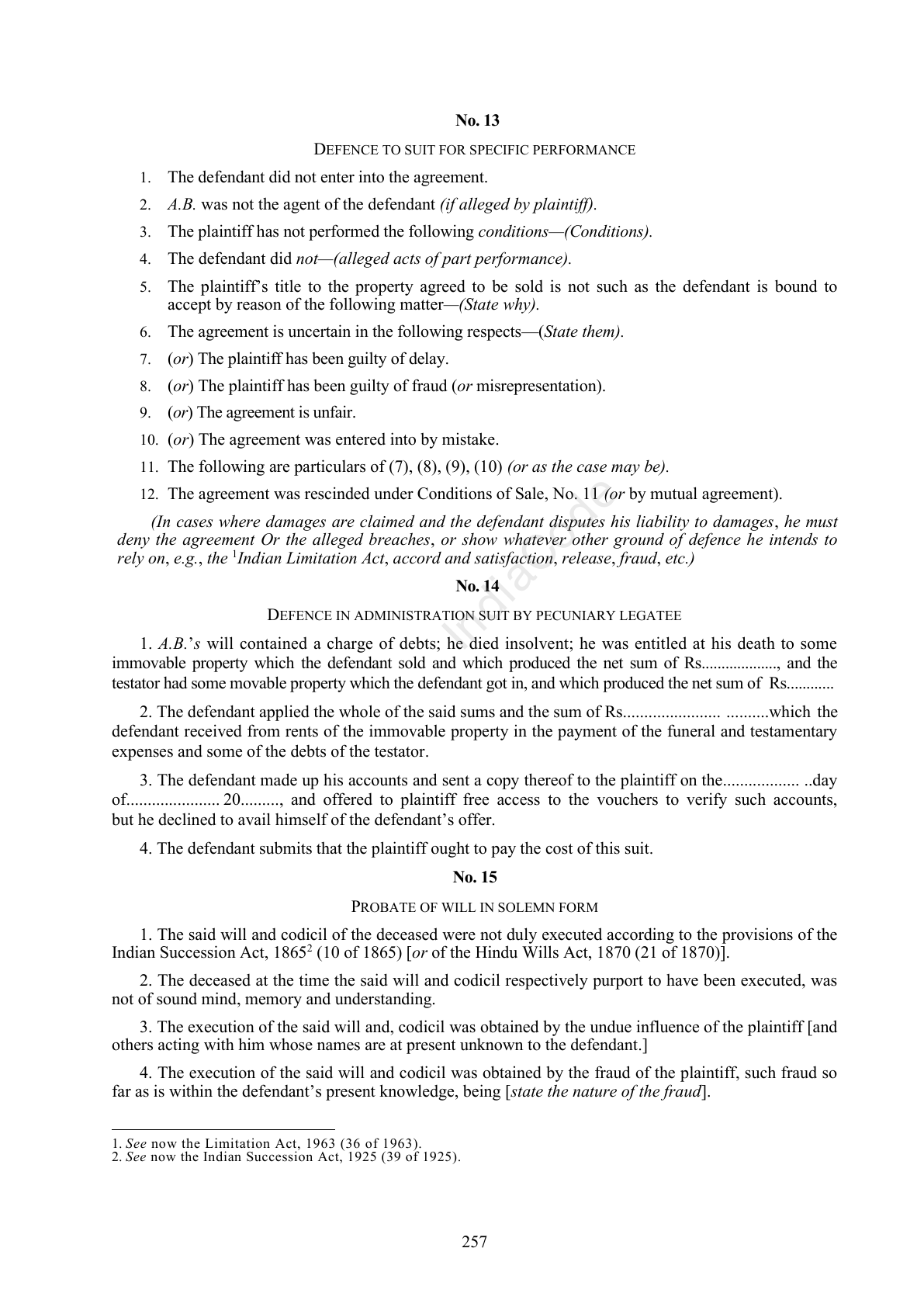
Full physical source page · unreviewed extraction
The Code of Civil Procedure, 1908: page 257
The Code of Civil Procedure, 1908, India Code delivered snapshot 393b8848fdfc476a, physical page 257, typed edition 77428589d4e341672ed6a3e5f663be7dec530c42d0600064ac1314302939267d. Unreviewed extraction.
Source: official India Code PDF · catalog record. Fetched 2026-10-19T23:06:46Z. SHA-256 393b8848fdfc476a21cc3abf4f0d3f510557e2dff6fc6914b1f379bea1730614.
Legal currency, territorial applicability and extraction fidelity are unverified. Catalog checksum/size differs from the delivered PDF; both identities are retained. Sections, state notes and footnotes share these physical pages. Compare the full original image.
Retained layout text
                                                        No. 13
                                DEFENCE TO SUIT FOR SPECIFIC PERFORMANCE
    1.   The defendant did not enter into the agreement.
    2.   A.B. was not the agent of the defendant (if alleged by plaintiff).
    3.   The plaintiff has not performed the following conditions—(Conditions).
    4.   The defendant did not—(alleged acts of part performance).
    5.   The plaintiff’s title to the property agreed to be sold is not such as the defendant is bound to
         accept by reason of the following matter—(State why).
    6.   The agreement is uncertain in the following respects—(State them).
    7.   (or) The plaintiff has been guilty of delay.
    8.   (or) The plaintiff has been guilty of fraud (or misrepresentation).
    9.   (or) The agreement is unfair.
    10. (or) The agreement was entered into by mistake.
    11. The following are particulars of (7), (8), (9), (10) (or as the case may be).
    12. The agreement was rescinded under Conditions of Sale, No. 11 (or by mutual agreement).
                                                                         e
     (In cases where damages are claimed and the defendant disputes his liability to damages, he must
                                                                  od
deny the agreement Or the alleged breaches, or show whatever other ground of defence he intends to
rely on, e.g., the 1Indian Limitation Act, accord and satisfaction, release, fraud, etc.)
                                                             aC
                                                        No. 14
                                                        di
                        DEFENCE IN ADMINISTRATION SUIT BY PECUNIARY LEGATEE
                                                  In
     1. A.B.’s will contained a charge of debts; he died insolvent; he was entitled at his death to some
immovable property which the defendant sold and which produced the net sum of Rs..................., and the
testator had some movable property which the defendant got in, and which produced the net sum of Rs............
    2. The defendant applied the whole of the said sums and the sum of Rs....................... ..........which the
defendant received from rents of the immovable property in the payment of the funeral and testamentary
expenses and some of the debts of the testator.
     3. The defendant made up his accounts and sent a copy thereof to the plaintiff on the.................. ..day
of...................... 20........., and offered to plaintiff free access to the vouchers to verify such accounts,
but he declined to avail himself of the defendant’s offer.
    4. The defendant submits that the plaintiff ought to pay the cost of this suit.
                                                        No. 15
                                      PROBATE OF WILL IN SOLEMN FORM
    1. The said will and codicil of the deceased were not duly executed according to the provisions of the
Indian Succession Act, 18652 (10 of 1865) [or of the Hindu Wills Act, 1870 (21 of 1870)].
    2. The deceased at the time the said will and codicil respectively purport to have been executed, was
not of sound mind, memory and understanding.
    3. The execution of the said will and, codicil was obtained by the undue influence of the plaintiff [and
others acting with him whose names are at present unknown to the defendant.]
     4. The execution of the said will and codicil was obtained by the fraud of the plaintiff, such fraud so
far as is within the defendant’s present knowledge, being [state the nature of the fraud].

1. See now the Limitation Act, 1963 (36 of 1963).
2. See now the Indian Succession Act, 1925 (39 of 1925).


                                                           257
Compare original page image