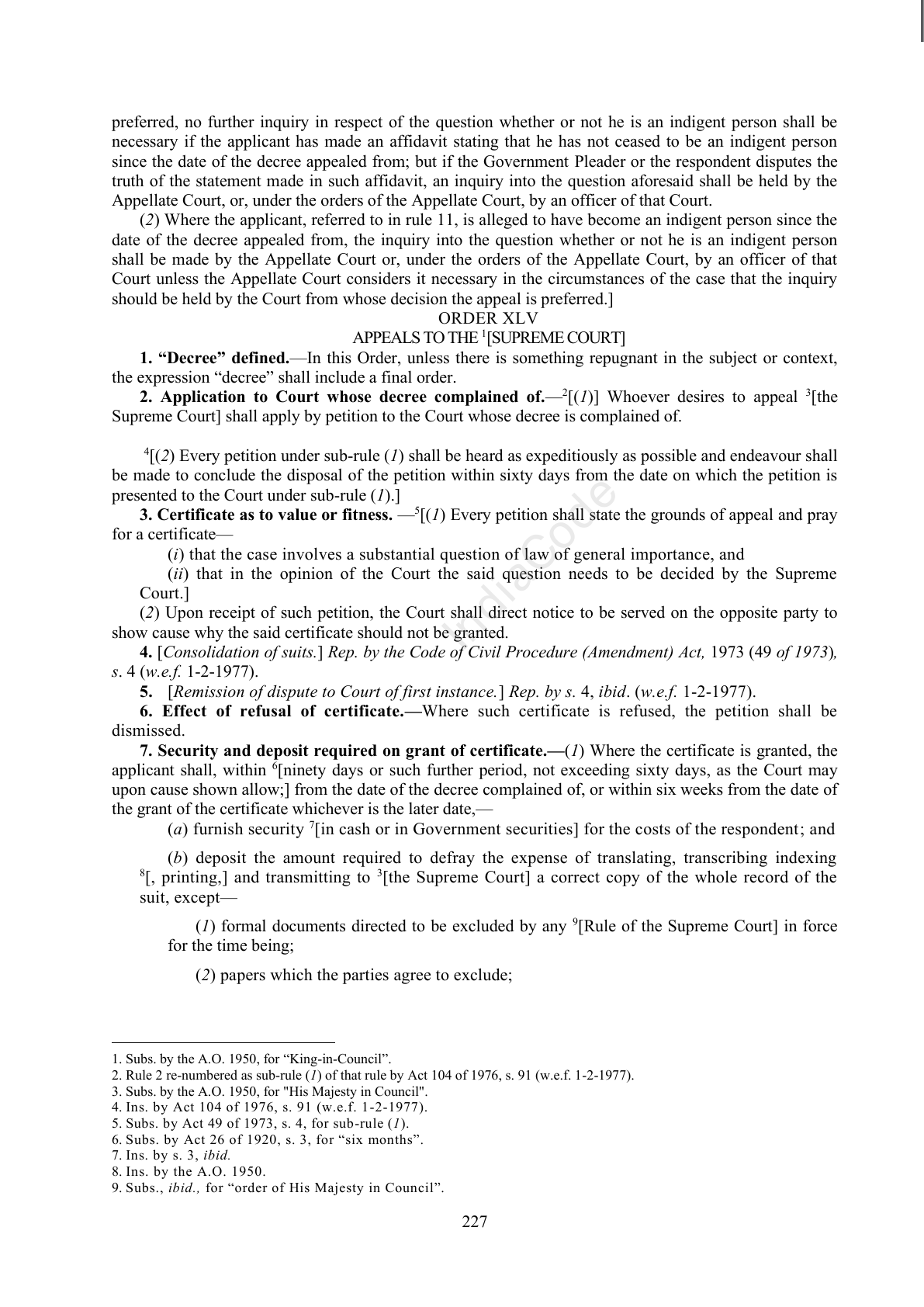
Full physical source page · unreviewed extraction
The Code of Civil Procedure, 1908: page 227
The Code of Civil Procedure, 1908, India Code delivered snapshot 393b8848fdfc476a, physical page 227, typed edition 77428589d4e341672ed6a3e5f663be7dec530c42d0600064ac1314302939267d. Unreviewed extraction.
Source: official India Code PDF · catalog record. Fetched 2026-10-19T23:06:46Z. SHA-256 393b8848fdfc476a21cc3abf4f0d3f510557e2dff6fc6914b1f379bea1730614.
Legal currency, territorial applicability and extraction fidelity are unverified. Catalog checksum/size differs from the delivered PDF; both identities are retained. Sections, state notes and footnotes share these physical pages. Compare the full original image.
Retained layout text
preferred, no further inquiry in respect of the question whether or not he is an indigent person shall be
necessary if the applicant has made an affidavit stating that he has not ceased to be an indigent person
since the date of the decree appealed from; but if the Government Pleader or the respondent disputes the
truth of the statement made in such affidavit, an inquiry into the question aforesaid shall be held by the
Appellate Court, or, under the orders of the Appellate Court, by an officer of that Court.
    (2) Where the applicant, referred to in rule 11, is alleged to have become an indigent person since the
date of the decree appealed from, the inquiry into the question whether or not he is an indigent person
shall be made by the Appellate Court or, under the orders of the Appellate Court, by an officer of that
Court unless the Appellate Court considers it necessary in the circumstances of the case that the inquiry
should be held by the Court from whose decision the appeal is preferred.]
                                                 ORDER XLV
                                    APPEALS TO THE 1[SUPREME COURT]
    1. “Decree” defined.—In this Order, unless there is something repugnant in the subject or context,
the expression “decree” shall include a final order.
    2. Application to Court whose decree complained of.—2[(1)] Whoever desires to appeal 3[the
Supreme Court] shall apply by petition to the Court whose decree is complained of.
     4
      [(2) Every petition under sub-rule (1) shall be heard as expeditiously as possible and endeavour shall
be made to conclude the disposal of the petition within sixty days from the date on which the petition is
presented to the Court under sub-rule (1).]                                        e
     3. Certificate as to value or fitness. —5[(1) Every petition shall state the grounds of appeal and pray
for a certificate—                                                         od
         (i) that the case involves a substantial question of law of general importance, and
                                                                    aC
         (ii) that in the opinion of the Court the said question needs to be decided by the Supreme
     Court.]
                                                              di
     (2) Upon receipt of such petition, the Court shall direct notice to be served on the opposite party to
show cause why the said certificate should not be granted.
                                                         In
     4. [Consolidation of suits.] Rep. by the Code of Civil Procedure (Amendment) Act, 1973 (49 of 1973),
s. 4 (w.e.f. 1-2-1977).
     5. [Remission of dispute to Court of first instance.] Rep. by s. 4, ibid. (w.e.f. 1-2-1977).
     6. Effect of refusal of certificate.—Where such certificate is refused, the petition shall be
dismissed.
     7. Security and deposit required on grant of certificate.—(1) Where the certificate is granted, the
applicant shall, within 6[ninety days or such further period, not exceeding sixty days, as the Court may
upon cause shown allow;] from the date of the decree complained of, or within six weeks from the date of
the grant of the certificate whichever is the later date,—
         (a) furnish security 7[in cash or in Government securities] for the costs of the respondent; and
          (b) deposit the amount required to defray the expense of translating, transcribing indexing
     8
      [, printing,] and transmitting to 3[the Supreme Court] a correct copy of the whole record of the
     suit, except—
               (1) formal documents directed to be excluded by any 9[Rule of the Supreme Court] in force
          for the time being;
               (2) papers which the parties agree to exclude;


1. Subs. by the A.O. 1950, for “King-in-Council”.
2. Rule 2 re-numbered as sub-rule (1) of that rule by Act 104 of 1976, s. 91 (w.e.f. 1-2-1977).
3. Subs. by the A.O. 1950, for "His Majesty in Council".
4. Ins. by Act 104 of 1976, s. 91 (w.e.f. 1-2-1977).
5. Subs. by Act 49 of 1973, s. 4, for sub-rule (1).
6. Subs. by Act 26 of 1920, s. 3, for “six months”.
7. Ins. by s. 3, ibid.
8. Ins. by the A.O. 1950.
9. Subs., ibid., for “order of His Majesty in Council”.

                                                               227
Compare original page image