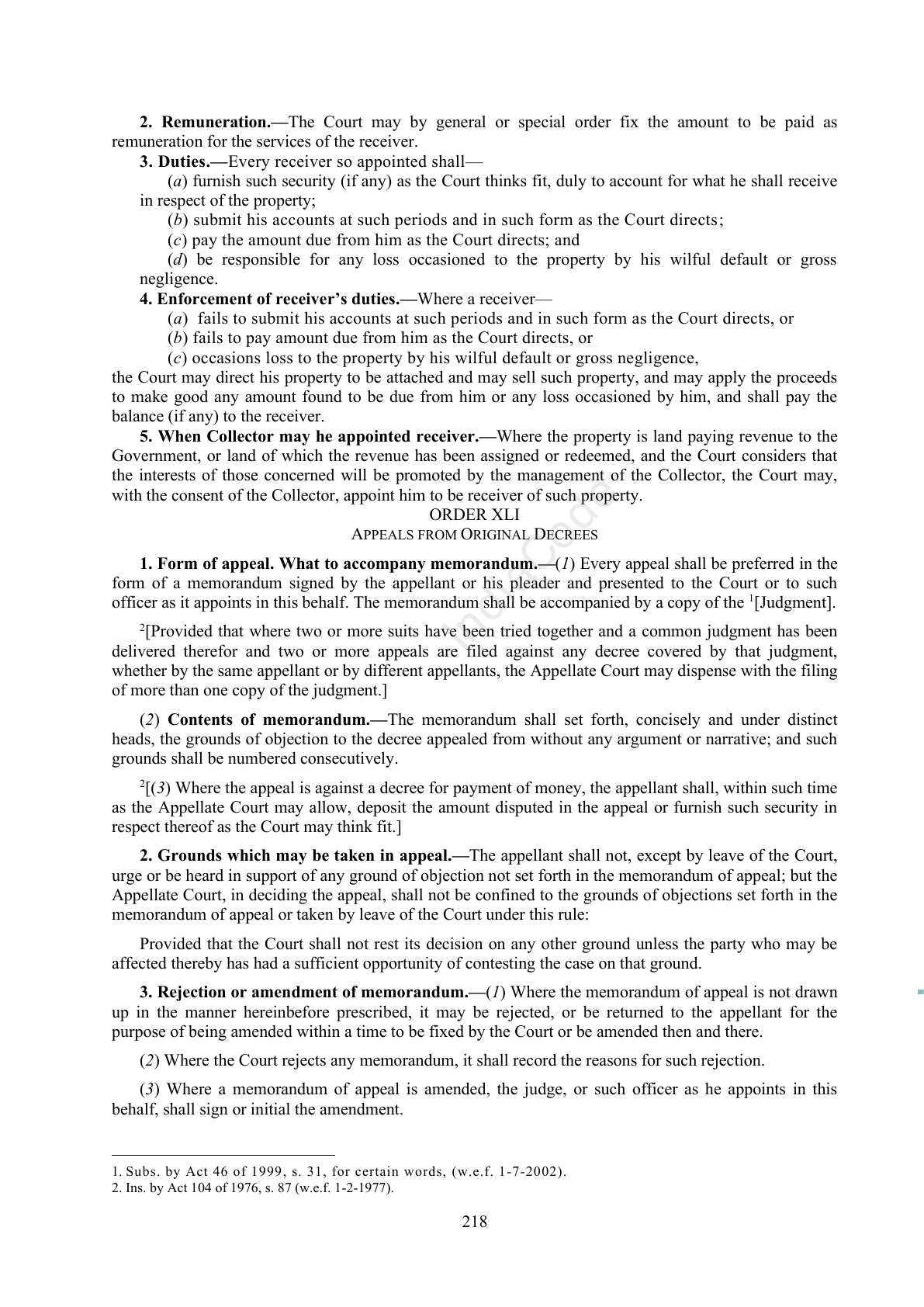
Full physical source page · unreviewed extraction
The Code of Civil Procedure, 1908: page 218
The Code of Civil Procedure, 1908, India Code delivered snapshot 393b8848fdfc476a, physical page 218, typed edition 77428589d4e341672ed6a3e5f663be7dec530c42d0600064ac1314302939267d. Unreviewed extraction.
Source: official India Code PDF · catalog record. Fetched 2026-10-19T23:06:46Z. SHA-256 393b8848fdfc476a21cc3abf4f0d3f510557e2dff6fc6914b1f379bea1730614.
Legal currency, territorial applicability and extraction fidelity are unverified. Catalog checksum/size differs from the delivered PDF; both identities are retained. Sections, state notes and footnotes share these physical pages. Compare the full original image.
Retained layout text
    2. Remuneration.—The Court may by general or special order fix the amount to be paid as
remuneration for the services of the receiver.
    3. Duties.—Every receiver so appointed shall—
         (a) furnish such security (if any) as the Court thinks fit, duly to account for what he shall receive
    in respect of the property;
         (b) submit his accounts at such periods and in such form as the Court directs;
         (c) pay the amount due from him as the Court directs; and
         (d) be responsible for any loss occasioned to the property by his wilful default or gross
    negligence.
    4. Enforcement of receiver’s duties.—Where a receiver—
         (a) fails to submit his accounts at such periods and in such form as the Court directs, or
         (b) fails to pay amount due from him as the Court directs, or
         (c) occasions loss to the property by his wilful default or gross negligence,
the Court may direct his property to be attached and may sell such property, and may apply the proceeds
to make good any amount found to be due from him or any loss occasioned by him, and shall pay the
balance (if any) to the receiver.
    5. When Collector may he appointed receiver.—Where the property is land paying revenue to the
Government, or land of which the revenue has been assigned or redeemed, and the Court considers that
the interests of those concerned will be promoted by the management of the Collector, the Court may,
with the consent of the Collector, appoint him to be receiver of such property.
                                                                           e
                                                 ORDER XLI
                                     APPEALS FROM ORIGINAL DECREESod
                                                           aC
    1. Form of appeal. What to accompany memorandum.—(1) Every appeal shall be preferred in the
form of a memorandum signed by the appellant or his pleader and presented to the Court or to such
officer as it appoints in this behalf. The memorandum shall be accompanied by a copy of the 1[Judgment].
                                                      di
    2
     [Provided that where two or more suits have been tried together and a common judgment has been
                                                  In
delivered therefor and two or more appeals are filed against any decree covered by that judgment,
whether by the same appellant or by different appellants, the Appellate Court may dispense with the filing
of more than one copy of the judgment.]
    (2) Contents of memorandum.—The memorandum shall set forth, concisely and under distinct
heads, the grounds of objection to the decree appealed from without any argument or narrative; and such
grounds shall be numbered consecutively.
    2
     [(3) Where the appeal is against a decree for payment of money, the appellant shall, within such time
as the Appellate Court may allow, deposit the amount disputed in the appeal or furnish such security in
respect thereof as the Court may think fit.]
    2. Grounds which may be taken in appeal.—The appellant shall not, except by leave of the Court,
urge or be heard in support of any ground of objection not set forth in the memorandum of appeal; but the
Appellate Court, in deciding the appeal, shall not be confined to the grounds of objections set forth in the
memorandum of appeal or taken by leave of the Court under this rule:
    Provided that the Court shall not rest its decision on any other ground unless the party who may be
affected thereby has had a sufficient opportunity of contesting the case on that ground.
    3. Rejection or amendment of memorandum.—(1) Where the memorandum of appeal is not drawn
up in the manner hereinbefore prescribed, it may be rejected, or be returned to the appellant for the
purpose of being amended within a time to be fixed by the Court or be amended then and there.
    (2) Where the Court rejects any memorandum, it shall record the reasons for such rejection.
   (3) Where a memorandum of appeal is amended, the judge, or such officer as he appoints in this
behalf, shall sign or initial the amendment.


1. Subs. by Act 46 of 1999, s. 31, for certain words, (w.e.f. 1-7-2002).
2. Ins. by Act 104 of 1976, s. 87 (w.e.f. 1-2-1977).

                                                       218
Compare original page image