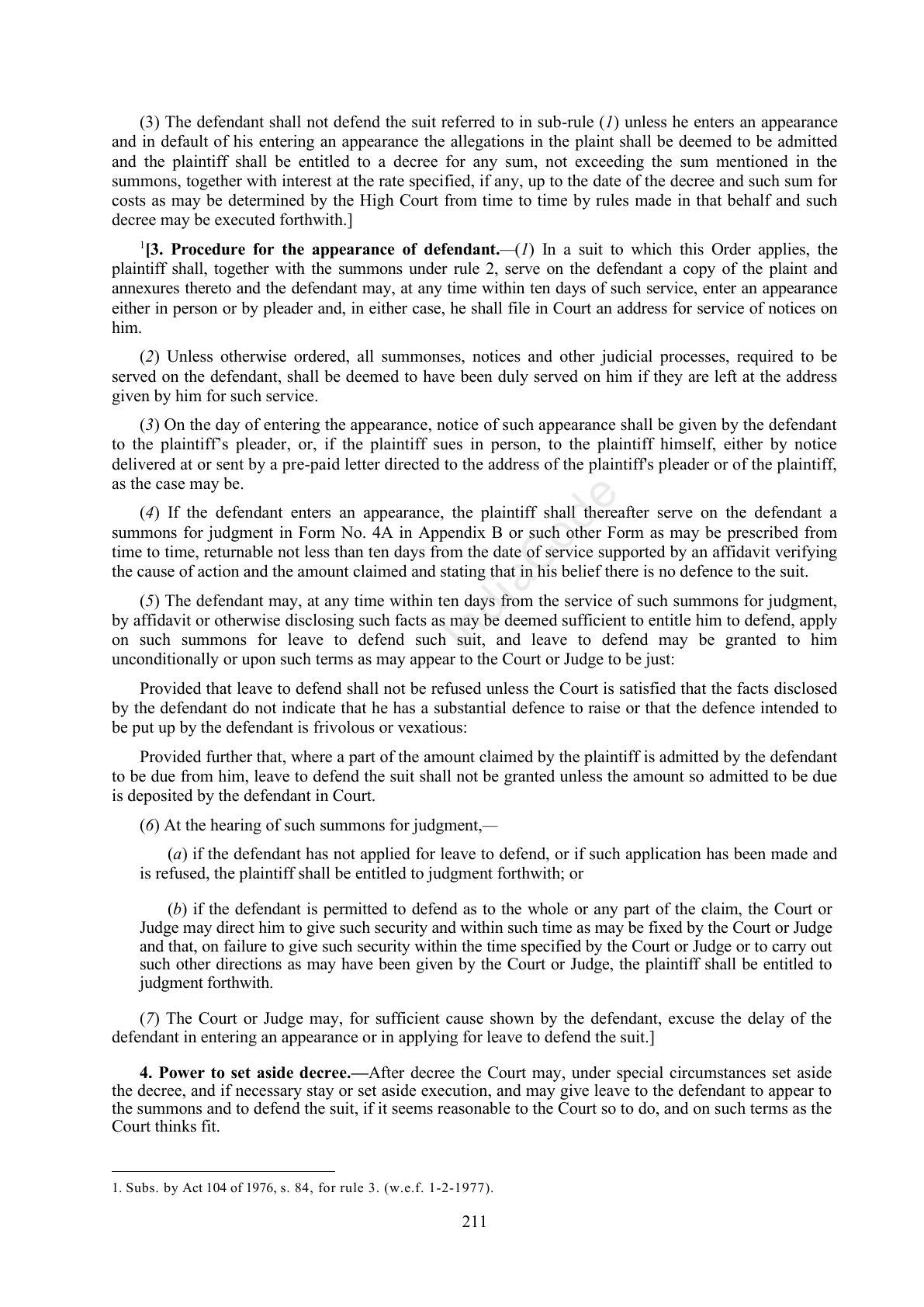
Full physical source page · unreviewed extraction
The Code of Civil Procedure, 1908: page 211
The Code of Civil Procedure, 1908, India Code delivered snapshot 393b8848fdfc476a, physical page 211, typed edition 77428589d4e341672ed6a3e5f663be7dec530c42d0600064ac1314302939267d. Unreviewed extraction.
Source: official India Code PDF · catalog record. Fetched 2026-10-19T23:06:46Z. SHA-256 393b8848fdfc476a21cc3abf4f0d3f510557e2dff6fc6914b1f379bea1730614.
Legal currency, territorial applicability and extraction fidelity are unverified. Catalog checksum/size differs from the delivered PDF; both identities are retained. Sections, state notes and footnotes share these physical pages. Compare the full original image.
Retained layout text
    (3) The defendant shall not defend the suit referred to in sub-rule (1) unless he enters an appearance
and in default of his entering an appearance the allegations in the plaint shall be deemed to be admitted
and the plaintiff shall be entitled to a decree for any sum, not exceeding the sum mentioned in the
summons, together with interest at the rate specified, if any, up to the date of the decree and such sum for
costs as may be determined by the High Court from time to time by rules made in that behalf and such
decree may be executed forthwith.]
    1
     [3. Procedure for the appearance of defendant.—(1) In a suit to which this Order applies, the
plaintiff shall, together with the summons under rule 2, serve on the defendant a copy of the plaint and
annexures thereto and the defendant may, at any time within ten days of such service, enter an appearance
either in person or by pleader and, in either case, he shall file in Court an address for service of notices on
him.
    (2) Unless otherwise ordered, all summonses, notices and other judicial processes, required to be
served on the defendant, shall be deemed to have been duly served on him if they are left at the address
given by him for such service.
     (3) On the day of entering the appearance, notice of such appearance shall be given by the defendant
to the plaintiff’s pleader, or, if the plaintiff sues in person, to the plaintiff himself, either by notice
delivered at or sent by a pre-paid letter directed to the address of the plaintiff's pleader or of the plaintiff,
as the case may be.
                                                                       e
    (4) If the defendant enters an appearance, the plaintiff shall thereafter serve on the defendant a
                                                                     od
summons for judgment in Form No. 4A in Appendix B or such other Form as may be prescribed from
time to time, returnable not less than ten days from the date of service supported by an affidavit verifying
                                                                aC
the cause of action and the amount claimed and stating that in his belief there is no defence to the suit.
    (5) The defendant may, at any time within ten days from the service of such summons for judgment,
                                                           di
by affidavit or otherwise disclosing such facts as may be deemed sufficient to entitle him to defend, apply
                                                      In
on such summons for leave to defend such suit, and leave to defend may be granted to him
unconditionally or upon such terms as may appear to the Court or Judge to be just:
    Provided that leave to defend shall not be refused unless the Court is satisfied that the facts disclosed
by the defendant do not indicate that he has a substantial defence to raise or that the defence intended to
be put up by the defendant is frivolous or vexatious:
    Provided further that, where a part of the amount claimed by the plaintiff is admitted by the defendant
to be due from him, leave to defend the suit shall not be granted unless the amount so admitted to be due
is deposited by the defendant in Court.
    (6) At the hearing of such summons for judgment,—
         (a) if the defendant has not applied for leave to defend, or if such application has been made and
    is refused, the plaintiff shall be entitled to judgment forthwith; or

        (b) if the defendant is permitted to defend as to the whole or any part of the claim, the Court or
    Judge may direct him to give such security and within such time as may be fixed by the Court or Judge
    and that, on failure to give such security within the time specified by the Court or Judge or to carry out
    such other directions as may have been given by the Court or Judge, the plaintiff shall be entitled to
    judgment forthwith.

    (7) The Court or Judge may, for sufficient cause shown by the defendant, excuse the delay of the
defendant in entering an appearance or in applying for leave to defend the suit.]

    4. Power to set aside decree.—After decree the Court may, under special circumstances set aside
the decree, and if necessary stay or set aside execution, and may give leave to the defendant to appear to
the summons and to defend the suit, if it seems reasonable to the Court so to do, and on such terms as the
Court thinks fit.


1. Subs. by Act 104 of 1976, s. 84, for rule 3. (w.e.f. 1-2-1977).

                                                            211
Compare original page image