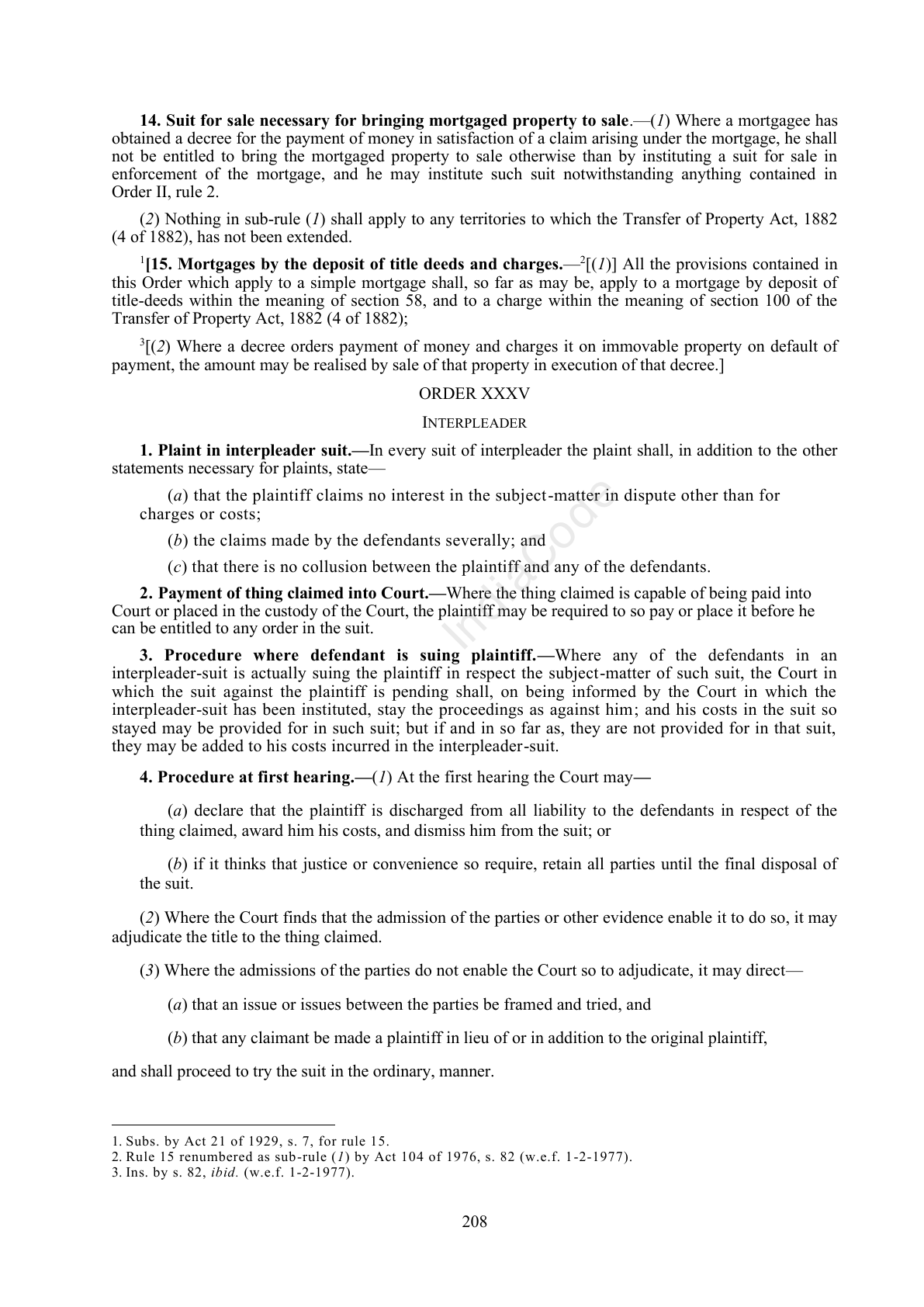
Full physical source page · unreviewed extraction
The Code of Civil Procedure, 1908: page 208
The Code of Civil Procedure, 1908, India Code delivered snapshot 393b8848fdfc476a, physical page 208, typed edition 77428589d4e341672ed6a3e5f663be7dec530c42d0600064ac1314302939267d. Unreviewed extraction.
Source: official India Code PDF · catalog record. Fetched 2026-10-19T23:06:46Z. SHA-256 393b8848fdfc476a21cc3abf4f0d3f510557e2dff6fc6914b1f379bea1730614.
Legal currency, territorial applicability and extraction fidelity are unverified. Catalog checksum/size differs from the delivered PDF; both identities are retained. Sections, state notes and footnotes share these physical pages. Compare the full original image.
Retained layout text
    14. Suit for sale necessary for bringing mortgaged property to sale.—(1) Where a mortgagee has
obtained a decree for the payment of money in satisfaction of a claim arising under the mortgage, he shall
not be entitled to bring the mortgaged property to sale otherwise than by instituting a suit for sale in
enforcement of the mortgage, and he may institute such suit notwithstanding anything contained in
Order II, rule 2.
    (2) Nothing in sub-rule (1) shall apply to any territories to which the Transfer of Property Act, 1882
(4 of 1882), has not been extended.
    1
      [15. Mortgages by the deposit of title deeds and charges.—2[(1)] All the provisions contained in
this Order which apply to a simple mortgage shall, so far as may be, apply to a mortgage by deposit of
title-deeds within the meaning of section 58, and to a charge within the meaning of section 100 of the
Transfer of Property Act, 1882 (4 of 1882);
    3
    [(2) Where a decree orders payment of money and charges it on immovable property on default of
payment, the amount may be realised by sale of that property in execution of that decree.]
                                                ORDER XXXV
                                                INTERPLEADER
     1. Plaint in interpleader suit.—In every suit of interpleader the plaint shall, in addition to the other
statements necessary for plaints, state—
       (a) that the plaintiff claims no interest in the subject-matter in dispute other than for
                                                                        e
    charges or costs;
        (b) the claims made by the defendants severally; and
                                                                 od
                                                           aC
        (c) that there is no collusion between the plaintiff and any of the defendants.
    2. Payment of thing claimed into Court.—Where the thing claimed is capable of being paid into
                                                      di
Court or placed in the custody of the Court, the plaintiff may be required to so pay or place it before he
can be entitled to any order in the suit.
                                                 In
    3. Procedure where defendant is suing plaintiff.—Where any of the defendants in an
interpleader-suit is actually suing the plaintiff in respect the subject-matter of such suit, the Court in
which the suit against the plaintiff is pending shall, on being informed by the Court in which the
interpleader-suit has been instituted, stay the proceedings as against him; and his costs in the suit so
stayed may be provided for in such suit; but if and in so far as, they are not provided for in that suit,
they may be added to his costs incurred in the interpleader-suit.
    4. Procedure at first hearing.—(1) At the first hearing the Court may—
        (a) declare that the plaintiff is discharged from all liability to the defendants in respect of the
    thing claimed, award him his costs, and dismiss him from the suit; or
        (b) if it thinks that justice or convenience so require, retain all parties until the final disposal of
    the suit.
    (2) Where the Court finds that the admission of the parties or other evidence enable it to do so, it may
adjudicate the title to the thing claimed.
    (3) Where the admissions of the parties do not enable the Court so to adjudicate, it may direct—
        (a) that an issue or issues between the parties be framed and tried, and
        (b) that any claimant be made a plaintiff in lieu of or in addition to the original plaintiff,
and shall proceed to try the suit in the ordinary, manner.


1. Subs. by Act 21 of 1929, s. 7, for rule 15.
2. Rule 15 renumbered as sub-rule (1) by Act 104 of 1976, s. 82 (w.e.f. 1-2-1977).
3. Ins. by s. 82, ibid. (w.e.f. 1-2-1977).


                                                       208
Compare original page image