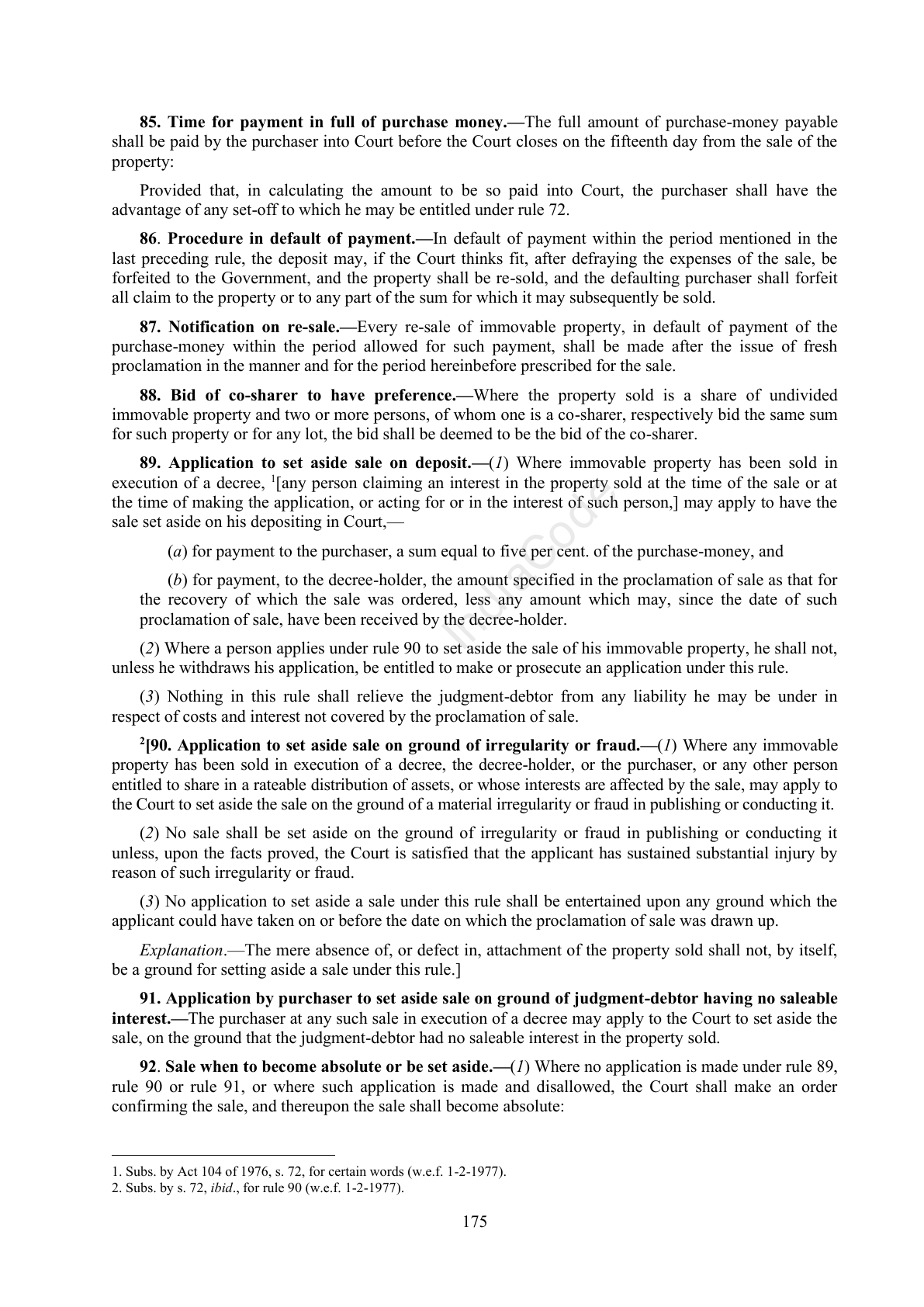
Full physical source page · unreviewed extraction
The Code of Civil Procedure, 1908: page 175
The Code of Civil Procedure, 1908, India Code delivered snapshot 393b8848fdfc476a, physical page 175, typed edition 77428589d4e341672ed6a3e5f663be7dec530c42d0600064ac1314302939267d. Unreviewed extraction.
Source: official India Code PDF · catalog record. Fetched 2026-10-19T23:06:46Z. SHA-256 393b8848fdfc476a21cc3abf4f0d3f510557e2dff6fc6914b1f379bea1730614.
Legal currency, territorial applicability and extraction fidelity are unverified. Catalog checksum/size differs from the delivered PDF; both identities are retained. Sections, state notes and footnotes share these physical pages. Compare the full original image.
Retained layout text
    85. Time for payment in full of purchase money.—The full amount of purchase-money payable
shall be paid by the purchaser into Court before the Court closes on the fifteenth day from the sale of the
property:
   Provided that, in calculating the amount to be so paid into Court, the purchaser shall have the
advantage of any set-off to which he may be entitled under rule 72.
     86. Procedure in default of payment.—In default of payment within the period mentioned in the
last preceding rule, the deposit may, if the Court thinks fit, after defraying the expenses of the sale, be
forfeited to the Government, and the property shall be re-sold, and the defaulting purchaser shall forfeit
all claim to the property or to any part of the sum for which it may subsequently be sold.
    87. Notification on re-sale.—Every re-sale of immovable property, in default of payment of the
purchase-money within the period allowed for such payment, shall be made after the issue of fresh
proclamation in the manner and for the period hereinbefore prescribed for the sale.
     88. Bid of co-sharer to have preference.—Where the property sold is a share of undivided
immovable property and two or more persons, of whom one is a co-sharer, respectively bid the same sum
for such property or for any lot, the bid shall be deemed to be the bid of the co-sharer.
    89. Application to set aside sale on deposit.—(1) Where immovable property has been sold in
execution of a decree, 1[any person claiming an interest in the property sold at the time of the sale or at
the time of making the application, or acting for or in the interest of such person,] may apply to have the
                                                                            e
sale set aside on his depositing in Court,—                                od
          (a) for payment to the purchaser, a sum equal to five per cent. of the purchase-money, and
                                                                    aC
         (b) for payment, to the decree-holder, the amount specified in the proclamation of sale as that for
     the recovery of which the sale was ordered, less any amount which may, since the date of such
                                                               di
     proclamation of sale, have been received by the decree-holder.
                                                         In
    (2) Where a person applies under rule 90 to set aside the sale of his immovable property, he shall not,
unless he withdraws his application, be entitled to make or prosecute an application under this rule.
    (3) Nothing in this rule shall relieve the judgment-debtor from any liability he may be under in
respect of costs and interest not covered by the proclamation of sale.
     2
      [90. Application to set aside sale on ground of irregularity or fraud.—(1) Where any immovable
property has been sold in execution of a decree, the decree-holder, or the purchaser, or any other person
entitled to share in a rateable distribution of assets, or whose interests are affected by the sale, may apply to
the Court to set aside the sale on the ground of a material irregularity or fraud in publishing or conducting it.
    (2) No sale shall be set aside on the ground of irregularity or fraud in publishing or conducting it
unless, upon the facts proved, the Court is satisfied that the applicant has sustained substantial injury by
reason of such irregularity or fraud.
    (3) No application to set aside a sale under this rule shall be entertained upon any ground which the
applicant could have taken on or before the date on which the proclamation of sale was drawn up.
    Explanation.—The mere absence of, or defect in, attachment of the property sold shall not, by itself,
be a ground for setting aside a sale under this rule.]
    91. Application by purchaser to set aside sale on ground of judgment-debtor having no saleable
interest.—The purchaser at any such sale in execution of a decree may apply to the Court to set aside the
sale, on the ground that the judgment-debtor had no saleable interest in the property sold.
    92. Sale when to become absolute or be set aside.—(1) Where no application is made under rule 89,
rule 90 or rule 91, or where such application is made and disallowed, the Court shall make an order
confirming the sale, and thereupon the sale shall become absolute:


1. Subs. by Act 104 of 1976, s. 72, for certain words (w.e.f. 1-2-1977).
2. Subs. by s. 72, ibid., for rule 90 (w.e.f. 1-2-1977).

                                                               175
Compare original page image