Full physical source page · unreviewed extraction
The Code of Civil Procedure, 1908: page 172
The Code of Civil Procedure, 1908, India Code delivered snapshot 393b8848fdfc476a, physical page 172, typed edition 77428589d4e341672ed6a3e5f663be7dec530c42d0600064ac1314302939267d. Unreviewed extraction.
Source: official India Code PDF · catalog record. Fetched 2026-10-19T23:06:46Z. SHA-256 393b8848fdfc476a21cc3abf4f0d3f510557e2dff6fc6914b1f379bea1730614.
Legal currency, territorial applicability and extraction fidelity are unverified. Catalog checksum/size differs from the delivered PDF; both identities are retained. Sections, state notes and footnotes share these physical pages. Compare the full original image.
Retained layout text
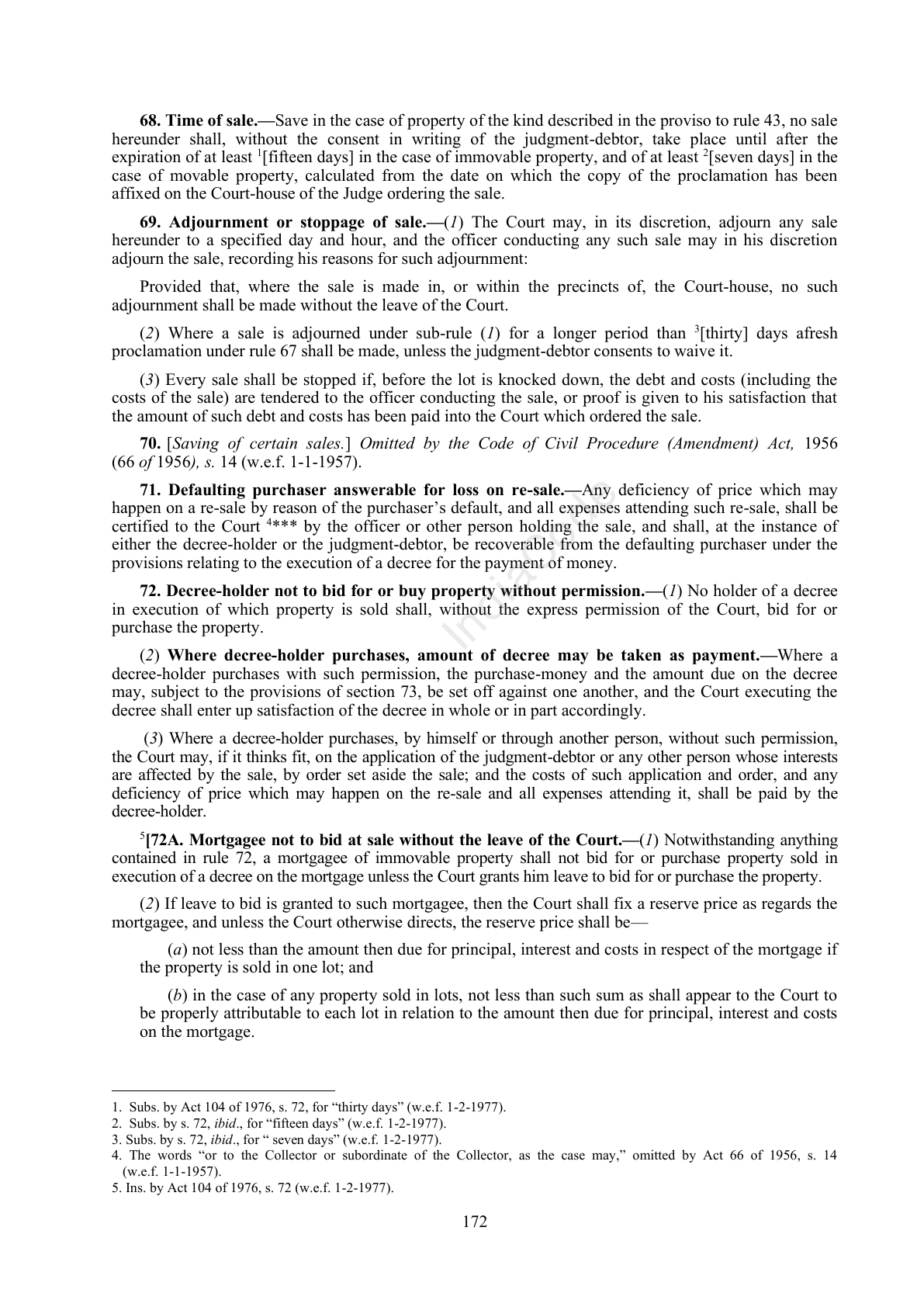
    68. Time of sale.—Save in the case of property of the kind described in the proviso to rule 43, no sale
hereunder shall, without the consent in writing of the judgment-debtor, take place until after the
expiration of at least 1[fifteen days] in the case of immovable property, and of at least 2[seven days] in the
case of movable property, calculated from the date on which the copy of the proclamation has been
affixed on the Court-house of the Judge ordering the sale.
    69. Adjournment or stoppage of sale.—(1) The Court may, in its discretion, adjourn any sale
hereunder to a specified day and hour, and the officer conducting any such sale may in his discretion
adjourn the sale, recording his reasons for such adjournment:
    Provided that, where the sale is made in, or within the precincts of, the Court-house, no such
adjournment shall be made without the leave of the Court.
    (2) Where a sale is adjourned under sub-rule (1) for a longer period than 3[thirty] days afresh
proclamation under rule 67 shall be made, unless the judgment-debtor consents to waive it.
    (3) Every sale shall be stopped if, before the lot is knocked down, the debt and costs (including the
costs of the sale) are tendered to the officer conducting the sale, or proof is given to his satisfaction that
the amount of such debt and costs has been paid into the Court which ordered the sale.
    70. [Saving of certain sales.] Omitted by the Code of Civil Procedure (Amendment) Act, 1956
(66 of 1956), s. 14 (w.e.f. 1-1-1957).
    71. Defaulting purchaser answerable for loss on re-sale.—Any deficiency of price which may
                                                                         e
happen on a re-sale by reason of the purchaser’s default, and all expenses attending such re-sale, shall be
                                                                   od
certified to the Court 4*** by the officer or other person holding the sale, and shall, at the instance of
either the decree-holder or the judgment-debtor, be recoverable from the defaulting purchaser under the
                                                            aC
provisions relating to the execution of a decree for the payment of money.
    72. Decree-holder not to bid for or buy property without permission.—(1) No holder of a decree
                                                       di
in execution of which property is sold shall, without the express permission of the Court, bid for or
purchase the property.
                                                   In
    (2) Where decree-holder purchases, amount of decree may be taken as payment.—Where a
decree-holder purchases with such permission, the purchase-money and the amount due on the decree
may, subject to the provisions of section 73, be set off against one another, and the Court executing the
decree shall enter up satisfaction of the decree in whole or in part accordingly.
     (3) Where a decree-holder purchases, by himself or through another person, without such permission,
the Court may, if it thinks fit, on the application of the judgment-debtor or any other person whose interests
are affected by the sale, by order set aside the sale; and the costs of such application and order, and any
deficiency of price which may happen on the re-sale and all expenses attending it, shall be paid by the
decree-holder.
    5
     [72A. Mortgagee not to bid at sale without the leave of the Court.—(1) Notwithstanding anything
contained in rule 72, a mortgagee of immovable property shall not bid for or purchase property sold in
execution of a decree on the mortgage unless the Court grants him leave to bid for or purchase the property.
   (2) If leave to bid is granted to such mortgagee, then the Court shall fix a reserve price as regards the
mortgagee, and unless the Court otherwise directs, the reserve price shall be—
        (a) not less than the amount then due for principal, interest and costs in respect of the mortgage if
    the property is sold in one lot; and
        (b) in the case of any property sold in lots, not less than such sum as shall appear to the Court to
    be properly attributable to each lot in relation to the amount then due for principal, interest and costs
    on the mortgage.


1. Subs. by Act 104 of 1976, s. 72, for “thirty days” (w.e.f. 1-2-1977).
2. Subs. by s. 72, ibid., for “fifteen days” (w.e.f. 1-2-1977).
3. Subs. by s. 72, ibid., for “ seven days” (w.e.f. 1-2-1977).
4. The words “or to the Collector or subordinate of the Collector, as the case may,” omitted by Act 66 of 1956, s. 14
  (w.e.f. 1-1-1957).
5. Ins. by Act 104 of 1976, s. 72 (w.e.f. 1-2-1977).

                                                        172
Compare original page image