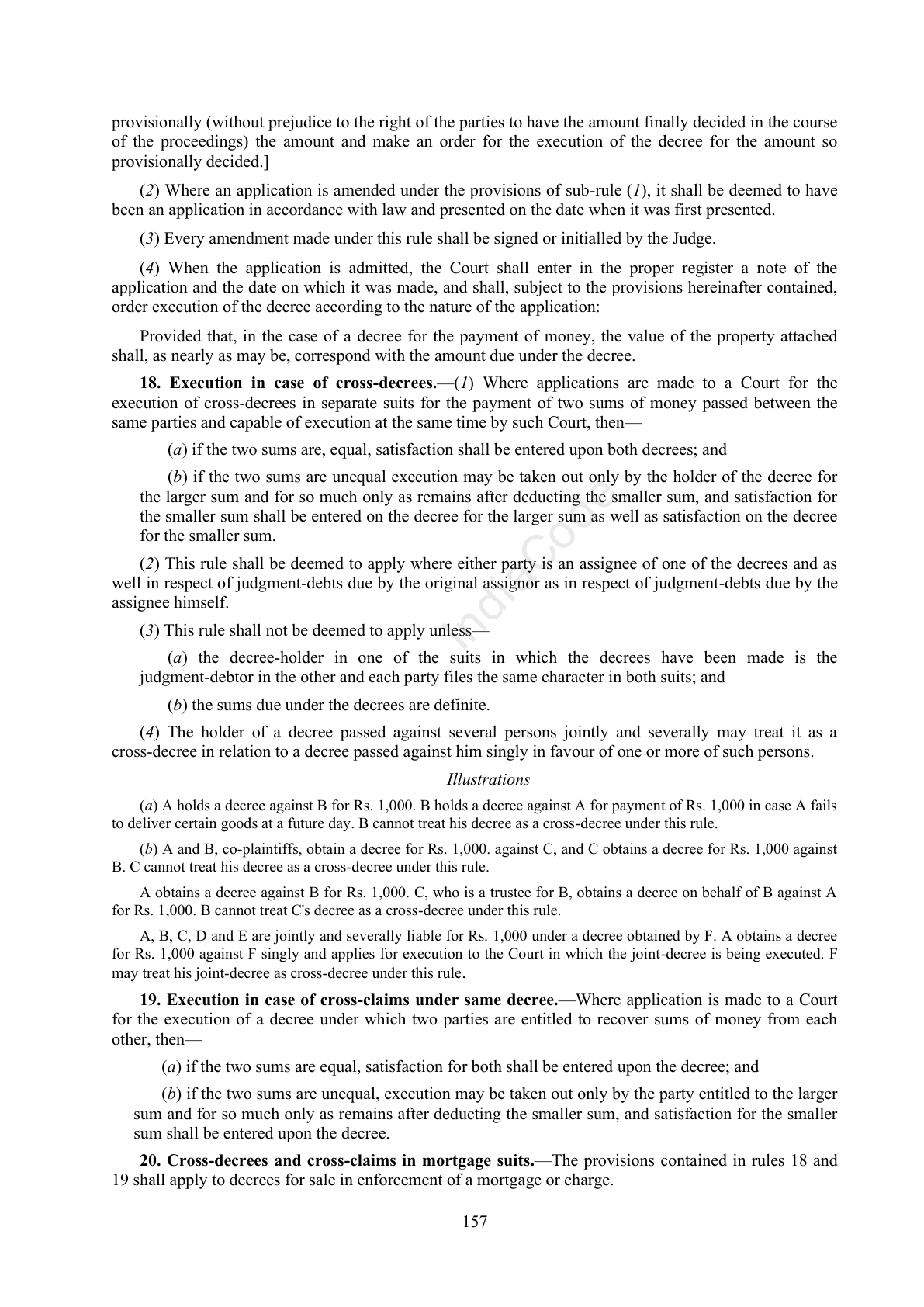
Full physical source page · unreviewed extraction
The Code of Civil Procedure, 1908: page 157
The Code of Civil Procedure, 1908, India Code delivered snapshot 393b8848fdfc476a, physical page 157, typed edition 77428589d4e341672ed6a3e5f663be7dec530c42d0600064ac1314302939267d. Unreviewed extraction.
Source: official India Code PDF · catalog record. Fetched 2026-10-19T23:06:46Z. SHA-256 393b8848fdfc476a21cc3abf4f0d3f510557e2dff6fc6914b1f379bea1730614.
Legal currency, territorial applicability and extraction fidelity are unverified. Catalog checksum/size differs from the delivered PDF; both identities are retained. Sections, state notes and footnotes share these physical pages. Compare the full original image.
Retained layout text
provisionally (without prejudice to the right of the parties to have the amount finally decided in the course
of the proceedings) the amount and make an order for the execution of the decree for the amount so
provisionally decided.]
   (2) Where an application is amended under the provisions of sub-rule (1), it shall be deemed to have
been an application in accordance with law and presented on the date when it was first presented.
    (3) Every amendment made under this rule shall be signed or initialled by the Judge.
    (4) When the application is admitted, the Court shall enter in the proper register a note of the
application and the date on which it was made, and shall, subject to the provisions hereinafter contained,
order execution of the decree according to the nature of the application:
    Provided that, in the case of a decree for the payment of money, the value of the property attached
shall, as nearly as may be, correspond with the amount due under the decree.
    18. Execution in case of cross-decrees.—(1) Where applications are made to a Court for the
execution of cross-decrees in separate suits for the payment of two sums of money passed between the
same parties and capable of execution at the same time by such Court, then—
         (a) if the two sums are, equal, satisfaction shall be entered upon both decrees; and
         (b) if the two sums are unequal execution may be taken out only by the holder of the decree for
    the larger sum and for so much only as remains after deducting the smaller sum, and satisfaction for
                                                                          e
    the smaller sum shall be entered on the decree for the larger sum as well as satisfaction on the decree
    for the smaller sum.                                           od
                                                             aC
    (2) This rule shall be deemed to apply where either party is an assignee of one of the decrees and as
well in respect of judgment-debts due by the original assignor as in respect of judgment-debts due by the
assignee himself.                                       di
    (3) This rule shall not be deemed to apply unless—
                                                   In
        (a) the decree-holder in one of the suits in which the decrees have been made is the
    judgment-debtor in the other and each party files the same character in both suits; and
         (b) the sums due under the decrees are definite.
    (4) The holder of a decree passed against several persons jointly and severally may treat it as a
cross-decree in relation to a decree passed against him singly in favour of one or more of such persons.
                                                      Illustrations
     (a) A holds a decree against B for Rs. 1,000. B holds a decree against A for payment of Rs. 1,000 in case A fails
to deliver certain goods at a future day. B cannot treat his decree as a cross-decree under this rule.
    (b) A and B, co-plaintiffs, obtain a decree for Rs. 1,000. against C, and C obtains a decree for Rs. 1,000 against
B. C cannot treat his decree as a cross-decree under this rule.
     A obtains a decree against B for Rs. 1,000. C, who is a trustee for B, obtains a decree on behalf of B against A
for Rs. 1,000. B cannot treat C's decree as a cross-decree under this rule.
    A, B, C, D and E are jointly and severally liable for Rs. 1,000 under a decree obtained by F. A obtains a decree
for Rs. 1,000 against F singly and applies for execution to the Court in which the joint-decree is being executed. F
may treat his joint-decree as cross-decree under this rule.
    19. Execution in case of cross-claims under same decree.—Where application is made to a Court
for the execution of a decree under which two parties are entitled to recover sums of money from each
other, then—
        (a) if the two sums are equal, satisfaction for both shall be entered upon the decree; and
      (b) if the two sums are unequal, execution may be taken out only by the party entitled to the larger
   sum and for so much only as remains after deducting the smaller sum, and satisfaction for the smaller
   sum shall be entered upon the decree.
    20. Cross-decrees and cross-claims in mortgage suits.—The provisions contained in rules 18 and
19 shall apply to decrees for sale in enforcement of a mortgage or charge.

                                                        157
Compare original page image