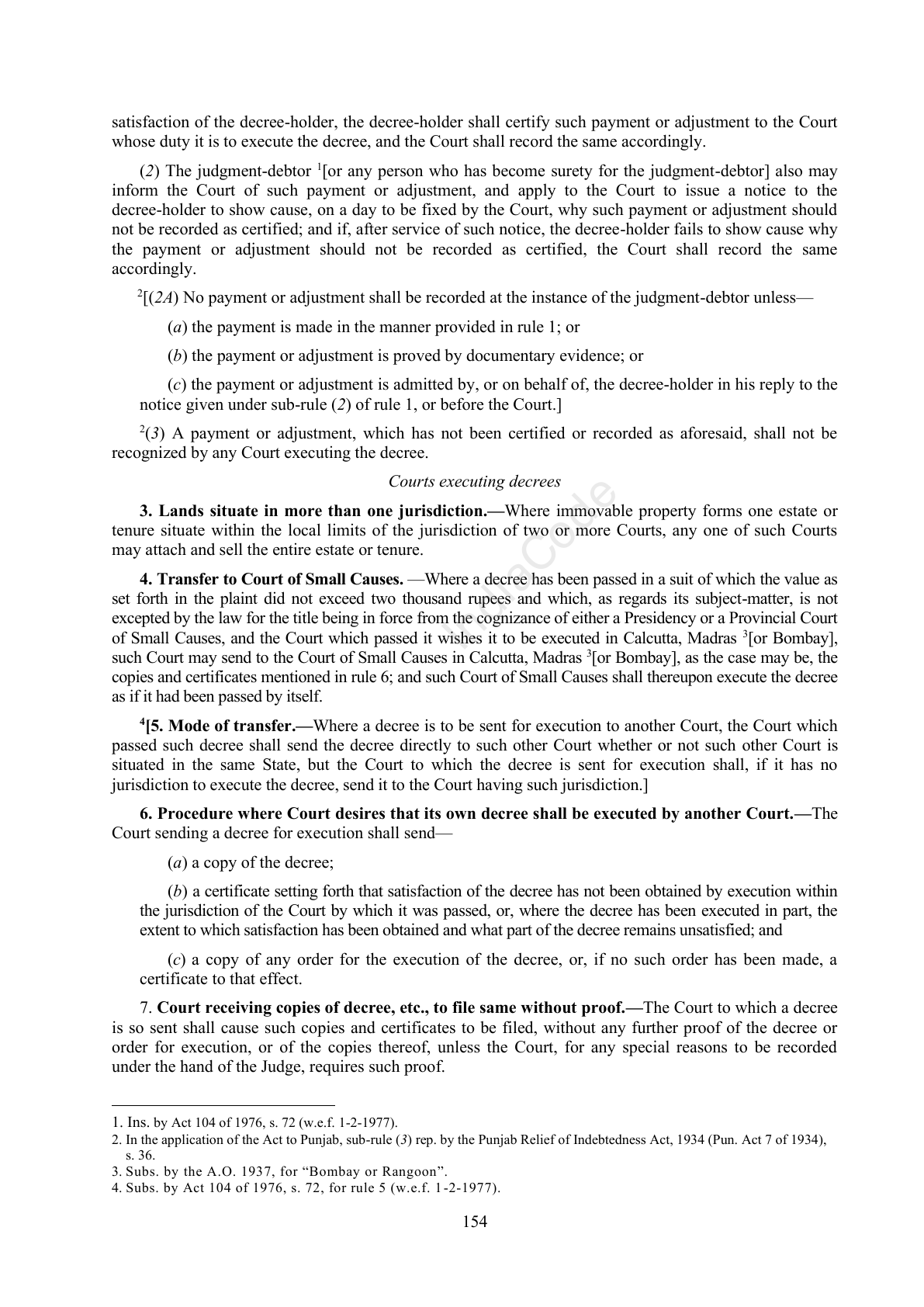
Full physical source page · unreviewed extraction
The Code of Civil Procedure, 1908: page 154
The Code of Civil Procedure, 1908, India Code delivered snapshot 393b8848fdfc476a, physical page 154, typed edition 77428589d4e341672ed6a3e5f663be7dec530c42d0600064ac1314302939267d. Unreviewed extraction.
Source: official India Code PDF · catalog record. Fetched 2026-10-19T23:06:46Z. SHA-256 393b8848fdfc476a21cc3abf4f0d3f510557e2dff6fc6914b1f379bea1730614.
Legal currency, territorial applicability and extraction fidelity are unverified. Catalog checksum/size differs from the delivered PDF; both identities are retained. Sections, state notes and footnotes share these physical pages. Compare the full original image.
Retained layout text
satisfaction of the decree-holder, the decree-holder shall certify such payment or adjustment to the Court
whose duty it is to execute the decree, and the Court shall record the same accordingly.
    (2) The judgment-debtor 1[or any person who has become surety for the judgment-debtor] also may
inform the Court of such payment or adjustment, and apply to the Court to issue a notice to the
decree-holder to show cause, on a day to be fixed by the Court, why such payment or adjustment should
not be recorded as certified; and if, after service of such notice, the decree-holder fails to show cause why
the payment or adjustment should not be recorded as certified, the Court shall record the same
accordingly.
    2
     [(2A) No payment or adjustment shall be recorded at the instance of the judgment-debtor unless—
          (a) the payment is made in the manner provided in rule 1; or
          (b) the payment or adjustment is proved by documentary evidence; or
         (c) the payment or adjustment is admitted by, or on behalf of, the decree-holder in his reply to the
     notice given under sub-rule (2) of rule 1, or before the Court.]
     2
    (3) A payment or adjustment, which has not been certified or recorded as aforesaid, shall not be
recognized by any Court executing the decree.
                                                  Courts executing decrees
                                                                                   e
    3. Lands situate in more than one jurisdiction.—Where immovable property forms one estate or
                                                                           od
tenure situate within the local limits of the jurisdiction of two or more Courts, any one of such Courts
may attach and sell the entire estate or tenure.
                                                                    aC
     4. Transfer to Court of Small Causes. —Where a decree has been passed in a suit of which the value as
set forth in the plaint did not exceed two thousand rupees and which, as regards its subject-matter, is not
                                                              di
excepted by the law for the title being in force from the cognizance of either a Presidency or a Provincial Court
                                                         In
of Small Causes, and the Court which passed it wishes it to be executed in Calcutta, Madras 3[or Bombay],
such Court may send to the Court of Small Causes in Calcutta, Madras 3[or Bombay], as the case may be, the
copies and certificates mentioned in rule 6; and such Court of Small Causes shall thereupon execute the decree
as if it had been passed by itself.
     4
     [5. Mode of transfer.—Where a decree is to be sent for execution to another Court, the Court which
passed such decree shall send the decree directly to such other Court whether or not such other Court is
situated in the same State, but the Court to which the decree is sent for execution shall, if it has no
jurisdiction to execute the decree, send it to the Court having such jurisdiction.]
   6. Procedure where Court desires that its own decree shall be executed by another Court.—The
Court sending a decree for execution shall send—
          (a) a copy of the decree;
          (b) a certificate setting forth that satisfaction of the decree has not been obtained by execution within
     the jurisdiction of the Court by which it was passed, or, where the decree has been executed in part, the
     extent to which satisfaction has been obtained and what part of the decree remains unsatisfied; and
         (c) a copy of any order for the execution of the decree, or, if no such order has been made, a
     certificate to that effect.
    7. Court receiving copies of decree, etc., to file same without proof.—The Court to which a decree
is so sent shall cause such copies and certificates to be filed, without any further proof of the decree or
order for execution, or of the copies thereof, unless the Court, for any special reasons to be recorded
under the hand of the Judge, requires such proof.


1. Ins. by Act 104 of 1976, s. 72 (w.e.f. 1-2-1977).
2. In the application of the Act to Punjab, sub-rule (3) rep. by the Punjab Relief of Indebtedness Act, 1934 (Pun. Act 7 of 1934),
   s. 36.
3. Subs. by the A.O. 1937, for “Bombay or Rangoon”.
4. Subs. by Act 104 of 1976, s. 72, for rule 5 (w.e.f. 1 -2-1977).

                                                               154
Compare original page image