Full physical source page · unreviewed extraction
The Code of Civil Procedure, 1908: page 150
The Code of Civil Procedure, 1908, India Code delivered snapshot 393b8848fdfc476a, physical page 150, typed edition 77428589d4e341672ed6a3e5f663be7dec530c42d0600064ac1314302939267d. Unreviewed extraction.
Source: official India Code PDF · catalog record. Fetched 2026-10-19T23:06:46Z. SHA-256 393b8848fdfc476a21cc3abf4f0d3f510557e2dff6fc6914b1f379bea1730614.
Legal currency, territorial applicability and extraction fidelity are unverified. Catalog checksum/size differs from the delivered PDF; both identities are retained. Sections, state notes and footnotes share these physical pages. Compare the full original image.
Retained layout text
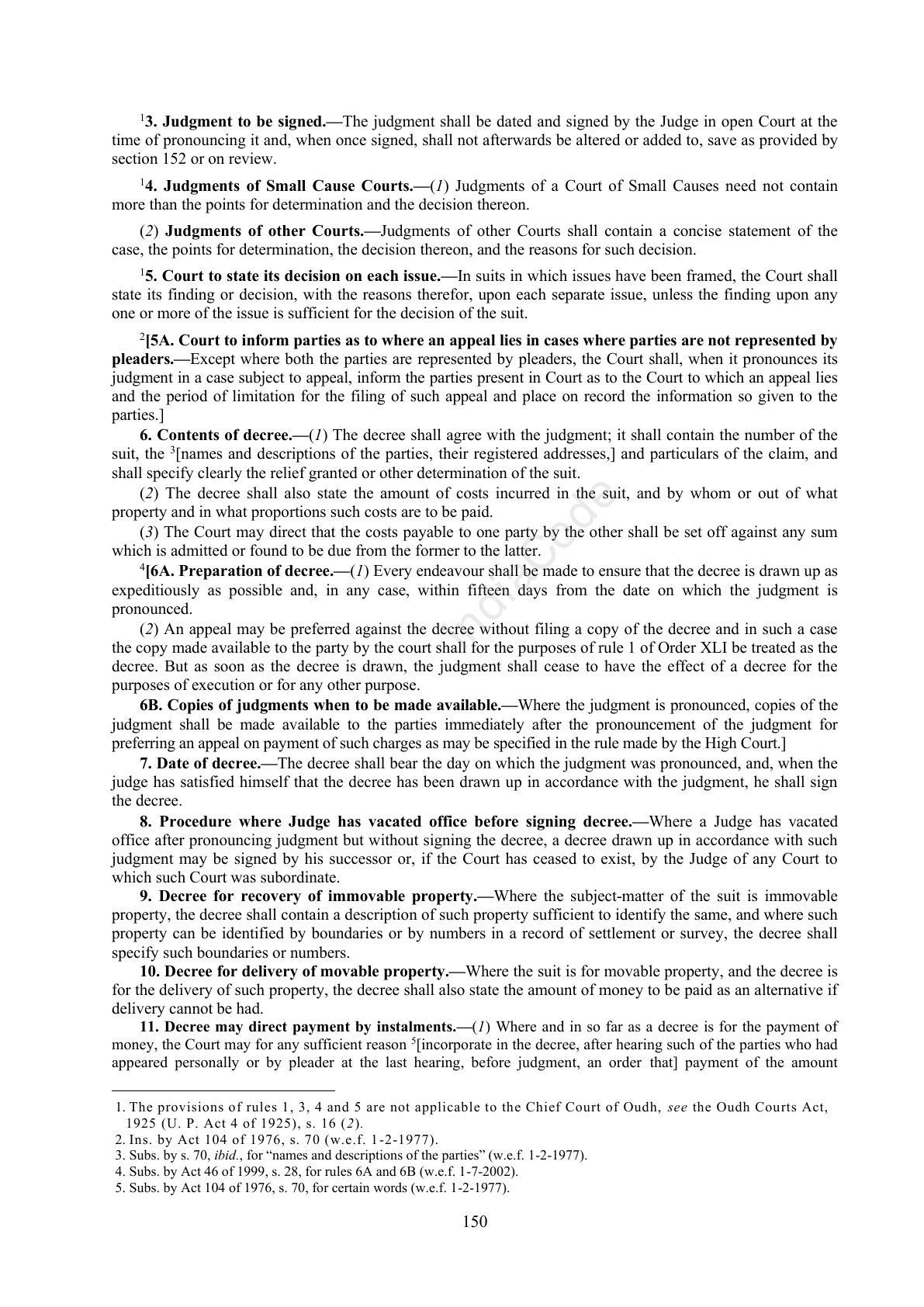
    13. Judgment to be signed.—The judgment shall be dated and signed by the Judge in open Court at the

time of pronouncing it and, when once signed, shall not afterwards be altered or added to, save as provided by
section 152 or on review.
    1
    4. Judgments of Small Cause Courts.—(1) Judgments of a Court of Small Causes need not contain
more than the points for determination and the decision thereon.
    (2) Judgments of other Courts.—Judgments of other Courts shall contain a concise statement of the
case, the points for determination, the decision thereon, and the reasons for such decision.
    15. Court to state its decision on each issue.—In suits in which issues have been framed, the Court shall

state its finding or decision, with the reasons therefor, upon each separate issue, unless the finding upon any
one or more of the issue is sufficient for the decision of the suit.
    2
      [5A. Court to inform parties as to where an appeal lies in cases where parties are not represented by
pleaders.—Except where both the parties are represented by pleaders, the Court shall, when it pronounces its
judgment in a case subject to appeal, inform the parties present in Court as to the Court to which an appeal lies
and the period of limitation for the filing of such appeal and place on record the information so given to the
parties.]
     6. Contents of decree.—(1) The decree shall agree with the judgment; it shall contain the number of the
suit, the 3[names and descriptions of the parties, their registered addresses,] and particulars of the claim, and
shall specify clearly the relief granted or other determination of the suit.
     (2) The decree shall also state the amount of costs incurred in the suit, and by whom or out of what
property and in what proportions such costs are to be paid.
                                                                         e
                                                                   od
     (3) The Court may direct that the costs payable to one party by the other shall be set off against any sum
which is admitted or found to be due from the former to the latter.
                                                            aC
     4[6A. Preparation of decree.—(1) Every endeavour shall be made to ensure that the decree is drawn up as

expeditiously as possible and, in any case, within fifteen days from the date on which the judgment is
pronounced.                                            di
     (2) An appeal may be preferred against the decree without filing a copy of the decree and in such a case
                                                   In
the copy made available to the party by the court shall for the purposes of rule 1 of Order XLI be treated as the
decree. But as soon as the decree is drawn, the judgment shall cease to have the effect of a decree for the
purposes of execution or for any other purpose.
     6B. Copies of judgments when to be made available.—Where the judgment is pronounced, copies of the
judgment shall be made available to the parties immediately after the pronouncement of the judgment for
preferring an appeal on payment of such charges as may be specified in the rule made by the High Court.]
     7. Date of decree.—The decree shall bear the day on which the judgment was pronounced, and, when the
judge has satisfied himself that the decree has been drawn up in accordance with the judgment, he shall sign
the decree.
     8. Procedure where Judge has vacated office before signing decree.—Where a Judge has vacated
office after pronouncing judgment but without signing the decree, a decree drawn up in accordance with such
judgment may be signed by his successor or, if the Court has ceased to exist, by the Judge of any Court to
which such Court was subordinate.
     9. Decree for recovery of immovable property.—Where the subject-matter of the suit is immovable
property, the decree shall contain a description of such property sufficient to identify the same, and where such
property can be identified by boundaries or by numbers in a record of settlement or survey, the decree shall
specify such boundaries or numbers.
     10. Decree for delivery of movable property.—Where the suit is for movable property, and the decree is
for the delivery of such property, the decree shall also state the amount of money to be paid as an alternative if
delivery cannot be had.
    11. Decree may direct payment by instalments.—(1) Where and in so far as a decree is for the payment of
money, the Court may for any sufficient reason 5[incorporate in the decree, after hearing such of the parties who had
appeared personally or by pleader at the last hearing, before judgment, an order that] payment of the amount

1. The provisions of rules 1, 3, 4 and 5 are not applicable to the Chief Court of Oudh, see the Oudh Courts Act,
  1925 (U. P. Act 4 of 1925), s. 16 (2).
2. Ins. by Act 104 of 1976, s. 70 (w.e.f. 1 -2-1977).
3. Subs. by s. 70, ibid., for “names and descriptions of the parties” (w.e.f. 1-2-1977).
4. Subs. by Act 46 of 1999, s. 28, for rules 6A and 6B (w.e.f. 1-7-2002).
5. Subs. by Act 104 of 1976, s. 70, for certain words (w.e.f. 1-2-1977).

                                                        150
Compare original page image