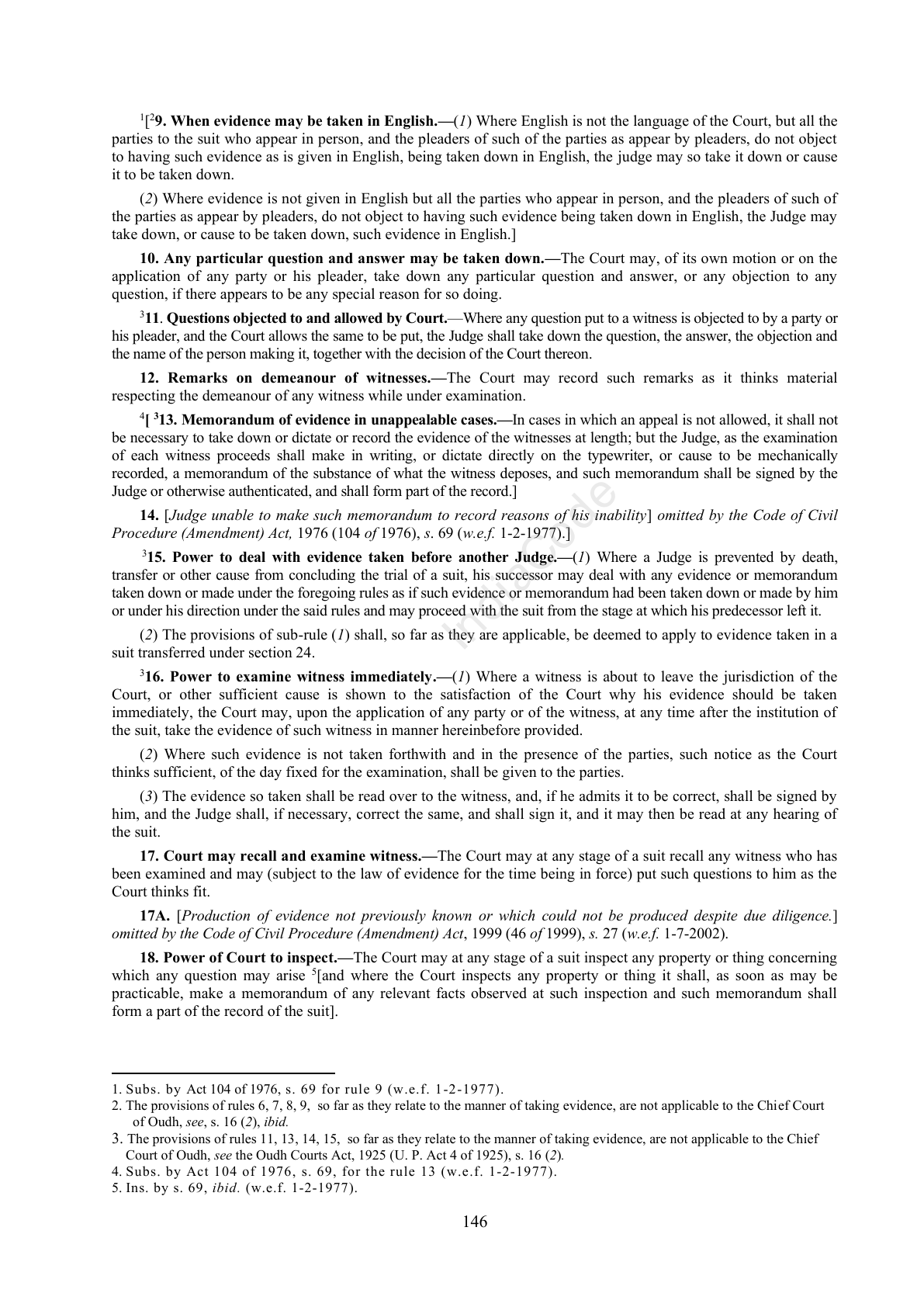
Full physical source page · unreviewed extraction
The Code of Civil Procedure, 1908: page 146
The Code of Civil Procedure, 1908, India Code delivered snapshot 393b8848fdfc476a, physical page 146, typed edition 77428589d4e341672ed6a3e5f663be7dec530c42d0600064ac1314302939267d. Unreviewed extraction.
Source: official India Code PDF · catalog record. Fetched 2026-10-19T23:06:46Z. SHA-256 393b8848fdfc476a21cc3abf4f0d3f510557e2dff6fc6914b1f379bea1730614.
Legal currency, territorial applicability and extraction fidelity are unverified. Catalog checksum/size differs from the delivered PDF; both identities are retained. Sections, state notes and footnotes share these physical pages. Compare the full original image.
Retained layout text
     1 2
       [ 9. When evidence may be taken in English.—(1) Where English is not the language of the Court, but all the
parties to the suit who appear in person, and the pleaders of such of the parties as appear by pleaders, do not object
to having such evidence as is given in English, being taken down in English, the judge may so take it down or cause
it to be taken down.
     (2) Where evidence is not given in English but all the parties who appear in person, and the pleaders of such of
the parties as appear by pleaders, do not object to having such evidence being taken down in English, the Judge may
take down, or cause to be taken down, such evidence in English.]
    10. Any particular question and answer may be taken down.—The Court may, of its own motion or on the
application of any party or his pleader, take down any particular question and answer, or any objection to any
question, if there appears to be any special reason for so doing.
     3
       11. Questions objected to and allowed by Court.—Where any question put to a witness is objected to by a party or
his pleader, and the Court allows the same to be put, the Judge shall take down the question, the answer, the objection and
the name of the person making it, together with the decision of the Court thereon.
    12. Remarks on demeanour of witnesses.—The Court may record such remarks as it thinks material
respecting the demeanour of any witness while under examination.
     4 3
     [ 13. Memorandum of evidence in unappealable cases.—In cases in which an appeal is not allowed, it shall not
be necessary to take down or dictate or record the evidence of the witnesses at length; but the Judge, as the examination
of each witness proceeds shall make in writing, or dictate directly on the typewriter, or cause to be mechanically
recorded, a memorandum of the substance of what the witness deposes, and such memorandum shall be signed by the
Judge or otherwise authenticated, and shall form part of the record.]
                                                                                    e
    14. [Judge unable to make such memorandum to record reasons of his inability] omitted by the Code of Civil
Procedure (Amendment) Act, 1976 (104 of 1976), s. 69 (w.e.f. 1-2-1977).]
     3
                                                                             od
      15. Power to deal with evidence taken before another Judge.—(1) Where a Judge is prevented by death,
                                                                     aC
transfer or other cause from concluding the trial of a suit, his successor may deal with any evidence or memorandum
taken down or made under the foregoing rules as if such evidence or memorandum had been taken down or made by him
                                                                di
or under his direction under the said rules and may proceed with the suit from the stage at which his predecessor left it.
                                                          In
     (2) The provisions of sub-rule (1) shall, so far as they are applicable, be deemed to apply to evidence taken in a
suit transferred under section 24.
     3
      16. Power to examine witness immediately.—(1) Where a witness is about to leave the jurisdiction of the
Court, or other sufficient cause is shown to the satisfaction of the Court why his evidence should be taken
immediately, the Court may, upon the application of any party or of the witness, at any time after the institution of
the suit, take the evidence of such witness in manner hereinbefore provided.
    (2) Where such evidence is not taken forthwith and in the presence of the parties, such notice as the Court
thinks sufficient, of the day fixed for the examination, shall be given to the parties.
     (3) The evidence so taken shall be read over to the witness, and, if he admits it to be correct, shall be signed by
him, and the Judge shall, if necessary, correct the same, and shall sign it, and it may then be read at any hearing of
the suit.
    17. Court may recall and examine witness.—The Court may at any stage of a suit recall any witness who has
been examined and may (subject to the law of evidence for the time being in force) put such questions to him as the
Court thinks fit.
    17A. [Production of evidence not previously known or which could not be produced despite due diligence.]
omitted by the Code of Civil Procedure (Amendment) Act, 1999 (46 of 1999), s. 27 (w.e.f. 1-7-2002).
    18. Power of Court to inspect.—The Court may at any stage of a suit inspect any property or thing concerning
which any question may arise 5[and where the Court inspects any property or thing it shall, as soon as may be
practicable, make a memorandum of any relevant facts observed at such inspection and such memorandum shall
form a part of the record of the suit].


1. Subs. by Act 104 of 1976, s. 69 for rule 9 (w.e.f. 1-2-1977).
2. The provisions of rules 6, 7, 8, 9, so far as they relate to the manner of taking evidence, are not applicable to the Chief Court
    of Oudh, see, s. 16 (2), ibid.
3. The provisions of rules 11, 13, 14, 15, so far as they relate to the manner of taking evidence, are not applicable to the Chief
   Court of Oudh, see the Oudh Courts Act, 1925 (U. P. Act 4 of 1925), s. 16 (2).
4. Subs. by Act 104 of 1976, s. 69, for the rule 13 (w.e.f. 1-2-1977).
5. Ins. by s. 69, ibid. (w.e.f. 1-2-1977).

                                                                146
Compare original page image