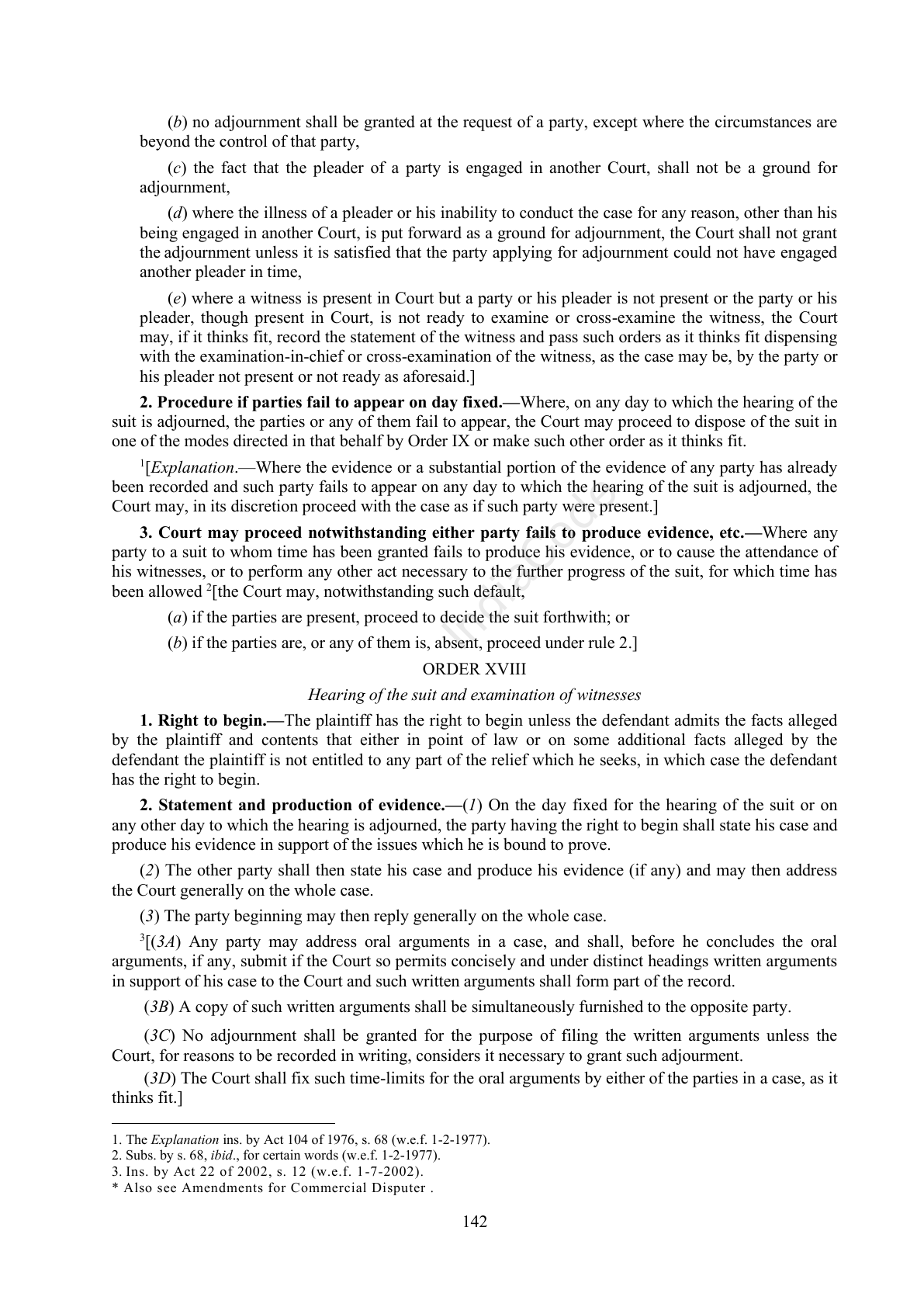
Full physical source page · unreviewed extraction
The Code of Civil Procedure, 1908: page 142
The Code of Civil Procedure, 1908, India Code delivered snapshot 393b8848fdfc476a, physical page 142, typed edition 77428589d4e341672ed6a3e5f663be7dec530c42d0600064ac1314302939267d. Unreviewed extraction.
Source: official India Code PDF · catalog record. Fetched 2026-10-19T23:06:46Z. SHA-256 393b8848fdfc476a21cc3abf4f0d3f510557e2dff6fc6914b1f379bea1730614.
Legal currency, territorial applicability and extraction fidelity are unverified. Catalog checksum/size differs from the delivered PDF; both identities are retained. Sections, state notes and footnotes share these physical pages. Compare the full original image.
Retained layout text
        (b) no adjournment shall be granted at the request of a party, except where the circumstances are
     beyond the control of that party,
         (c) the fact that the pleader of a party is engaged in another Court, shall not be a ground for
     adjournment,
         (d) where the illness of a pleader or his inability to conduct the case for any reason, other than his
     being engaged in another Court, is put forward as a ground for adjournment, the Court shall not grant
     the adjournment unless it is satisfied that the party applying for adjournment could not have engaged
     another pleader in time,
         (e) where a witness is present in Court but a party or his pleader is not present or the party or his
     pleader, though present in Court, is not ready to examine or cross-examine the witness, the Court
     may, if it thinks fit, record the statement of the witness and pass such orders as it thinks fit dispensing
     with the examination-in-chief or cross-examination of the witness, as the case may be, by the party or
     his pleader not present or not ready as aforesaid.]
     2. Procedure if parties fail to appear on day fixed.—Where, on any day to which the hearing of the
suit is adjourned, the parties or any of them fail to appear, the Court may proceed to dispose of the suit in
one of the modes directed in that behalf by Order IX or make such other order as it thinks fit.
     1
    [Explanation.—Where the evidence or a substantial portion of the evidence of any party has already
been recorded and such party fails to appear on any day to which the hearing of the suit is adjourned, the
                                                                        e
Court may, in its discretion proceed with the case as if such party were present.]
                                                                       od
    3. Court may proceed notwithstanding either party fails to produce evidence, etc.—Where any
party to a suit to whom time has been granted fails to produce his evidence, or to cause the attendance of
                                                                   aC
his witnesses, or to perform any other act necessary to the further progress of the suit, for which time has
been allowed 2[the Court may, notwithstanding such default,
                                                              di
          (a) if the parties are present, proceed to decide the suit forthwith; or
                                                        In
          (b) if the parties are, or any of them is, absent, proceed under rule 2.]
                                                   ORDER XVIII
                                   Hearing of the suit and examination of witnesses
    1. Right to begin.—The plaintiff has the right to begin unless the defendant admits the facts alleged
by the plaintiff and contents that either in point of law or on some additional facts alleged by the
defendant the plaintiff is not entitled to any part of the relief which he seeks, in which case the defendant
has the right to begin.
    2. Statement and production of evidence.—(1) On the day fixed for the hearing of the suit or on
any other day to which the hearing is adjourned, the party having the right to begin shall state his case and
produce his evidence in support of the issues which he is bound to prove.
    (2) The other party shall then state his case and produce his evidence (if any) and may then address
the Court generally on the whole case.
    (3) The party beginning may then reply generally on the whole case.
    3
      [(3A) Any party may address oral arguments in a case, and shall, before he concludes the oral
arguments, if any, submit if the Court so permits concisely and under distinct headings written arguments
in support of his case to the Court and such written arguments shall form part of the record.
     (3B) A copy of such written arguments shall be simultaneously furnished to the opposite party.
     (3C) No adjournment shall be granted for the purpose of filing the written arguments unless the
Court, for reasons to be recorded in writing, considers it necessary to grant such adjourment.
     (3D) The Court shall fix such time-limits for the oral arguments by either of the parties in a case, as it
thinks fit.]

1. The Explanation ins. by Act 104 of 1976, s. 68 (w.e.f. 1-2-1977).
2. Subs. by s. 68, ibid., for certain words (w.e.f. 1-2-1977).
3. Ins. by Act 22 of 2002, s. 12 (w.e.f. 1-7-2002).
* Also see Amendments for Commercial Disputer .

                                                              142
Compare original page image