Full physical source page · unreviewed extraction
The Code of Civil Procedure, 1908: page 127
The Code of Civil Procedure, 1908, India Code delivered snapshot 393b8848fdfc476a, physical page 127, typed edition 77428589d4e341672ed6a3e5f663be7dec530c42d0600064ac1314302939267d. Unreviewed extraction.
Source: official India Code PDF · catalog record. Fetched 2026-10-19T23:06:46Z. SHA-256 393b8848fdfc476a21cc3abf4f0d3f510557e2dff6fc6914b1f379bea1730614.
Legal currency, territorial applicability and extraction fidelity are unverified. Catalog checksum/size differs from the delivered PDF; both identities are retained. Sections, state notes and footnotes share these physical pages. Compare the full original image.
Retained layout text
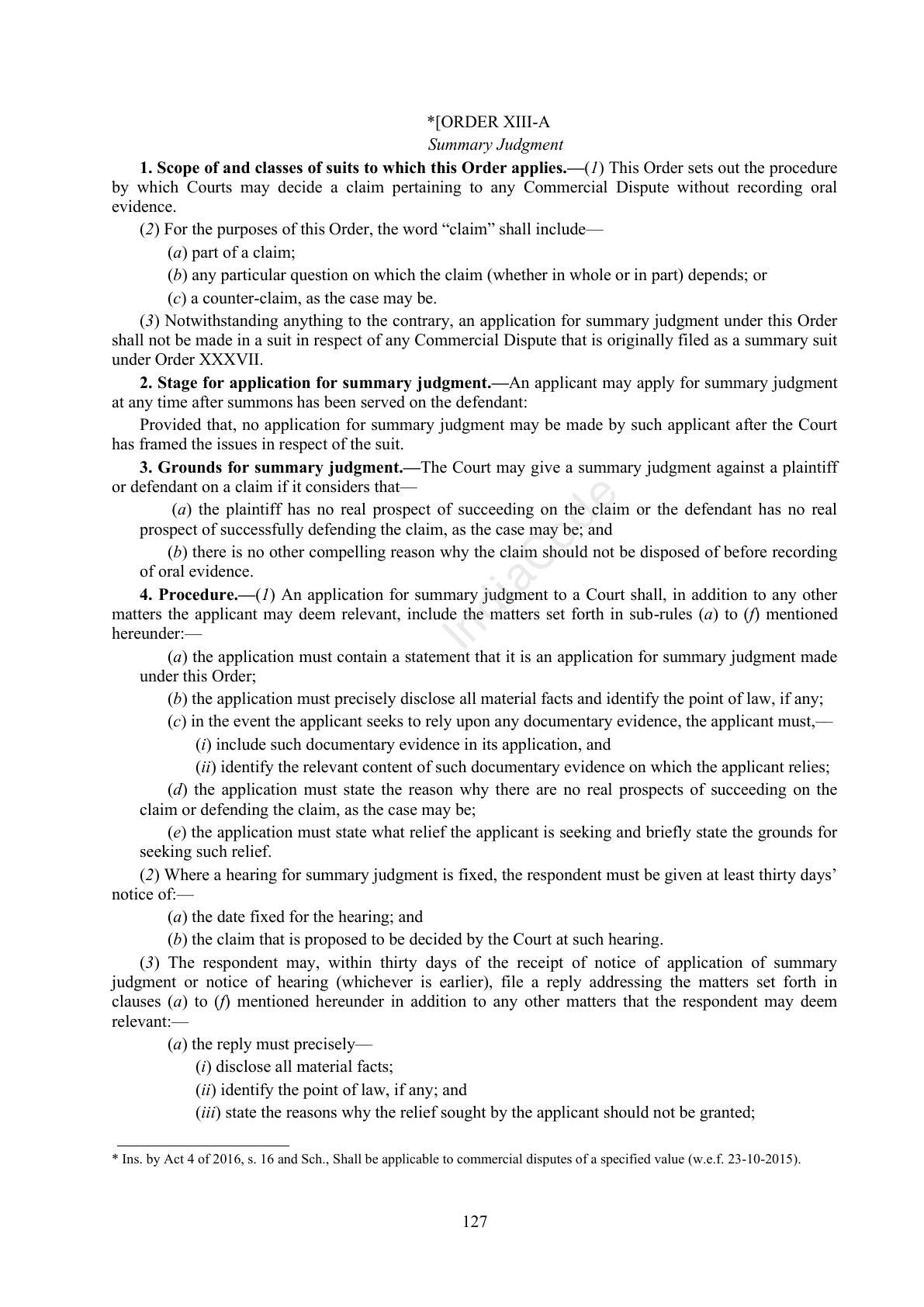
                                                   *[ORDER XIII-A
                                                   Summary Judgment
    1. Scope of and classes of suits to which this Order applies.—(1) This Order sets out the procedure
by which Courts may decide a claim pertaining to any Commercial Dispute without recording oral
evidence.
    (2) For the purposes of this Order, the word “claim” shall include—
         (a) part of a claim;
         (b) any particular question on which the claim (whether in whole or in part) depends; or
         (c) a counter-claim, as the case may be.
    (3) Notwithstanding anything to the contrary, an application for summary judgment under this Order
shall not be made in a suit in respect of any Commercial Dispute that is originally filed as a summary suit
under Order XXXVII.
    2. Stage for application for summary judgment.—An applicant may apply for summary judgment
at any time after summons has been served on the defendant:
    Provided that, no application for summary judgment may be made by such applicant after the Court
has framed the issues in respect of the suit.
    3. Grounds for summary judgment.—The Court may give a summary judgment against a plaintiff
or defendant on a claim if it considers that––
                                                                                  e
          (a) the plaintiff has no real prospect of succeeding on the claim or the defendant has no real
    prospect of successfully defending the claim, as the case may be; and  od
         (b) there is no other compelling reason why the claim should not be disposed of before recording
    of oral evidence.                                               aC
    4. Procedure.—(1) An application for summary judgment to a Court shall, in addition to any other
                                                              di
matters the applicant may deem relevant, include the matters set forth in sub-rules (a) to (f) mentioned
hereunder:—                                              In
         (a) the application must contain a statement that it is an application for summary judgment made
    under this Order;
         (b) the application must precisely disclose all material facts and identify the point of law, if any;
         (c) in the event the applicant seeks to rely upon any documentary evidence, the applicant must,––
              (i) include such documentary evidence in its application, and
              (ii) identify the relevant content of such documentary evidence on which the applicant relies;
         (d) the application must state the reason why there are no real prospects of succeeding on the
    claim or defending the claim, as the case may be;
         (e) the application must state what relief the applicant is seeking and briefly state the grounds for
    seeking such relief.
    (2) Where a hearing for summary judgment is fixed, the respondent must be given at least thirty days’
notice of:—
         (a) the date fixed for the hearing; and
         (b) the claim that is proposed to be decided by the Court at such hearing.
    (3) The respondent may, within thirty days of the receipt of notice of application of summary
judgment or notice of hearing (whichever is earlier), file a reply addressing the matters set forth in
clauses (a) to (f) mentioned hereunder in addition to any other matters that the respondent may deem
relevant:—
         (a) the reply must precisely––
              (i) disclose all material facts;
              (ii) identify the point of law, if any; and
              (iii) state the reasons why the relief sought by the applicant should not be granted;

* Ins. by Act 4 of 2016, s. 16 and Sch., Shall be applicable to commercial disputes of a specified value (w.e.f. 23-10-2015).


                                                               127
Compare original page image