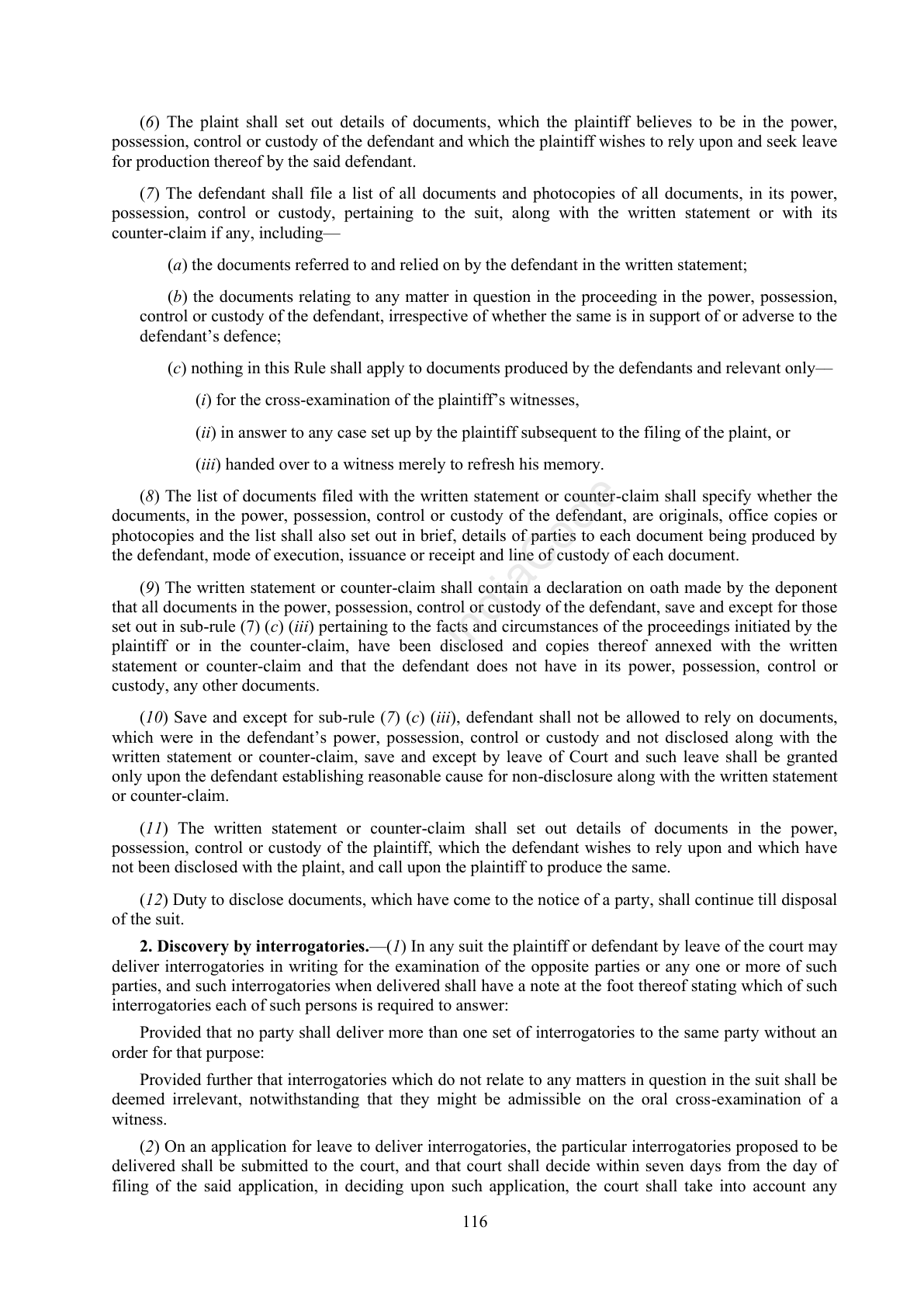
Full physical source page · unreviewed extraction
The Code of Civil Procedure, 1908: page 116
The Code of Civil Procedure, 1908, India Code delivered snapshot 393b8848fdfc476a, physical page 116, typed edition 77428589d4e341672ed6a3e5f663be7dec530c42d0600064ac1314302939267d. Unreviewed extraction.
Source: official India Code PDF · catalog record. Fetched 2026-10-19T23:06:46Z. SHA-256 393b8848fdfc476a21cc3abf4f0d3f510557e2dff6fc6914b1f379bea1730614.
Legal currency, territorial applicability and extraction fidelity are unverified. Catalog checksum/size differs from the delivered PDF; both identities are retained. Sections, state notes and footnotes share these physical pages. Compare the full original image.
Retained layout text
    (6) The plaint shall set out details of documents, which the plaintiff believes to be in the power,
possession, control or custody of the defendant and which the plaintiff wishes to rely upon and seek leave
for production thereof by the said defendant.
    (7) The defendant shall file a list of all documents and photocopies of all documents, in its power,
possession, control or custody, pertaining to the suit, along with the written statement or with its
counter-claim if any, including—
        (a) the documents referred to and relied on by the defendant in the written statement;
        (b) the documents relating to any matter in question in the proceeding in the power, possession,
    control or custody of the defendant, irrespective of whether the same is in support of or adverse to the
    defendant’s defence;
        (c) nothing in this Rule shall apply to documents produced by the defendants and relevant only––
            (i) for the cross-examination of the plaintiff’s witnesses,
            (ii) in answer to any case set up by the plaintiff subsequent to the filing of the plaint, or
            (iii) handed over to a witness merely to refresh his memory.
    (8) The list of documents filed with the written statement or counter-claim shall specify whether the
                                                                      e
documents, in the power, possession, control or custody of the defendant, are originals, office copies or
                                                                od
photocopies and the list shall also set out in brief, details of parties to each document being produced by
the defendant, mode of execution, issuance or receipt and line of custody of each document.
                                                         aC
     (9) The written statement or counter-claim shall contain a declaration on oath made by the deponent
                                                    di
that all documents in the power, possession, control or custody of the defendant, save and except for those
set out in sub-rule (7) (c) (iii) pertaining to the facts and circumstances of the proceedings initiated by the
                                                In
plaintiff or in the counter-claim, have been disclosed and copies thereof annexed with the written
statement or counter-claim and that the defendant does not have in its power, possession, control or
custody, any other documents.
    (10) Save and except for sub-rule (7) (c) (iii), defendant shall not be allowed to rely on documents,
which were in the defendant’s power, possession, control or custody and not disclosed along with the
written statement or counter-claim, save and except by leave of Court and such leave shall be granted
only upon the defendant establishing reasonable cause for non-disclosure along with the written statement
or counter-claim.
    (11) The written statement or counter-claim shall set out details of documents in the power,
possession, control or custody of the plaintiff, which the defendant wishes to rely upon and which have
not been disclosed with the plaint, and call upon the plaintiff to produce the same.
     (12) Duty to disclose documents, which have come to the notice of a party, shall continue till disposal
of the suit.
    2. Discovery by interrogatories.—(1) In any suit the plaintiff or defendant by leave of the court may
deliver interrogatories in writing for the examination of the opposite parties or any one or more of such
parties, and such interrogatories when delivered shall have a note at the foot thereof stating which of such
interrogatories each of such persons is required to answer:
    Provided that no party shall deliver more than one set of interrogatories to the same party without an
order for that purpose:
    Provided further that interrogatories which do not relate to any matters in question in the suit shall be
deemed irrelevant, notwithstanding that they might be admissible on the oral cross-examination of a
witness.
     (2) On an application for leave to deliver interrogatories, the particular interrogatories proposed to be
delivered shall be submitted to the court, and that court shall decide within seven days from the day of
filing of the said application, in deciding upon such application, the court shall take into account any

                                                     116
Compare original page image