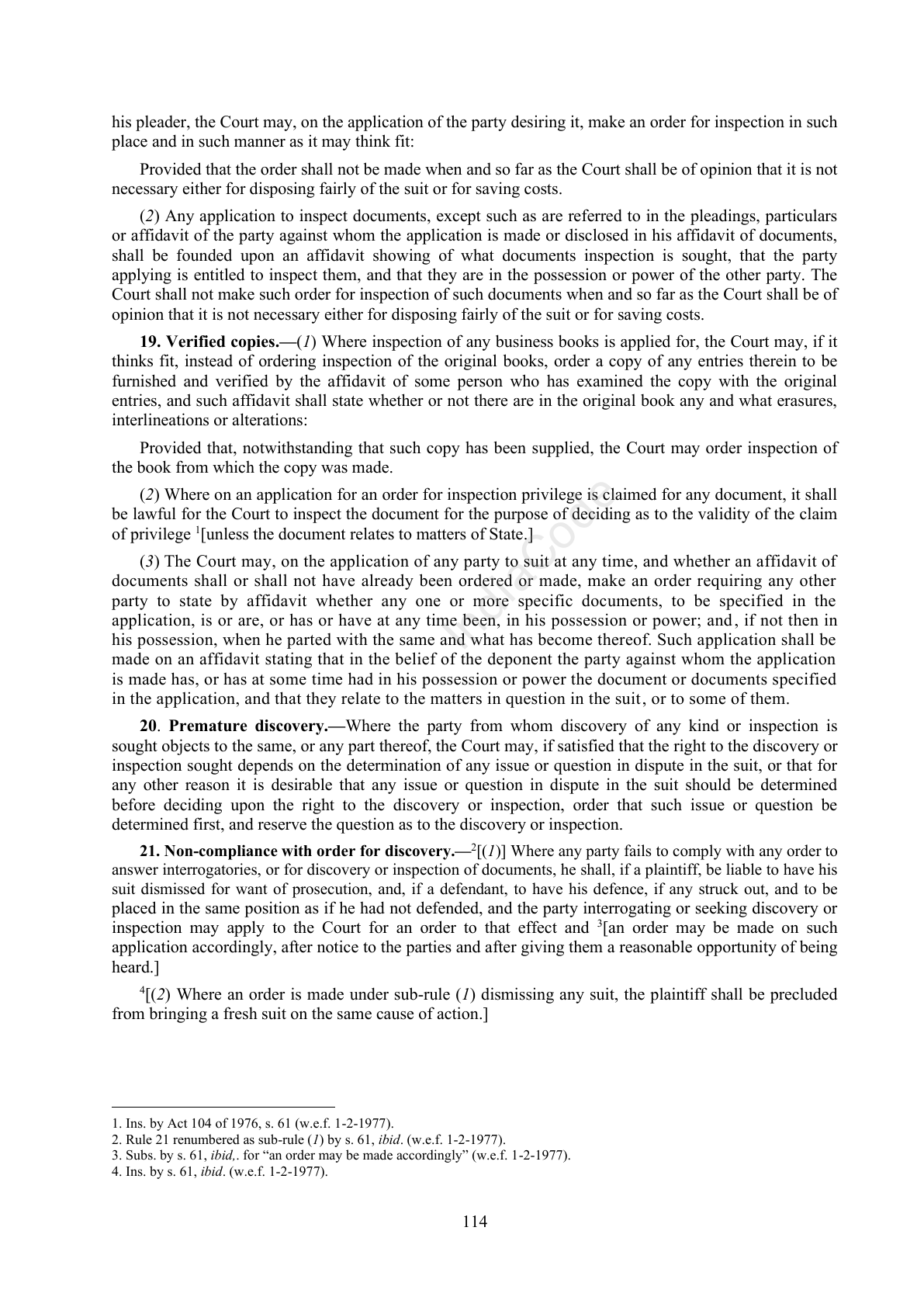
Full physical source page · unreviewed extraction
The Code of Civil Procedure, 1908: page 114
The Code of Civil Procedure, 1908, India Code delivered snapshot 393b8848fdfc476a, physical page 114, typed edition 77428589d4e341672ed6a3e5f663be7dec530c42d0600064ac1314302939267d. Unreviewed extraction.
Source: official India Code PDF · catalog record. Fetched 2026-10-19T23:06:46Z. SHA-256 393b8848fdfc476a21cc3abf4f0d3f510557e2dff6fc6914b1f379bea1730614.
Legal currency, territorial applicability and extraction fidelity are unverified. Catalog checksum/size differs from the delivered PDF; both identities are retained. Sections, state notes and footnotes share these physical pages. Compare the full original image.
Retained layout text
his pleader, the Court may, on the application of the party desiring it, make an order for inspection in such
place and in such manner as it may think fit:
    Provided that the order shall not be made when and so far as the Court shall be of opinion that it is not
necessary either for disposing fairly of the suit or for saving costs.
    (2) Any application to inspect documents, except such as are referred to in the pleadings, particulars
or affidavit of the party against whom the application is made or disclosed in his affidavit of documents,
shall be founded upon an affidavit showing of what documents inspection is sought, that the party
applying is entitled to inspect them, and that they are in the possession or power of the other party. The
Court shall not make such order for inspection of such documents when and so far as the Court shall be of
opinion that it is not necessary either for disposing fairly of the suit or for saving costs.
    19. Verified copies.—(1) Where inspection of any business books is applied for, the Court may, if it
thinks fit, instead of ordering inspection of the original books, order a copy of any entries therein to be
furnished and verified by the affidavit of some person who has examined the copy with the original
entries, and such affidavit shall state whether or not there are in the original book any and what erasures,
interlineations or alterations:
    Provided that, notwithstanding that such copy has been supplied, the Court may order inspection of
the book from which the copy was made.
    (2) Where on an application for an order for inspection privilege is claimed for any document, it shall
                                                                                  e
be lawful for the Court to inspect the document for the purpose of deciding as to the validity of the claim
of privilege 1[unless the document relates to matters of State.]           od
    (3) The Court may, on the application of any party to suit at any time, and whether an affidavit of
                                                                   aC
documents shall or shall not have already been ordered or made, make an order requiring any other
party to state by affidavit whether any one or more specific documents, to be specified in the
                                                              di
application, is or are, or has or have at any time been, in his possession or power; and , if not then in
                                                         In
his possession, when he parted with the same and what has become thereof. Such application shall be
made on an affidavit stating that in the belief of the deponent the party against whom the application
is made has, or has at some time had in his possession or power the document or documents specified
in the application, and that they relate to the matters in question in the suit, or to some of them.
    20. Premature discovery.—Where the party from whom discovery of any kind or inspection is
sought objects to the same, or any part thereof, the Court may, if satisfied that the right to the discovery or
inspection sought depends on the determination of any issue or question in dispute in the suit, or that for
any other reason it is desirable that any issue or question in dispute in the suit should be determined
before deciding upon the right to the discovery or inspection, order that such issue or question be
determined first, and reserve the question as to the discovery or inspection.
     21. Non-compliance with order for discovery.—2[(1)] Where any party fails to comply with any order to
answer interrogatories, or for discovery or inspection of documents, he shall, if a plaintiff, be liable to have his
suit dismissed for want of prosecution, and, if a defendant, to have his defence, if any struck out, and to be
placed in the same position as if he had not defended, and the party interrogating or seeking discovery or
inspection may apply to the Court for an order to that effect and 3[an order may be made on such
application accordingly, after notice to the parties and after giving them a reasonable opportunity of being
heard.]
     4
    [(2) Where an order is made under sub-rule (1) dismissing any suit, the plaintiff shall be precluded
from bringing a fresh suit on the same cause of action.]


1. Ins. by Act 104 of 1976, s. 61 (w.e.f. 1-2-1977).
2. Rule 21 renumbered as sub-rule (1) by s. 61, ibid. (w.e.f. 1-2-1977).
3. Subs. by s. 61, ibid,. for “an order may be made accordingly” (w.e.f. 1-2-1977).
4. Ins. by s. 61, ibid. (w.e.f. 1-2-1977).


                                                               114
Compare original page image