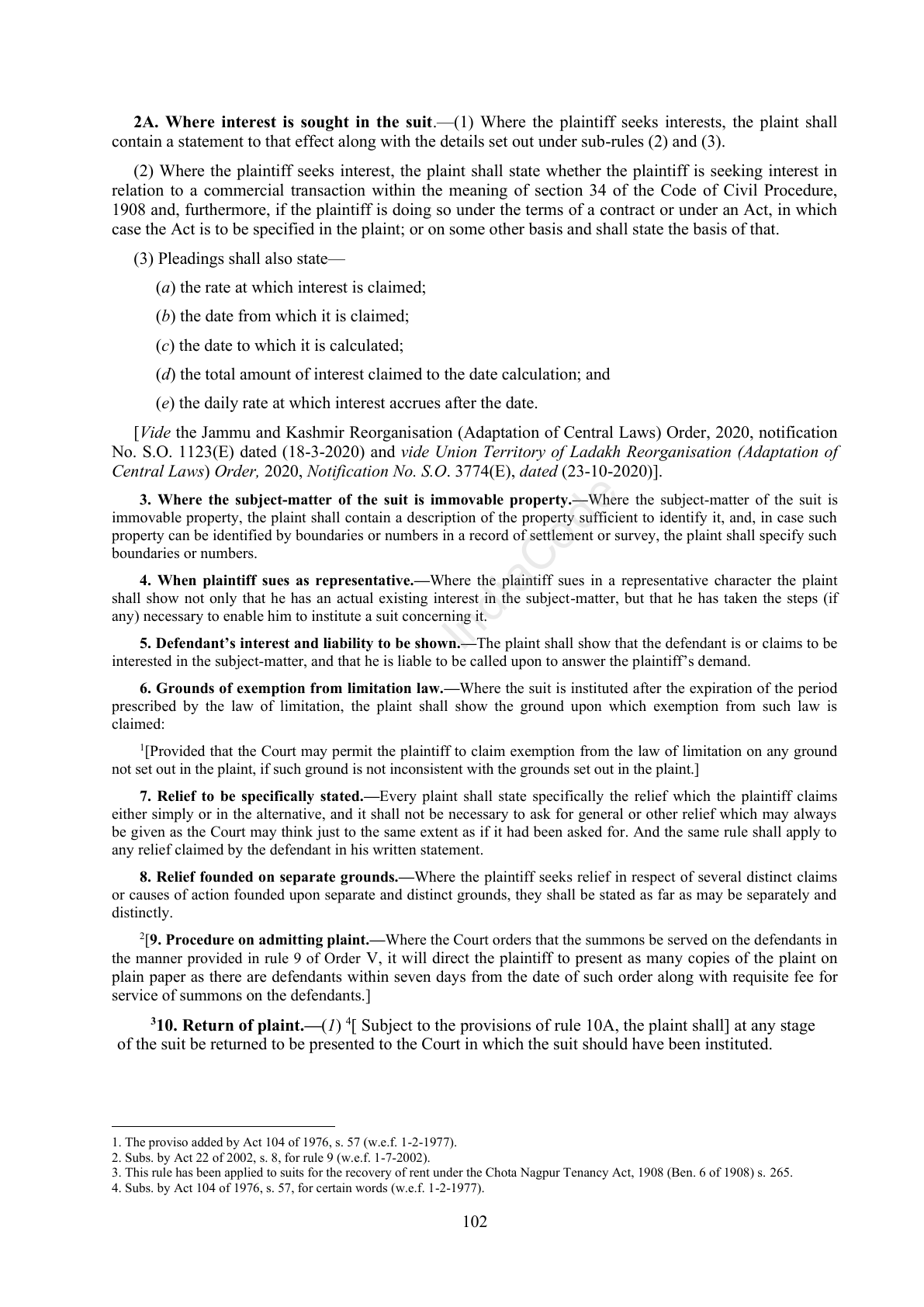
Full physical source page · unreviewed extraction
The Code of Civil Procedure, 1908: page 102
The Code of Civil Procedure, 1908, India Code delivered snapshot 393b8848fdfc476a, physical page 102, typed edition 77428589d4e341672ed6a3e5f663be7dec530c42d0600064ac1314302939267d. Unreviewed extraction.
Source: official India Code PDF · catalog record. Fetched 2026-10-19T23:06:46Z. SHA-256 393b8848fdfc476a21cc3abf4f0d3f510557e2dff6fc6914b1f379bea1730614.
Legal currency, territorial applicability and extraction fidelity are unverified. Catalog checksum/size differs from the delivered PDF; both identities are retained. Sections, state notes and footnotes share these physical pages. Compare the full original image.
Retained layout text
   2A. Where interest is sought in the suit.—(1) Where the plaintiff seeks interests, the plaint shall
contain a statement to that effect along with the details set out under sub-rules (2) and (3).
    (2) Where the plaintiff seeks interest, the plaint shall state whether the plaintiff is seeking interest in
relation to a commercial transaction within the meaning of section 34 of the Code of Civil Procedure,
1908 and, furthermore, if the plaintiff is doing so under the terms of a contract or under an Act, in which
case the Act is to be specified in the plaint; or on some other basis and shall state the basis of that.
    (3) Pleadings shall also state—
         (a) the rate at which interest is claimed;
         (b) the date from which it is claimed;
         (c) the date to which it is calculated;
         (d) the total amount of interest claimed to the date calculation; and
         (e) the daily rate at which interest accrues after the date.
  [Vide the Jammu and Kashmir Reorganisation (Adaptation of Central Laws) Order, 2020, notification
No. S.O. 1123(E) dated (18-3-2020) and vide Union Territory of Ladakh Reorganisation (Adaptation of
Central Laws) Order, 2020, Notification No. S.O. 3774(E), dated (23-10-2020)].
    3. Where the subject-matter of the suit is immovable property.—Where the subject-matter of the suit is
                                                                                      e
immovable property, the plaint shall contain a description of the property sufficient to identify it, and, in case such
                                                                               od
property can be identified by boundaries or numbers in a record of settlement or survey, the plaint shall specify such
boundaries or numbers.
                                                                       aC
     4. When plaintiff sues as representative.—Where the plaintiff sues in a representative character the plaint
shall show not only that he has an actual existing interest in the subject-matter, but that he has taken the steps (if
                                                                 di
any) necessary to enable him to institute a suit concerning it.
                                                           In
     5. Defendant’s interest and liability to be shown.—The plaint shall show that the defendant is or claims to be
interested in the subject-matter, and that he is liable to be called upon to answer the plaintiff’s demand.
    6. Grounds of exemption from limitation law.—Where the suit is instituted after the expiration of the period
prescribed by the law of limitation, the plaint shall show the ground upon which exemption from such law is
claimed:
     1
      [Provided that the Court may permit the plaintiff to claim exemption from the law of limitation on any ground
not set out in the plaint, if such ground is not inconsistent with the grounds set out in the plaint.]
     7. Relief to be specifically stated.—Every plaint shall state specifically the relief which the plaintiff claims
either simply or in the alternative, and it shall not be necessary to ask for general or other relief which may always
be given as the Court may think just to the same extent as if it had been asked for. And the same rule shall apply to
any relief claimed by the defendant in his written statement.
     8. Relief founded on separate grounds.—Where the plaintiff seeks relief in respect of several distinct claims
or causes of action founded upon separate and distinct grounds, they shall be stated as far as may be separately and
distinctly.
     2
     [9. Procedure on admitting plaint.—Where the Court orders that the summons be served on the defendants in
the manner provided in rule 9 of Order V, it will direct the plaintiff to present as many copies of the plaint on
plain paper as there are defendants within seven days from the date of such order along with requisite fee for
service of summons on the defendants.]
         3
       10. Return of plaint.—(1) 4[ Subject to the provisions of rule 10A, the plaint shall] at any stage
 of the suit be returned to be presented to the Court in which the suit should have been instituted.


1. The proviso added by Act 104 of 1976, s. 57 (w.e.f. 1-2-1977).
2. Subs. by Act 22 of 2002, s. 8, for rule 9 (w.e.f. 1-7-2002).
3. This rule has been applied to suits for the recovery of rent under the Chota Nagpur Tenancy Act, 1908 (Ben. 6 of 1908) s. 265.
4. Subs. by Act 104 of 1976, s. 57, for certain words (w.e.f. 1-2-1977).

                                                                  102
Compare original page image