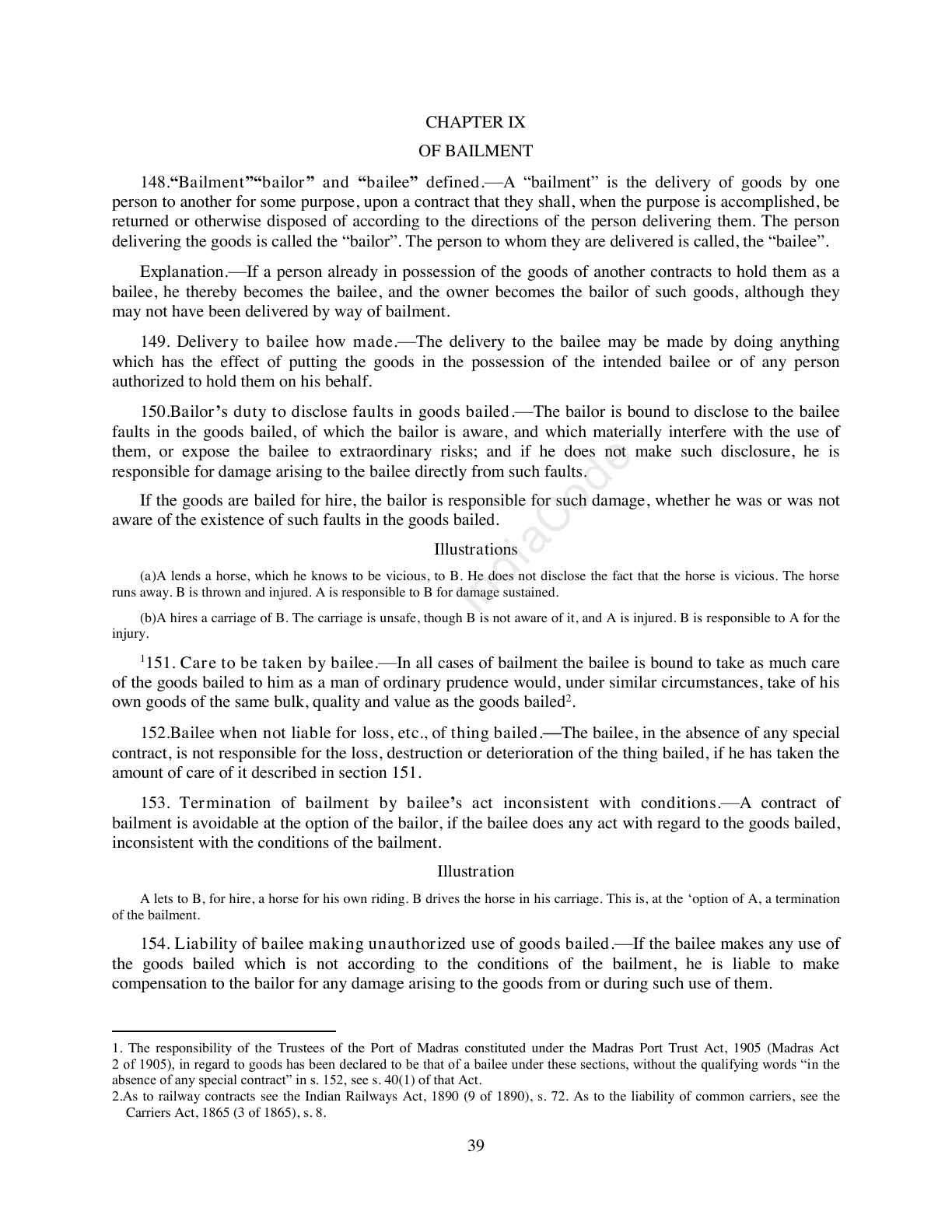
Full physical source page · unreviewed extraction
The Indian Contract Act, 1872: page 39
The Indian Contract Act, 1872, India Code delivered snapshot 85a7a066098255c9, physical page 39. Unreviewed extraction.
Source: official India Code PDF · catalog record. Fetched 2026-10-19T23:06:49Z. SHA-256 85a7a066098255c93001d678aeaf483f91d3080918363c03b78d40c3eeb8b386.
Legal currency, territorial applicability and extraction fidelity are unverified. Catalog checksum/size differs from the delivered PDF; both identities are retained. Sections, state notes and footnotes share these physical pages. Compare the full original image.
Retained layout text
                                                          CHAPTER IX
                                                        OF BAILMENT
    148.“Bailment”“bailor” and “bailee” defined.—A “bailment” is the delivery of goods by one
person to another for some purpose, upon a contract that they shall, when the purpose is accomplished, be
returned or otherwise disposed of according to the directions of the person delivering them. The person
delivering the goods is called the “bailor”. The person to whom they are delivered is called, the “bailee”.
    Explanation.—If a person already in possession of the goods of another contracts to hold them as a
bailee, he thereby becomes the bailee, and the owner becomes the bailor of such goods, although they
may not have been delivered by way of bailment.
    149. Delivery to bailee how made.—The delivery to the bailee may be made by doing anything
which has the effect of putting the goods in the possession of the intended bailee or of any person
authorized to hold them on his behalf.
    150.Bailor’s duty to disclose faults in goods bailed.—The bailor is bound to disclose to the bailee
faults in the goods bailed, of which the bailor is aware, and which materially interfere with the use of
them, or expose the bailee to extraordinary risks; and if he does not make such disclosure, he is
responsible for damage arising to the bailee directly from such faults.                e
                                                                               od
   If the goods are bailed for hire, the bailor is responsible for such damage, whether he was or was not
aware of the existence of such faults in the goods bailed.
                                                           Illustrations
                                                                        aC
                                                                  di
     (a)A lends a horse, which he knows to be vicious, to B. He does not disclose the fact that the horse is vicious. The horse
                                                             In
runs away. B is thrown and injured. A is responsible to B for damage sustained.
     (b)A hires a carriage of B. The carriage is unsafe, though B is not aware of it, and A is injured. B is responsible to A for the
injury.

     151. Care to be taken by bailee.—In all cases of bailment the bailee is bound to take as much care
     1

of the goods bailed to him as a man of ordinary prudence would, under similar circumstances, take of his
own goods of the same bulk, quality and value as the goods bailed2.
    152.Bailee when not liable for loss, etc., of thing bailed.—The bailee, in the absence of any special
contract, is not responsible for the loss, destruction or deterioration of the thing bailed, if he has taken the
amount of care of it described in section 151.
    153. Termination of bailment by bailee’s act inconsistent with conditions.—A contract of
bailment is avoidable at the option of the bailor, if the bailee does any act with regard to the goods bailed,
inconsistent with the conditions of the bailment.
                                                            Illustration
     A lets to B, for hire, a horse for his own riding. B drives the horse in his carriage. This is, at the ‘option of A, a termination
of the bailment.

    154. Liability of bailee making unauthorized use of goods bailed.—If the bailee makes any use of
the goods bailed which is not according to the conditions of the bailment, he is liable to make
compensation to the bailor for any damage arising to the goods from or during such use of them.


1. The responsibility of the Trustees of the Port of Madras constituted under the Madras Port Trust Act, 1905 (Madras Act
2 of 1905), in regard to goods has been declared to be that of a bailee under these sections, without the qualifying words “in the
absence of any special contract” in s. 152, see s. 40(1) of that Act.
2.As to railway contracts see the Indian Railways Act, 1890 (9 of 1890), s. 72. As to the liability of common carriers, see the
   Carriers Act, 1865 (3 of 1865), s. 8.

                                                                 39
Compare original page image