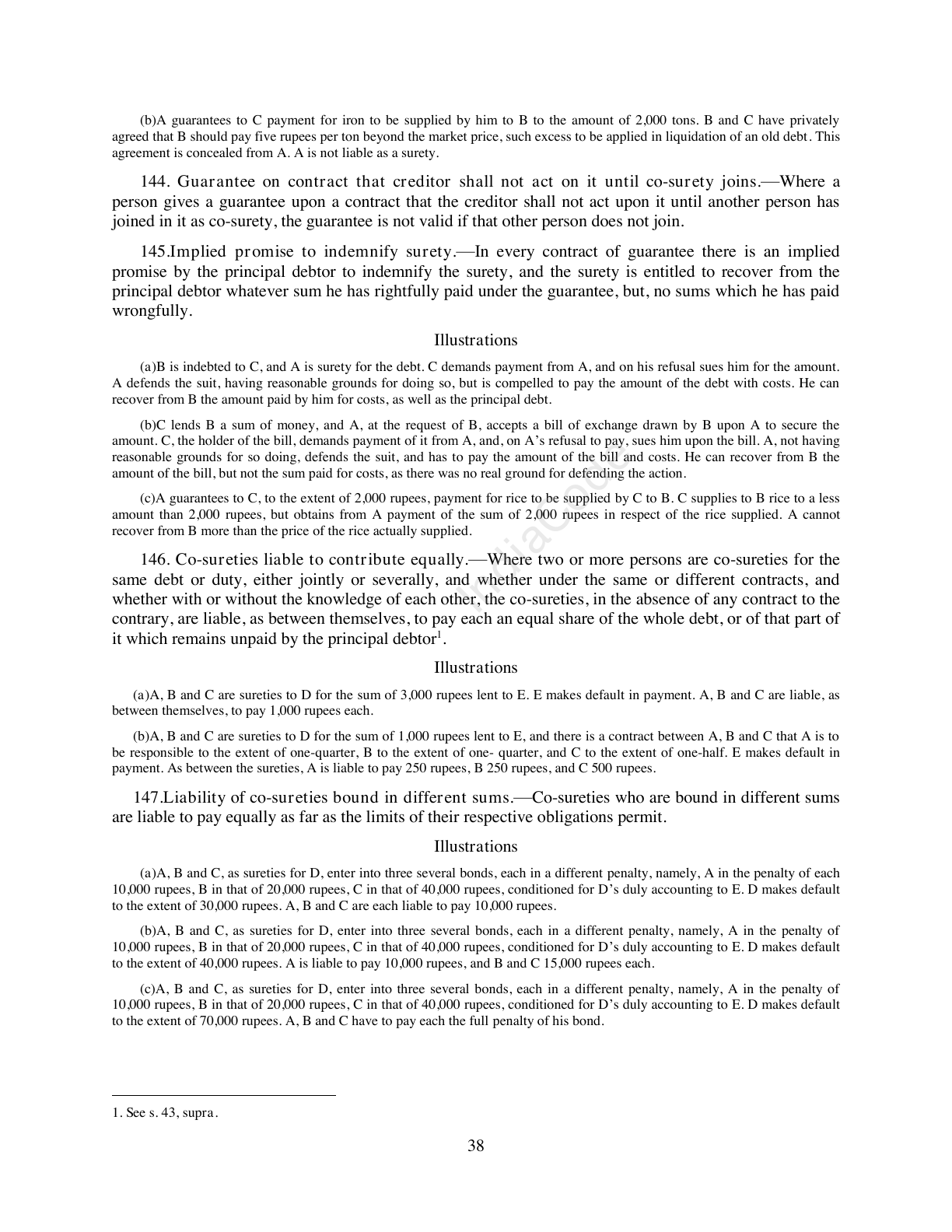
Full physical source page · unreviewed extraction
The Indian Contract Act, 1872: page 38
The Indian Contract Act, 1872, India Code delivered snapshot 85a7a066098255c9, physical page 38. Unreviewed extraction.
Source: official India Code PDF · catalog record. Fetched 2026-10-19T23:06:49Z. SHA-256 85a7a066098255c93001d678aeaf483f91d3080918363c03b78d40c3eeb8b386.
Legal currency, territorial applicability and extraction fidelity are unverified. Catalog checksum/size differs from the delivered PDF; both identities are retained. Sections, state notes and footnotes share these physical pages. Compare the full original image.
Retained layout text
     (b)A guarantees to C payment for iron to be supplied by him to B to the amount of 2,000 tons. B and C have privately
agreed that B should pay five rupees per ton beyond the market price, such excess to be applied in liquidation of an old debt. This
agreement is concealed from A. A is not liable as a surety.

    144. Guarantee on contract that creditor shall not act on it until co-surety joins.—Where a
person gives a guarantee upon a contract that the creditor shall not act upon it until another person has
joined in it as co-surety, the guarantee is not valid if that other person does not join.
    145.Implied promise to indemnify surety.—In every contract of guarantee there is an implied
promise by the principal debtor to indemnify the surety, and the surety is entitled to recover from the
principal debtor whatever sum he has rightfully paid under the guarantee, but, no sums which he has paid
wrongfully.
                                                          Illustrations
     (a)B is indebted to C, and A is surety for the debt. C demands payment from A, and on his refusal sues him for the amount.
A defends the suit, having reasonable grounds for doing so, but is compelled to pay the amount of the debt with costs. He can
recover from B the amount paid by him for costs, as well as the principal debt.
     (b)C lends B a sum of money, and A, at the request of B, accepts a bill of exchange drawn by B upon A to secure the
amount. C, the holder of the bill, demands payment of it from A, and, on A’s refusal to pay, sues him upon the bill. A, not having
reasonable grounds for so doing, defends the suit, and has to pay the amount of the bill and costs. He can recover from B the
                                                                                     e
amount of the bill, but not the sum paid for costs, as there was no real ground for defending the action.
                                                                              od
     (c)A guarantees to C, to the extent of 2,000 rupees, payment for rice to be supplied by C to B. C supplies to B rice to a less
amount than 2,000 rupees, but obtains from A payment of the sum of 2,000 rupees in respect of the rice supplied. A cannot
recover from B more than the price of the rice actually supplied.     aC
    146. Co-sureties liable to contribute equally.—Where two or more persons are co-sureties for the
                                                                 di
same debt or duty, either jointly or severally, and whether under the same or different contracts, and
                                                           In
whether with or without the knowledge of each other, the co-sureties, in the absence of any contract to the
contrary, are liable, as between themselves, to pay each an equal share of the whole debt, or of that part of
it which remains unpaid by the principal debtor1.
                                                          Illustrations
   (a)A, B and C are sureties to D for the sum of 3,000 rupees lent to E. E makes default in payment. A, B and C are liable, as
between themselves, to pay 1,000 rupees each.
    (b)A, B and C are sureties to D for the sum of 1,000 rupees lent to E, and there is a contract between A, B and C that A is to
be responsible to the extent of one-quarter, B to the extent of one- quarter, and C to the extent of one-half. E makes default in
payment. As between the sureties, A is liable to pay 250 rupees, B 250 rupees, and C 500 rupees.

   147.Liability of co-sureties bound in different sums.—Co-sureties who are bound in different sums
are liable to pay equally as far as the limits of their respective obligations permit.
                                                          Illustrations
     (a)A, B and C, as sureties for D, enter into three several bonds, each in a different penalty, namely, A in the penalty of each
10,000 rupees, B in that of 20,000 rupees, C in that of 40,000 rupees, conditioned for D’s duly accounting to E. D makes default
to the extent of 30,000 rupees. A, B and C are each liable to pay 10,000 rupees.
     (b)A, B and C, as sureties for D, enter into three several bonds, each in a different penalty, namely, A in the penalty of
10,000 rupees, B in that of 20,000 rupees, C in that of 40,000 rupees, conditioned for D’s duly accounting to E. D makes default
to the extent of 40,000 rupees. A is liable to pay 10,000 rupees, and B and C 15,000 rupees each.
     (c)A, B and C, as sureties for D, enter into three several bonds, each in a different penalty, namely, A in the penalty of
10,000 rupees, B in that of 20,000 rupees, C in that of 40,000 rupees, conditioned for D’s duly accounting to E. D makes default
to the extent of 70,000 rupees. A, B and C have to pay each the full penalty of his bond.


1. See s. 43, supra.

                                                                38
Compare original page image