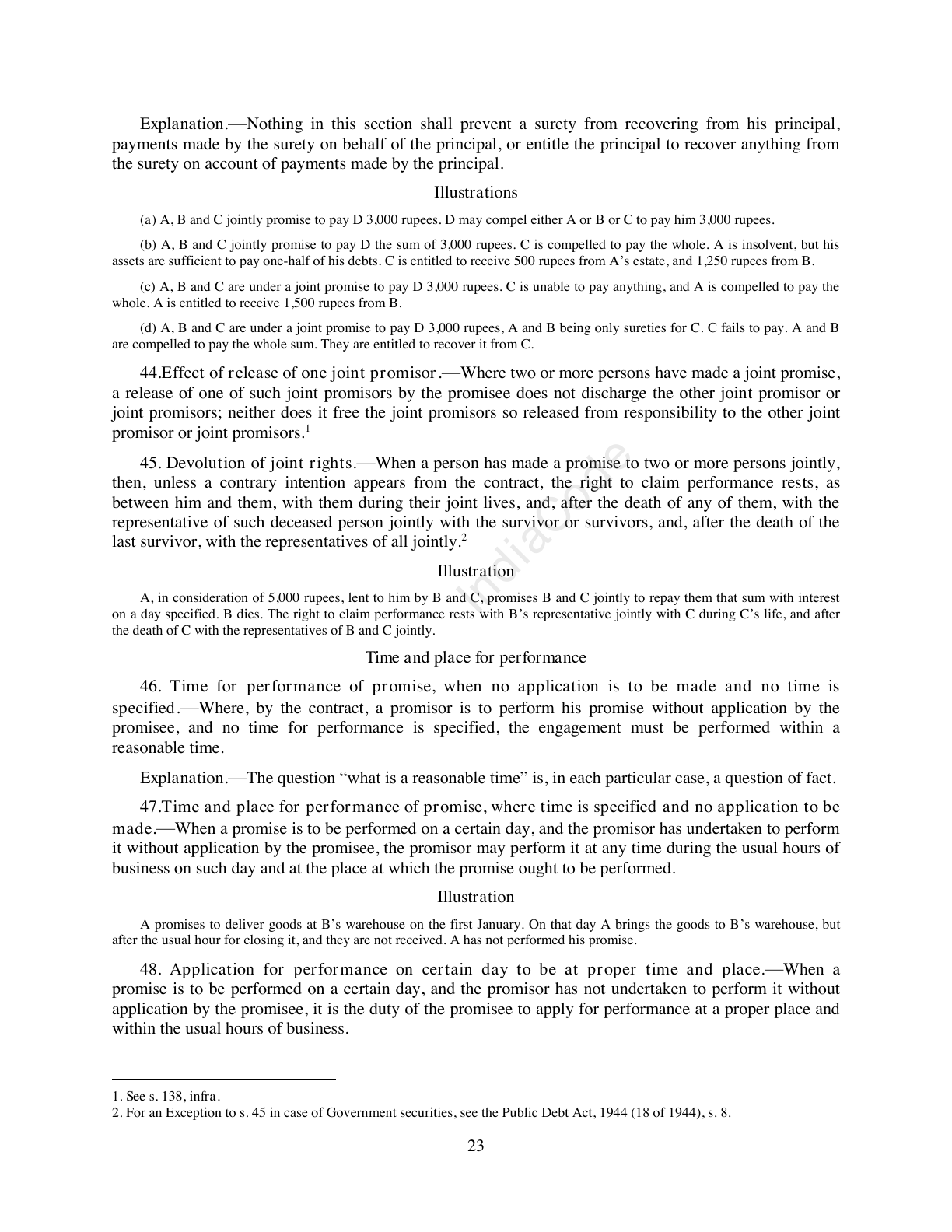
Full physical source page · unreviewed extraction
The Indian Contract Act, 1872: page 23
The Indian Contract Act, 1872, India Code delivered snapshot 85a7a066098255c9, physical page 23. Unreviewed extraction.
Source: official India Code PDF · catalog record. Fetched 2026-10-19T23:06:49Z. SHA-256 85a7a066098255c93001d678aeaf483f91d3080918363c03b78d40c3eeb8b386.
Legal currency, territorial applicability and extraction fidelity are unverified. Catalog checksum/size differs from the delivered PDF; both identities are retained. Sections, state notes and footnotes share these physical pages. Compare the full original image.
Retained layout text
    Explanation.—Nothing in this section shall prevent a surety from recovering from his principal,
payments made by the surety on behalf of the principal, or entitle the principal to recover anything from
the surety on account of payments made by the principal.
                                                          Illustrations
     (a) A, B and C jointly promise to pay D 3,000 rupees. D may compel either A or B or C to pay him 3,000 rupees.
     (b) A, B and C jointly promise to pay D the sum of 3,000 rupees. C is compelled to pay the whole. A is insolvent, but his
assets are sufficient to pay one-half of his debts. C is entitled to receive 500 rupees from A’s estate, and 1,250 rupees from B.
    (c) A, B and C are under a joint promise to pay D 3,000 rupees. C is unable to pay anything, and A is compelled to pay the
whole. A is entitled to receive 1,500 rupees from B.
     (d) A, B and C are under a joint promise to pay D 3,000 rupees, A and B being only sureties for C. C fails to pay. A and B
are compelled to pay the whole sum. They are entitled to recover it from C.

    44.Effect of release of one joint promisor.—Where two or more persons have made a joint promise,
a release of one of such joint promisors by the promisee does not discharge the other joint promisor or
joint promisors; neither does it free the joint promisors so released from responsibility to the other joint
promisor or joint promisors.1
     45. Devolution of joint rights.—When a person has made a promise to two or more persons jointly,
                                                                                     e
                                                                              od
then, unless a contrary intention appears from the contract, the right to claim performance rests, as
between him and them, with them during their joint lives, and, after the death of any of them, with the
                                                                      aC
representative of such deceased person jointly with the survivor or survivors, and, after the death of the
last survivor, with the representatives of all jointly.2
                                                                 di
                                                          Illustration
                                                           In
     A, in consideration of 5,000 rupees, lent to him by B and C, promises B and C jointly to repay them that sum with interest
on a day specified. B dies. The right to claim performance rests with B’s representative jointly with C during C’s life, and after
the death of C with the representatives of B and C jointly.

                                             Time and place for performance
    46. Time for performance of promise, when no application is to be made and no time is
specified.—Where, by the contract, a promisor is to perform his promise without application by the
promisee, and no time for performance is specified, the engagement must be performed within a
reasonable time.
     Explanation.—The question “what is a reasonable time” is, in each particular case, a question of fact.
    47.Time and place for performance of promise, where time is specified and no application to be
made.—When a promise is to be performed on a certain day, and the promisor has undertaken to perform
it without application by the promisee, the promisor may perform it at any time during the usual hours of
business on such day and at the place at which the promise ought to be performed.
                                                          Illustration
      A promises to deliver goods at B’s warehouse on the first January. On that day A brings the goods to B’s warehouse, but
after the usual hour for closing it, and they are not received. A has not performed his promise.

    48. Application for performance on certain day to be at proper time and place.—When a
promise is to be performed on a certain day, and the promisor has not undertaken to perform it without
application by the promisee, it is the duty of the promisee to apply for performance at a proper place and
within the usual hours of business.


1. See s. 138, infra.
2. For an Exception to s. 45 in case of Government securities, see the Public Debt Act, 1944 (18 of 1944), s. 8.

                                                                23
Compare original page image