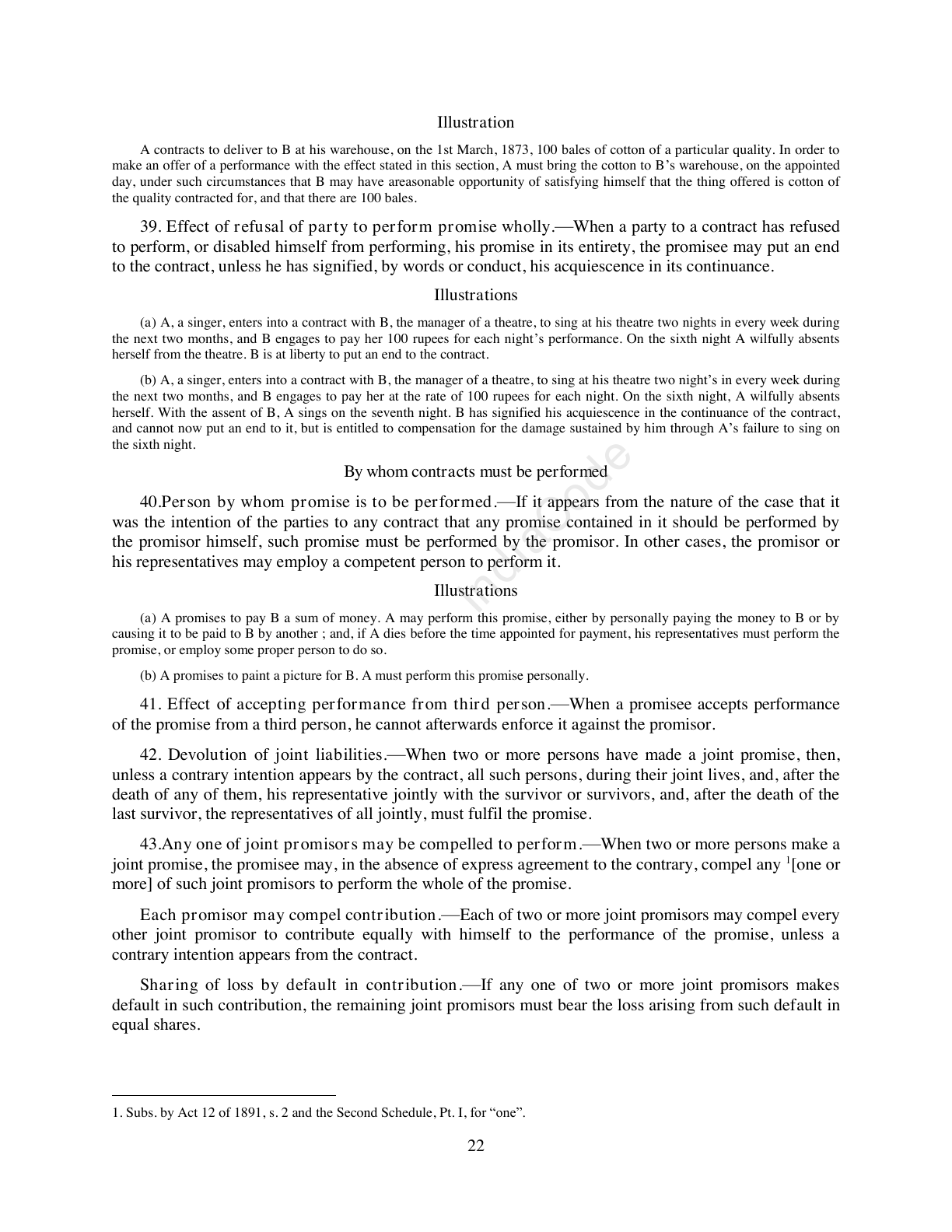
Full physical source page · unreviewed extraction
The Indian Contract Act, 1872: page 22
The Indian Contract Act, 1872, India Code delivered snapshot 85a7a066098255c9, physical page 22. Unreviewed extraction.
Source: official India Code PDF · catalog record. Fetched 2026-10-19T23:06:49Z. SHA-256 85a7a066098255c93001d678aeaf483f91d3080918363c03b78d40c3eeb8b386.
Legal currency, territorial applicability and extraction fidelity are unverified. Catalog checksum/size differs from the delivered PDF; both identities are retained. Sections, state notes and footnotes share these physical pages. Compare the full original image.
Retained layout text
                                                           Illustration
     A contracts to deliver to B at his warehouse, on the 1st March, 1873, 100 bales of cotton of a particular quality. In order to
make an offer of a performance with the effect stated in this section, A must bring the cotton to B’s warehouse, on the appointed
day, under such circumstances that B may have areasonable opportunity of satisfying himself that the thing offered is cotton of
the quality contracted for, and that there are 100 bales.

     39. Effect of refusal of party to perform promise wholly.—When a party to a contract has refused
to perform, or disabled himself from performing, his promise in its entirety, the promisee may put an end
to the contract, unless he has signified, by words or conduct, his acquiescence in its continuance.
                                                           Illustrations
     (a) A, a singer, enters into a contract with B, the manager of a theatre, to sing at his theatre two nights in every week during
the next two months, and B engages to pay her 100 rupees for each night’s performance. On the sixth night A wilfully absents
herself from the theatre. B is at liberty to put an end to the contract.
     (b) A, a singer, enters into a contract with B, the manager of a theatre, to sing at his theatre two night’s in every week during
the next two months, and B engages to pay her at the rate of 100 rupees for each night. On the sixth night, A wilfully absents
herself. With the assent of B, A sings on the seventh night. B has signified his acquiescence in the continuance of the contract,
and cannot now put an end to it, but is entitled to compensation for the damage sustained by him through A’s failure to sing on
the sixth night.

                                          By whom contracts must be performed         e
                                                                               od
     40.Person by whom promise is to be performed.—If it appears from the nature of the case that it
                                                                       aC
was the intention of the parties to any contract that any promise contained in it should be performed by
the promisor himself, such promise must be performed by the promisor. In other cases, the promisor or
his representatives may employ a competent person to perform it.  di
                                                           Illustrations
                                                            In
     (a) A promises to pay B a sum of money. A may perform this promise, either by personally paying the money to B or by
causing it to be paid to B by another ; and, if A dies before the time appointed for payment, his representatives must perform the
promise, or employ some proper person to do so.
     (b) A promises to paint a picture for B. A must perform this promise personally.

     41. Effect of accepting performance from third person.—When a promisee accepts performance
of the promise from a third person, he cannot afterwards enforce it against the promisor.
     42. Devolution of joint liabilities.—When two or more persons have made a joint promise, then,
unless a contrary intention appears by the contract, all such persons, during their joint lives, and, after the
death of any of them, his representative jointly with the survivor or survivors, and, after the death of the
last survivor, the representatives of all jointly, must fulfil the promise.
    43.Any one of joint promisors may be compelled to perform.—When two or more persons make a
joint promise, the promisee may, in the absence of express agreement to the contrary, compel any 1[one or
more] of such joint promisors to perform the whole of the promise.
    Each promisor may compel contribution.—Each of two or more joint promisors may compel every
other joint promisor to contribute equally with himself to the performance of the promise, unless a
contrary intention appears from the contract.
    Sharing of loss by default in contribution.—If any one of two or more joint promisors makes
default in such contribution, the remaining joint promisors must bear the loss arising from such default in
equal shares.


1. Subs. by Act 12 of 1891, s. 2 and the Second Schedule, Pt. I, for “one”.

                                                                 22
Compare original page image