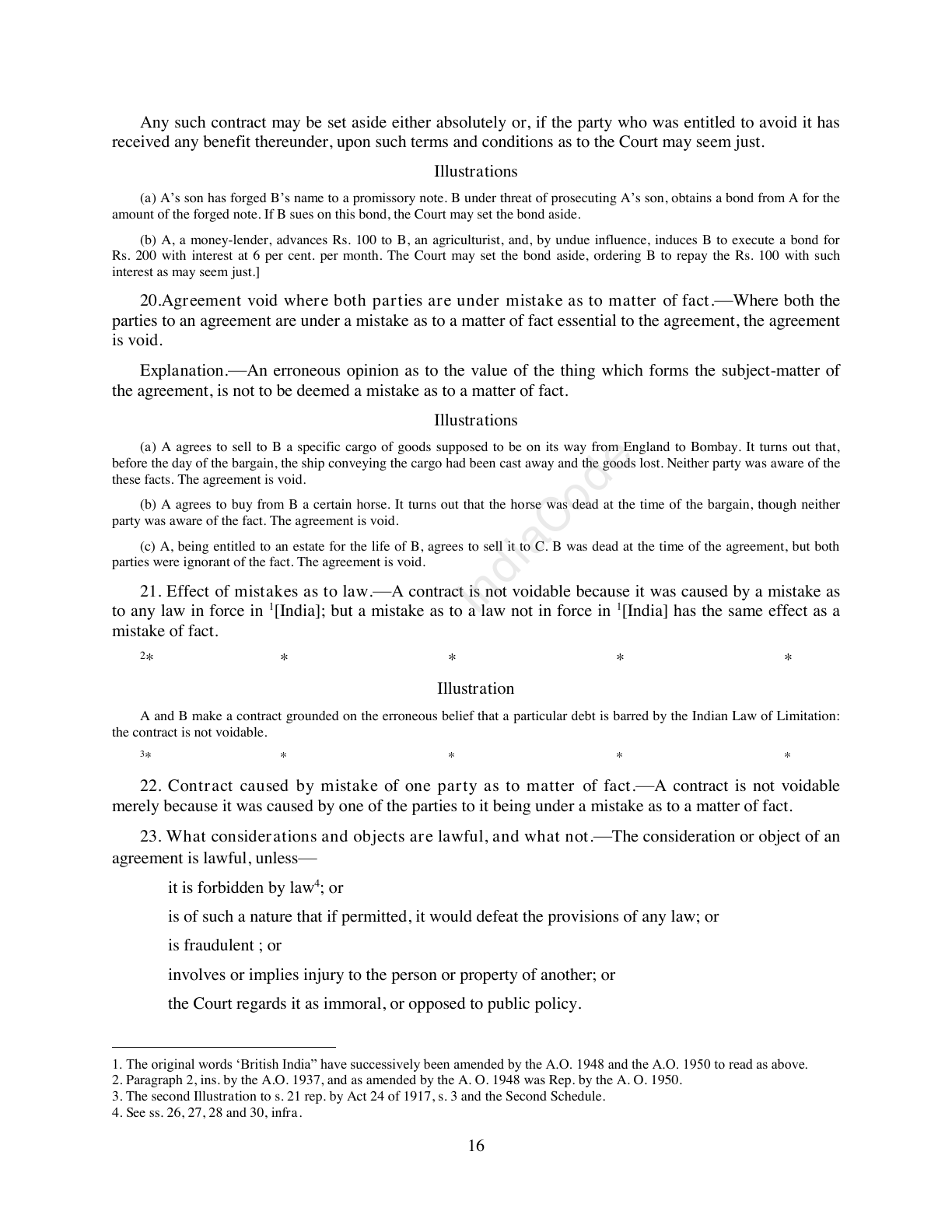
Full physical source page · unreviewed extraction
The Indian Contract Act, 1872: page 16
The Indian Contract Act, 1872, India Code delivered snapshot 85a7a066098255c9, physical page 16. Unreviewed extraction.
Source: official India Code PDF · catalog record. Fetched 2026-10-19T23:06:49Z. SHA-256 85a7a066098255c93001d678aeaf483f91d3080918363c03b78d40c3eeb8b386.
Legal currency, territorial applicability and extraction fidelity are unverified. Catalog checksum/size differs from the delivered PDF; both identities are retained. Sections, state notes and footnotes share these physical pages. Compare the full original image.
Retained layout text
    Any such contract may be set aside either absolutely or, if the party who was entitled to avoid it has
received any benefit thereunder, upon such terms and conditions as to the Court may seem just.
                                                          Illustrations
    (a) A’s son has forged B’s name to a promissory note. B under threat of prosecuting A’s son, obtains a bond from A for the
amount of the forged note. If B sues on this bond, the Court may set the bond aside.
     (b) A, a money-lender, advances Rs. 100 to B, an agriculturist, and, by undue influence, induces B to execute a bond for
Rs. 200 with interest at 6 per cent. per month. The Court may set the bond aside, ordering B to repay the Rs. 100 with such
interest as may seem just.]

    20.Agreement void where both parties are under mistake as to matter of fact.—Where both the
parties to an agreement are under a mistake as to a matter of fact essential to the agreement, the agreement
is void.
    Explanation.—An erroneous opinion as to the value of the thing which forms the subject-matter of
the agreement, is not to be deemed a mistake as to a matter of fact.
                                                          Illustrations
     (a) A agrees to sell to B a specific cargo of goods supposed to be on its way from England to Bombay. It turns out that,
                                                                                     e
before the day of the bargain, the ship conveying the cargo had been cast away and the goods lost. Neither party was aware of the
these facts. The agreement is void.
                                                                              od
     (b) A agrees to buy from B a certain horse. It turns out that the horse was dead at the time of the bargain, though neither
party was aware of the fact. The agreement is void.
                                                                      aC
     (c) A, being entitled to an estate for the life of B, agrees to sell it to C. B was dead at the time of the agreement, but both
parties were ignorant of the fact. The agreement is void.        di
    21. Effect of mistakes as to law.—A contract is not voidable because it was caused by a mistake as
                                                           In
to any law in force in 1[India]; but a mistake as to a law not in force in 1[India] has the same effect as a
mistake of fact.
     2
      *                       *                             *                              *                             *
                                                           Illustration
     A and B make a contract grounded on the erroneous belief that a particular debt is barred by the Indian Law of Limitation:
the contract is not voidable.
     3*                       *                             *                              *                             *

   22. Contract caused by mistake of one party as to matter of fact.—A contract is not voidable
merely because it was caused by one of the parties to it being under a mistake as to a matter of fact.
    23. What considerations and objects are lawful, and what not.—The consideration or object of an
agreement is lawful, unless—
          it is forbidden by law4; or
          is of such a nature that if permitted, it would defeat the provisions of any law; or
          is fraudulent ; or
          involves or implies injury to the person or property of another; or
          the Court regards it as immoral, or opposed to public policy.


1. The original words ‘British India” have successively been amended by the A.O. 1948 and the A.O. 1950 to read as above.
2. Paragraph 2, ins. by the A.O. 1937, and as amended by the A. O. 1948 was Rep. by the A. O. 1950.
3. The second Illustration to s. 21 rep. by Act 24 of 1917, s. 3 and the Second Schedule.
4. See ss. 26, 27, 28 and 30, infra.

                                                                16
Compare original page image