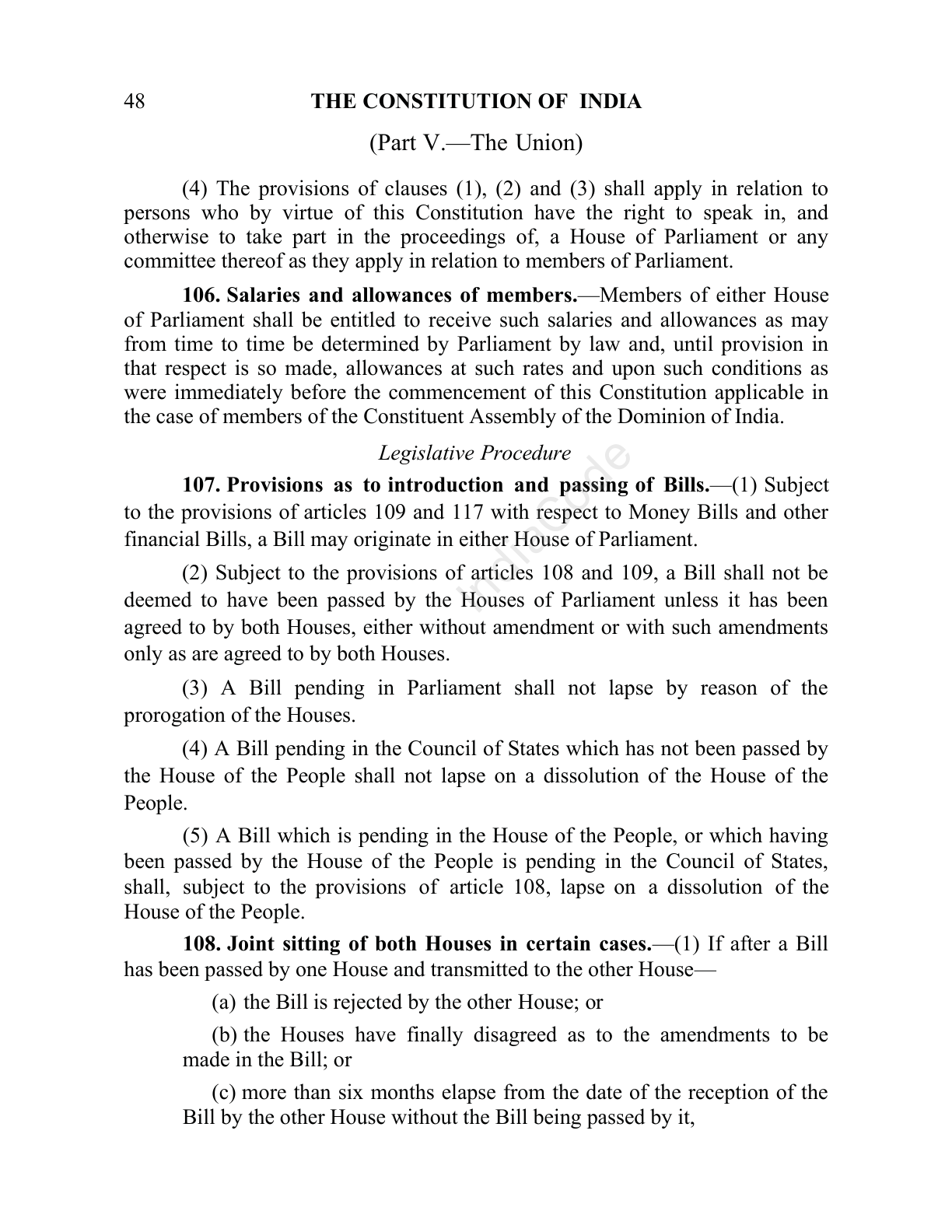
Full physical source page · unreviewed extraction
The Constitution of India in English 2026: page 79
The Constitution of India in English 2026, India Code delivered snapshot ed1820c0a1100c2c, physical page 79, typed edition 223d395df4de00897c78a4c0a752b32348d86f7c4f7013254fd4e03da46ceca0. Unreviewed extraction.
Source: official India Code PDF · catalog record. Fetched 2026-10-19T23:32:36Z. SHA-256 ed1820c0a1100c2c6aa8ece835a8c8a60f996ae7eba30cc1798233683c66cfba.
Legal currency, territorial applicability and extraction fidelity are unverified. Catalog checksum/size differs from the delivered PDF; both identities are retained. Articles, Schedule/appendix material and source footnotes share these physical pages. Compare the full original image.
Source cover/preface date: 10th September, 2026. Preface amendment statement: Constitution (One Hundred and Sixth Amendment) Act, 2023. Embedded PDF title: Constitution of India_ 20 MAY 2026 (final).pdf. These are distinct source labels, not currentness or commencement approval.
Retained layout text
48                   THE CONSTITUTION OF INDIA
                           (Part V.—The Union)
      (4) The provisions of clauses (1), (2) and (3) shall apply in relation to
persons who by virtue of this Constitution have the right to speak in, and
otherwise to take part in the proceedings of, a House of Parliament or any
committee thereof as they apply in relation to members of Parliament.
       106. Salaries and allowances of members.—Members of either House
of Parliament shall be entitled to receive such salaries and allowances as may
from time to time be determined by Parliament by law and, until provision in
that respect is so made, allowances at such rates and upon such conditions as
were immediately before the commencement of this Constitution applicable in
the case of members of the Constituent Assembly of the Dominion of India.
                               Legislative Proceduree
       107. Provisions as to introduction and passing of Bills.—(1) Subject
                                               od
to the provisions of articles 109 and 117 with respect to Money Bills and other
                                          aC
financial Bills, a Bill may originate in either House of Parliament.
                                       di
      (2) Subject to the provisions of articles 108 and 109, a Bill shall not be
                                    In
deemed to have been passed by the Houses of Parliament unless it has been
agreed to by both Houses, either without amendment or with such amendments
only as are agreed to by both Houses.
      (3) A Bill pending in Parliament shall not lapse by reason of the
prorogation of the Houses.
      (4) A Bill pending in the Council of States which has not been passed by
the House of the People shall not lapse on a dissolution of the House of the
People.
       (5) A Bill which is pending in the House of the People, or which having
been passed by the House of the People is pending in the Council of States,
shall, subject to the provisions of article 108, lapse on a dissolution of the
House of the People.
       108. Joint sitting of both Houses in certain cases.—(1) If after a Bill
has been passed by one House and transmitted to the other House—
           (a) the Bill is rejected by the other House; or
         (b) the Houses have finally disagreed as to the amendments to be
      made in the Bill; or
         (c) more than six months elapse from the date of the reception of the
      Bill by the other House without the Bill being passed by it,
Compare original page image