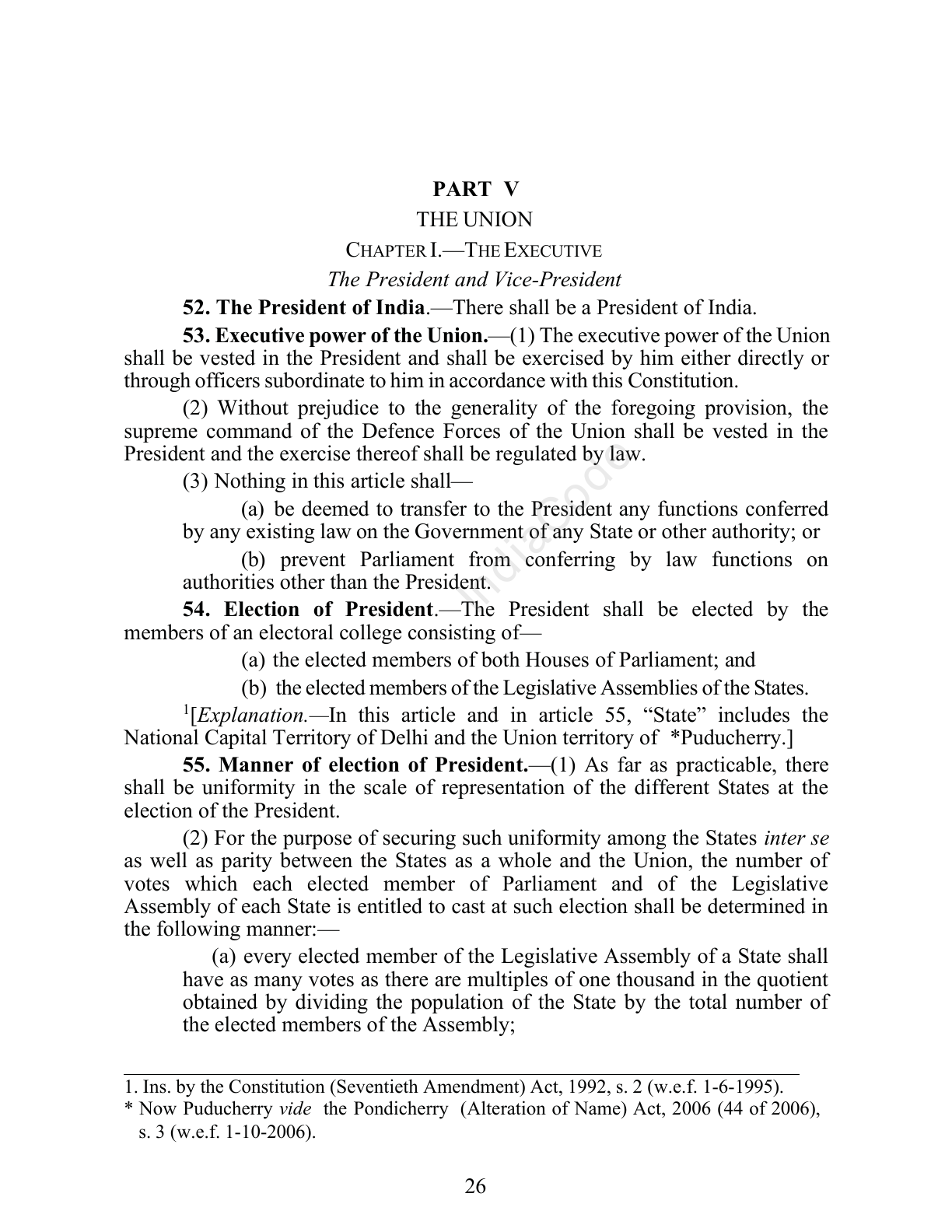
Full physical source page · unreviewed extraction
The Constitution of India in English 2026: page 57
The Constitution of India in English 2026, India Code delivered snapshot ed1820c0a1100c2c, physical page 57, typed edition 223d395df4de00897c78a4c0a752b32348d86f7c4f7013254fd4e03da46ceca0. Unreviewed extraction.
Source: official India Code PDF · catalog record. Fetched 2026-10-19T23:32:36Z. SHA-256 ed1820c0a1100c2c6aa8ece835a8c8a60f996ae7eba30cc1798233683c66cfba.
Legal currency, territorial applicability and extraction fidelity are unverified. Catalog checksum/size differs from the delivered PDF; both identities are retained. Articles, Schedule/appendix material and source footnotes share these physical pages. Compare the full original image.
Source cover/preface date: 10th September, 2026. Preface amendment statement: Constitution (One Hundred and Sixth Amendment) Act, 2023. Embedded PDF title: Constitution of India_ 20 MAY 2026 (final).pdf. These are distinct source labels, not currentness or commencement approval.
Retained layout text
                                     PART V
                                    THE UNION
                            CHAPTER I.—THE EXECUTIVE
                          The President and Vice-President
       52. The President of India.—There shall be a President of India.
       53. Executive power of the Union.—(1) The executive power of the Union
shall be vested in the President and shall be exercised by him either directly or
through officers subordinate to him in accordance with this Constitution.
       (2) Without prejudice to the generality of the foregoing provision, the
supreme command of the Defence Forces of the Union shall be vested in the
President and the exercise thereof shall be regulated by law.
                                                        e
       (3) Nothing in this article shall—          od
               (a) be deemed to transfer to the President any functions conferred
                                              aC
       by any existing law on the Government of any State or other authority; or
               (b) prevent Parliament from conferring by law functions on
                                          di
       authorities other than the President.
                                      In
       54. Election of President.—The President shall be elected by the
members of an electoral college consisting of—
               (a) the elected members of both Houses of Parliament; and
               (b) the elected members of the Legislative Assemblies of the States.
       1
         [Explanation.—In this article and in article 55, “State” includes the
National Capital Territory of Delhi and the Union territory of *Puducherry.]
       55. Manner of election of President.—(1) As far as practicable, there
shall be uniformity in the scale of representation of the different States at the
election of the President.
       (2) For the purpose of securing such uniformity among the States inter se
as well as parity between the States as a whole and the Union, the number of
votes which each elected member of Parliament and of the Legislative
Assembly of each State is entitled to cast at such election shall be determined in
the following manner:—
           (a) every elected member of the Legislative Assembly of a State shall
       have as many votes as there are multiples of one thousand in the quotient
       obtained by dividing the population of the State by the total number of
       the elected members of the Assembly;

1. Ins. by the Constitution (Seventieth Amendment) Act, 1992, s. 2 (w.e.f. 1-6-1995).
* Now Puducherry vide the Pondicherry (Alteration of Name) Act, 2006 (44 of 2006),
  s. 3 (w.e.f. 1-10-2006).

                                         26
Compare original page image