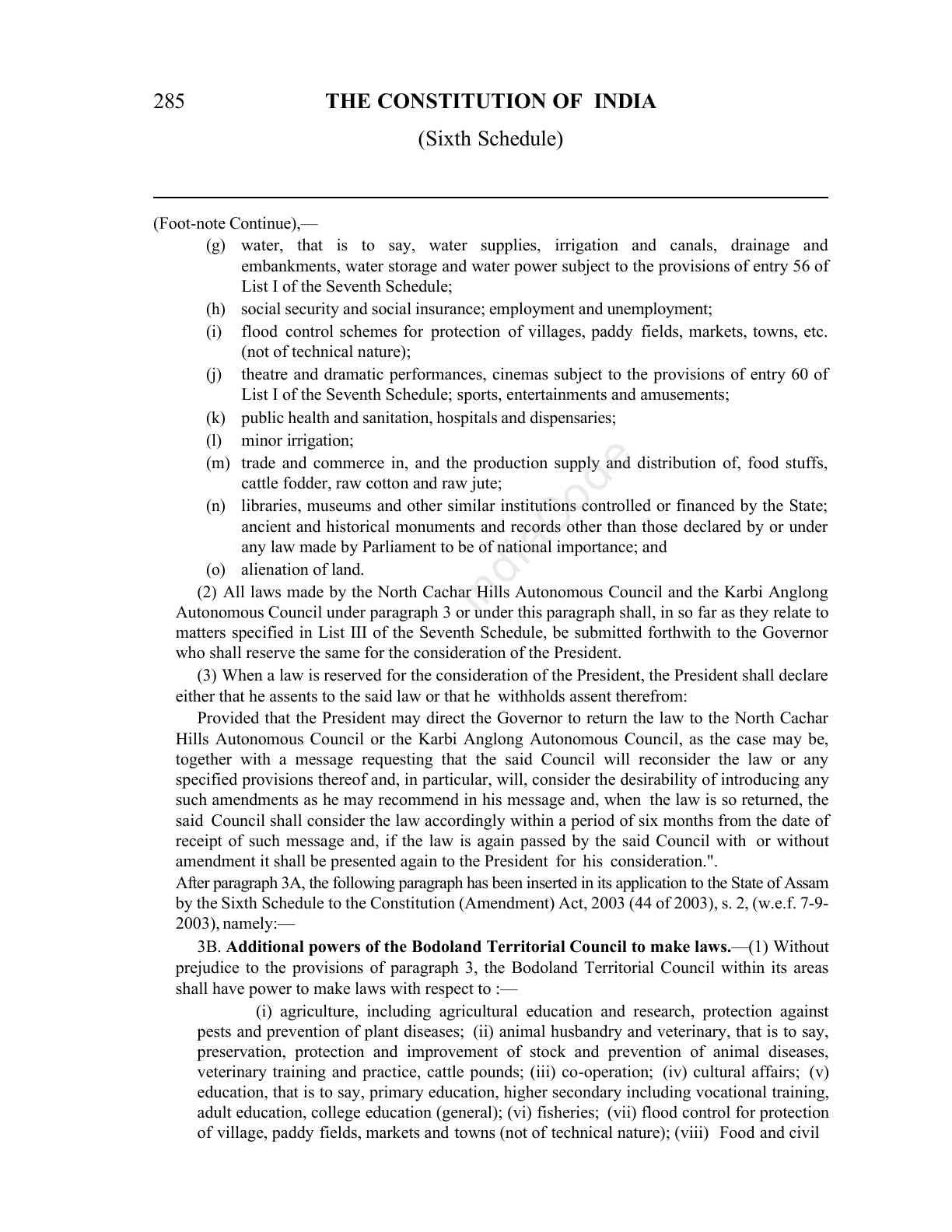
Full physical source page · unreviewed extraction
The Constitution of India in English 2026: page 316
The Constitution of India in English 2026, India Code delivered snapshot ed1820c0a1100c2c, physical page 316, typed edition 223d395df4de00897c78a4c0a752b32348d86f7c4f7013254fd4e03da46ceca0. Unreviewed extraction.
Source: official India Code PDF · catalog record. Fetched 2026-10-19T23:32:36Z. SHA-256 ed1820c0a1100c2c6aa8ece835a8c8a60f996ae7eba30cc1798233683c66cfba.
Legal currency, territorial applicability and extraction fidelity are unverified. Catalog checksum/size differs from the delivered PDF; both identities are retained. Articles, Schedule/appendix material and source footnotes share these physical pages. Compare the full original image.
Source cover/preface date: 10th September, 2026. Preface amendment statement: Constitution (One Hundred and Sixth Amendment) Act, 2023. Embedded PDF title: Constitution of India_ 20 MAY 2026 (final).pdf. These are distinct source labels, not currentness or commencement approval.
Retained layout text
285                       THE CONSTITUTION OF INDIA
                                         (Sixth Schedule)


(Foot-note Continue),—
        (g) water, that is to say, water supplies, irrigation and canals, drainage and
              embankments, water storage and water power subject to the provisions of entry 56 of
              List I of the Seventh Schedule;
        (h) social security and social insurance; employment and unemployment;
        (i) flood control schemes for protection of villages, paddy fields, markets, towns, etc.
              (not of technical nature);
        (j) theatre and dramatic performances, cinemas subject to the provisions of entry 60 of
              List I of the Seventh Schedule; sports, entertainments and amusements;
        (k) public health and sanitation, hospitals and dispensaries;
        (l) minor irrigation;
        (m) trade and commerce in, and the production supply and distribution of, food stuffs,
                                                                  e
              cattle fodder, raw cotton and raw jute;       od
        (n) libraries, museums and other similar institutions controlled or financed by the State;
                                                      aC
              ancient and historical monuments and records other than those declared by or under
              any law made by Parliament to be of national importance; and
        (o) alienation of land.                  di
       (2) All laws made by the North Cachar Hills Autonomous Council and the Karbi Anglong
                                            In
   Autonomous Council under paragraph 3 or under this paragraph shall, in so far as they relate to
   matters specified in List III of the Seventh Schedule, be submitted forthwith to the Governor
   who shall reserve the same for the consideration of the President.
       (3) When a law is reserved for the consideration of the President, the President shall declare
   either that he assents to the said law or that he withholds assent therefrom:
       Provided that the President may direct the Governor to return the law to the North Cachar
   Hills Autonomous Council or the Karbi Anglong Autonomous Council, as the case may be,
   together with a message requesting that the said Council will reconsider the law or any
   specified provisions thereof and, in particular, will, consider the desirability of introducing any
   such amendments as he may recommend in his message and, when the law is so returned, the
   said Council shall consider the law accordingly within a period of six months from the date of
   receipt of such message and, if the law is again passed by the said Council with or without
   amendment it shall be presented again to the President for his consideration.".
   After paragraph 3A, the following paragraph has been inserted in its application to the State of Assam
   by the Sixth Schedule to the Constitution (Amendment) Act, 2003 (44 of 2003), s. 2, (w.e.f. 7-9-
   2003), namely:—
       3B. Additional powers of the Bodoland Territorial Council to make laws.—(1) Without
   prejudice to the provisions of paragraph 3, the Bodoland Territorial Council within its areas
   shall have power to make laws with respect to :—
                (i) agriculture, including agricultural education and research, protection against
       pests and prevention of plant diseases; (ii) animal husbandry and veterinary, that is to say,
       preservation, protection and improvement of stock and prevention of animal diseases,
       veterinary training and practice, cattle pounds; (iii) co-operation; (iv) cultural affairs; (v)
       education, that is to say, primary education, higher secondary including vocational training,
       adult education, college education (general); (vi) fisheries; (vii) flood control for protection
       of village, paddy fields, markets and towns (not of technical nature); (viii) Food and civil
Compare original page image