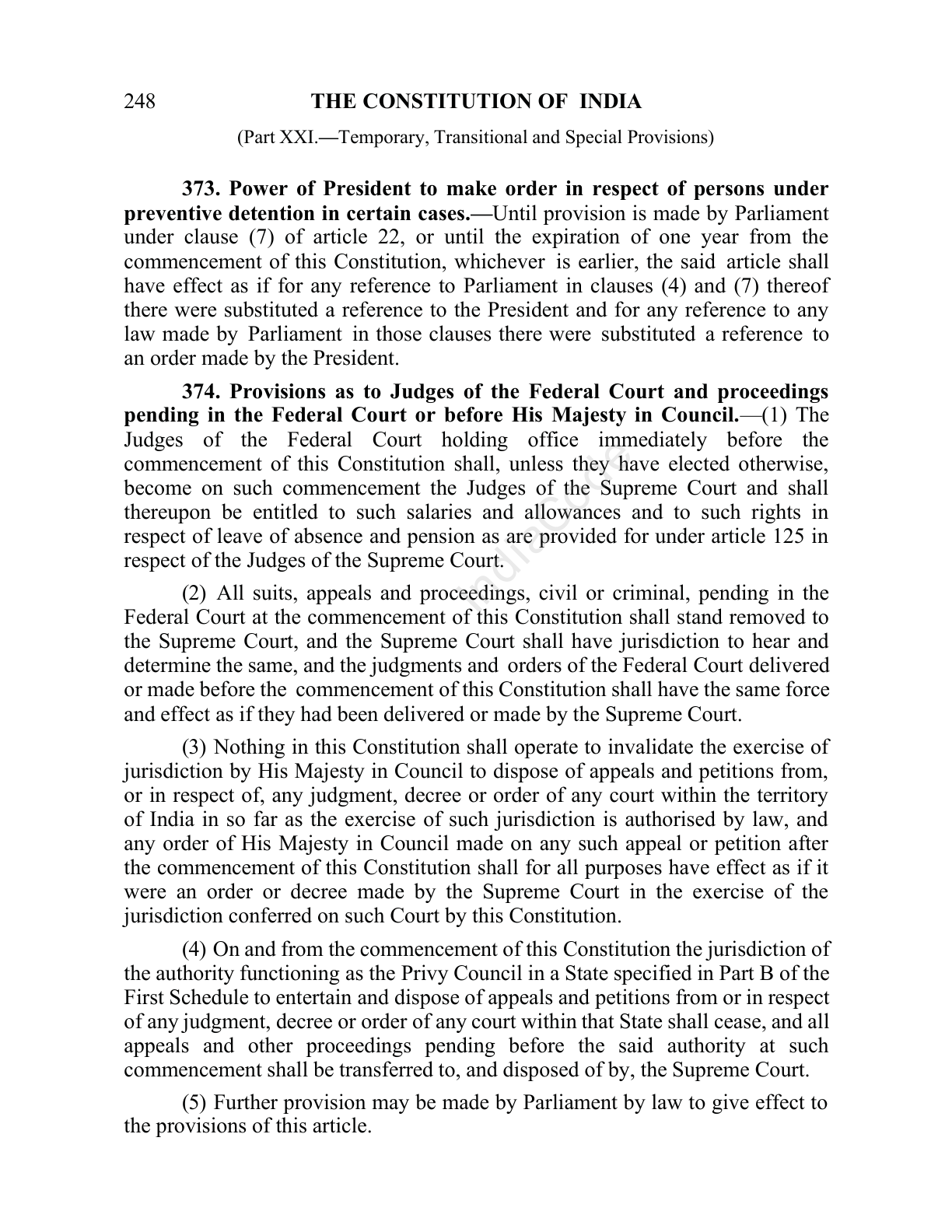
Full physical source page · unreviewed extraction
The Constitution of India in English 2026: page 279
The Constitution of India in English 2026, India Code delivered snapshot ed1820c0a1100c2c, physical page 279, typed edition 223d395df4de00897c78a4c0a752b32348d86f7c4f7013254fd4e03da46ceca0. Unreviewed extraction.
Source: official India Code PDF · catalog record. Fetched 2026-10-19T23:32:36Z. SHA-256 ed1820c0a1100c2c6aa8ece835a8c8a60f996ae7eba30cc1798233683c66cfba.
Legal currency, territorial applicability and extraction fidelity are unverified. Catalog checksum/size differs from the delivered PDF; both identities are retained. Articles, Schedule/appendix material and source footnotes share these physical pages. Compare the full original image.
Source cover/preface date: 10th September, 2026. Preface amendment statement: Constitution (One Hundred and Sixth Amendment) Act, 2023. Embedded PDF title: Constitution of India_ 20 MAY 2026 (final).pdf. These are distinct source labels, not currentness or commencement approval.
Retained layout text
248                   THE CONSTITUTION OF INDIA
             (Part XXI.—Temporary, Transitional and Special Provisions)

      373. Power of President to make order in respect of persons under
preventive detention in certain cases.—Until provision is made by Parliament
under clause (7) of article 22, or until the expiration of one year from the
commencement of this Constitution, whichever is earlier, the said article shall
have effect as if for any reference to Parliament in clauses (4) and (7) thereof
there were substituted a reference to the President and for any reference to any
law made by Parliament in those clauses there were substituted a reference to
an order made by the President.
       374. Provisions as to Judges of the Federal Court and proceedings
pending in the Federal Court or before His Majesty in Council.—(1) The
Judges of the Federal Court holding office immediately before the
commencement of this Constitution shall, unless they have elected otherwise,
                                                       e
                                                  od
become on such commencement the Judges of the Supreme Court and shall
thereupon be entitled to such salaries and allowances and to such rights in
                                             aC
respect of leave of absence and pension as are provided for under article 125 in
respect of the Judges of the Supreme Court.
                                         di
       (2) All suits, appeals and proceedings, civil or criminal, pending in the
                                     In
Federal Court at the commencement of this Constitution shall stand removed to
the Supreme Court, and the Supreme Court shall have jurisdiction to hear and
determine the same, and the judgments and orders of the Federal Court delivered
or made before the commencement of this Constitution shall have the same force
and effect as if they had been delivered or made by the Supreme Court.
       (3) Nothing in this Constitution shall operate to invalidate the exercise of
jurisdiction by His Majesty in Council to dispose of appeals and petitions from,
or in respect of, any judgment, decree or order of any court within the territory
of India in so far as the exercise of such jurisdiction is authorised by law, and
any order of His Majesty in Council made on any such appeal or petition after
the commencement of this Constitution shall for all purposes have effect as if it
were an order or decree made by the Supreme Court in the exercise of the
jurisdiction conferred on such Court by this Constitution.
       (4) On and from the commencement of this Constitution the jurisdiction of
the authority functioning as the Privy Council in a State specified in Part B of the
First Schedule to entertain and dispose of appeals and petitions from or in respect
of any judgment, decree or order of any court within that State shall cease, and all
appeals and other proceedings pending before the said authority at such
commencement shall be transferred to, and disposed of by, the Supreme Court.
       (5) Further provision may be made by Parliament by law to give effect to
the provisions of this article.
Compare original page image