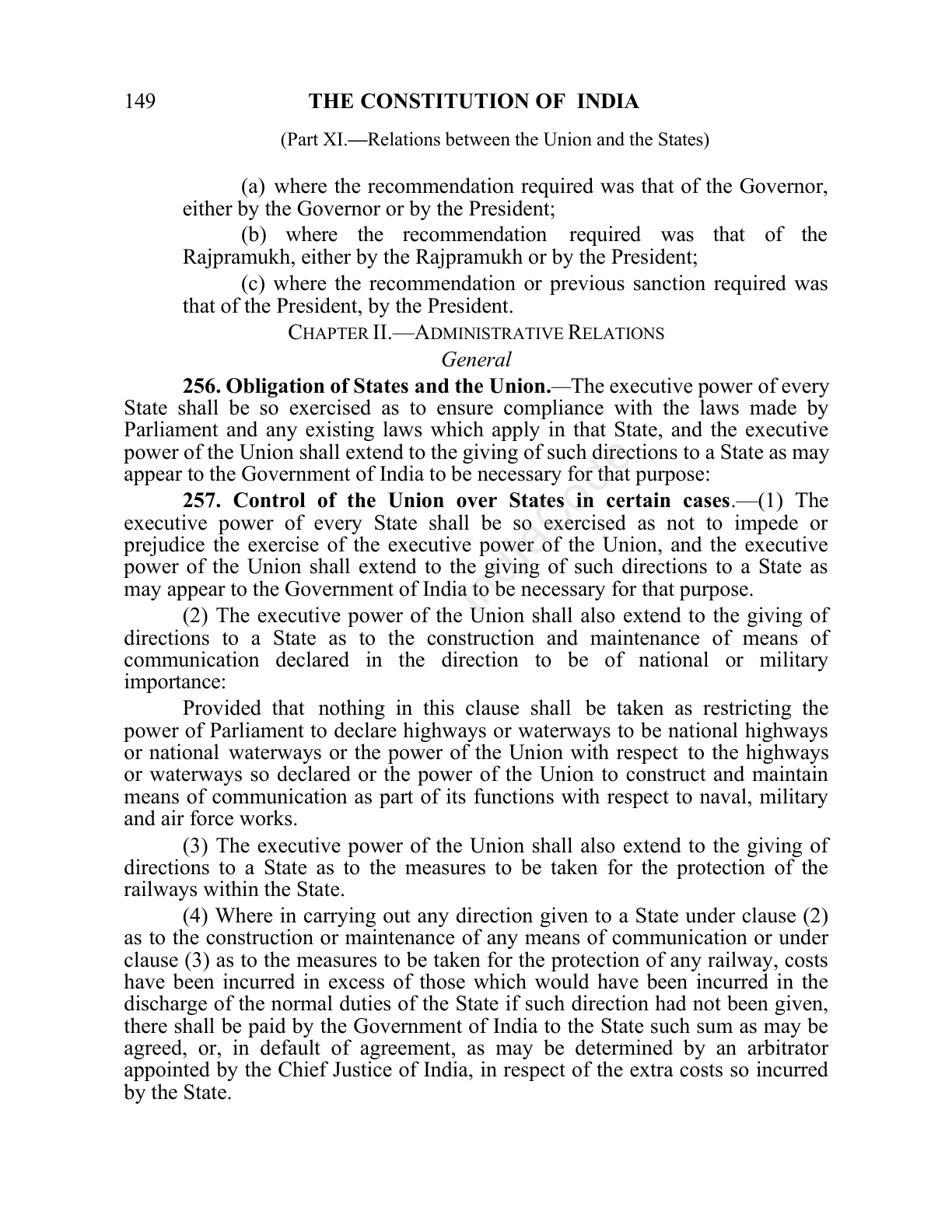
Full physical source page · unreviewed extraction
The Constitution of India in English 2026: page 180
The Constitution of India in English 2026, India Code delivered snapshot ed1820c0a1100c2c, physical page 180, typed edition 223d395df4de00897c78a4c0a752b32348d86f7c4f7013254fd4e03da46ceca0. Unreviewed extraction.
Source: official India Code PDF · catalog record. Fetched 2026-10-19T23:32:36Z. SHA-256 ed1820c0a1100c2c6aa8ece835a8c8a60f996ae7eba30cc1798233683c66cfba.
Legal currency, territorial applicability and extraction fidelity are unverified. Catalog checksum/size differs from the delivered PDF; both identities are retained. Articles, Schedule/appendix material and source footnotes share these physical pages. Compare the full original image.
Source cover/preface date: 10th September, 2026. Preface amendment statement: Constitution (One Hundred and Sixth Amendment) Act, 2023. Embedded PDF title: Constitution of India_ 20 MAY 2026 (final).pdf. These are distinct source labels, not currentness or commencement approval.
Retained layout text
149                  THE CONSTITUTION OF INDIA
                  (Part XI.—Relations between the Union and the States)

              (a) where the recommendation required was that of the Governor,
       either by the Governor or by the President;
              (b) where the recommendation required was that of the
       Rajpramukh, either by the Rajpramukh or by the President;
              (c) where the recommendation or previous sanction required was
       that of the President, by the President.
                    CHAPTER II.—ADMINISTRATIVE RELATIONS
                                      General
       256. Obligation of States and the Union.—The executive power of every
State shall be so exercised as to ensure compliance with the laws made by
Parliament and any existing laws which apply in that State, and the executive
power of the Union shall extend to the giving of such directions to a State as may
                                                       e
appear to the Government of India to be necessary for that purpose:
                                                  od
       257. Control of the Union over States in certain cases.—(1) The
executive power of every State shall be so exercised as not to impede or
                                             aC
prejudice the exercise of the executive power of the Union, and the executive
power of the Union shall extend to the giving of such directions to a State as
                                         di
may appear to the Government of India to be necessary for that purpose.
                                     In
       (2) The executive power of the Union shall also extend to the giving of
directions to a State as to the construction and maintenance of means of
communication declared in the direction to be of national or military
importance:
       Provided that nothing in this clause shall be taken as restricting the
power of Parliament to declare highways or waterways to be national highways
or national waterways or the power of the Union with respect to the highways
or waterways so declared or the power of the Union to construct and maintain
means of communication as part of its functions with respect to naval, military
and air force works.
       (3) The executive power of the Union shall also extend to the giving of
directions to a State as to the measures to be taken for the protection of the
railways within the State.
       (4) Where in carrying out any direction given to a State under clause (2)
as to the construction or maintenance of any means of communication or under
clause (3) as to the measures to be taken for the protection of any railway, costs
have been incurred in excess of those which would have been incurred in the
discharge of the normal duties of the State if such direction had not been given,
there shall be paid by the Government of India to the State such sum as may be
agreed, or, in default of agreement, as may be determined by an arbitrator
appointed by the Chief Justice of India, in respect of the extra costs so incurred
by the State.
Compare original page image