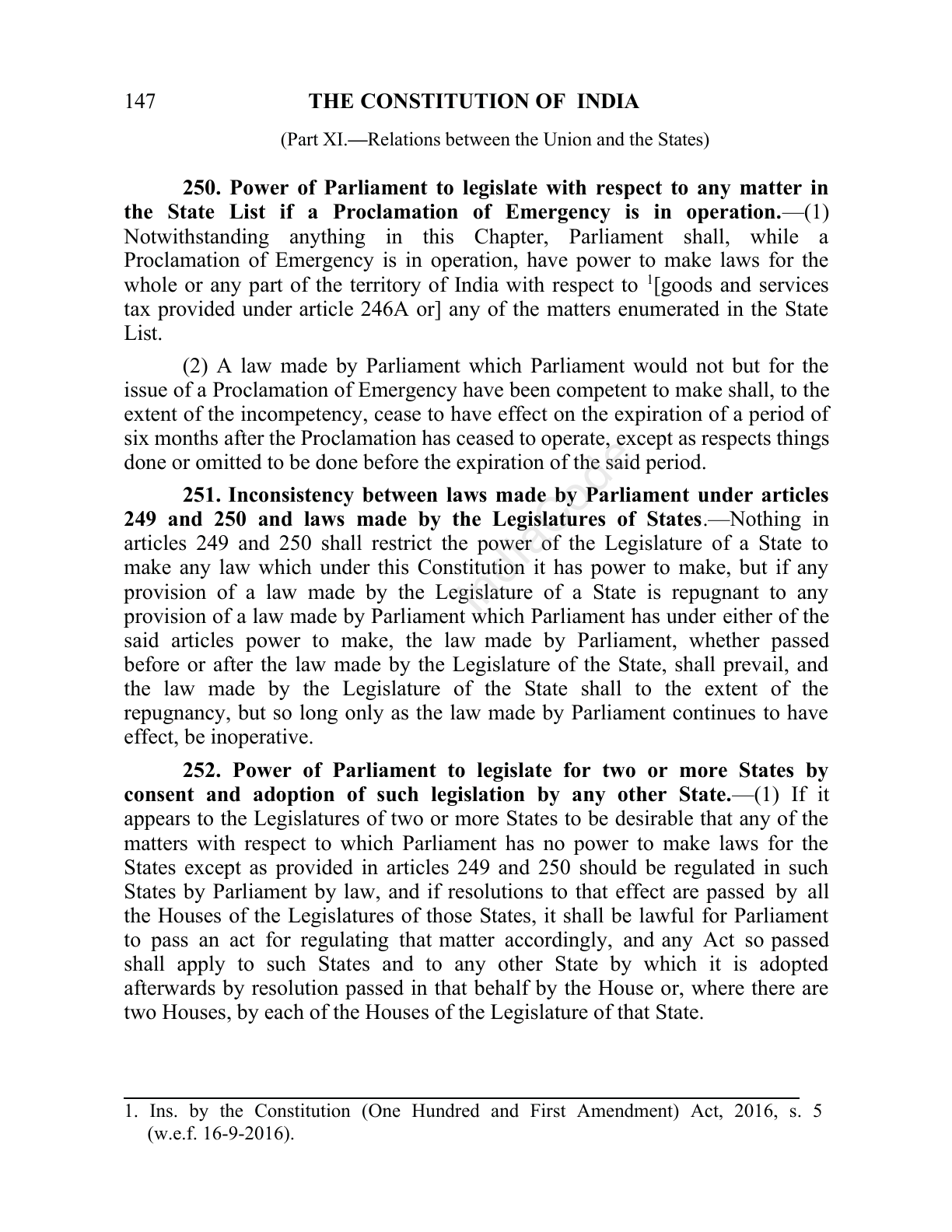
Full physical source page · unreviewed extraction
The Constitution of India in English 2026: page 178
The Constitution of India in English 2026, India Code delivered snapshot ed1820c0a1100c2c, physical page 178, typed edition 223d395df4de00897c78a4c0a752b32348d86f7c4f7013254fd4e03da46ceca0. Unreviewed extraction.
Source: official India Code PDF · catalog record. Fetched 2026-10-19T23:32:36Z. SHA-256 ed1820c0a1100c2c6aa8ece835a8c8a60f996ae7eba30cc1798233683c66cfba.
Legal currency, territorial applicability and extraction fidelity are unverified. Catalog checksum/size differs from the delivered PDF; both identities are retained. Articles, Schedule/appendix material and source footnotes share these physical pages. Compare the full original image.
Source cover/preface date: 10th September, 2026. Preface amendment statement: Constitution (One Hundred and Sixth Amendment) Act, 2023. Embedded PDF title: Constitution of India_ 20 MAY 2026 (final).pdf. These are distinct source labels, not currentness or commencement approval.
Retained layout text
147                  THE CONSTITUTION OF INDIA
                  (Part XI.—Relations between the Union and the States)

        250. Power of Parliament to legislate with respect to any matter in
the State List if a Proclamation of Emergency is in operation.—(1)
Notwithstanding anything in this Chapter, Parliament shall, while a
Proclamation of Emergency is in operation, have power to make laws for the
whole or any part of the territory of India with respect to 1[goods and services
tax provided under article 246A or] any of the matters enumerated in the State
List.
        (2) A law made by Parliament which Parliament would not but for the
issue of a Proclamation of Emergency have been competent to make shall, to the
extent of the incompetency, cease to have effect on the expiration of a period of
six months after the Proclamation has ceased to operate, except as respects things
done or omitted to be done before the expiration of the said period.
                                                       e
                                                  od
        251. Inconsistency between laws made by Parliament under articles
249 and 250 and laws made by the Legislatures of States.—Nothing in
                                             aC
articles 249 and 250 shall restrict the power of the Legislature of a State to
make any law which under this Constitution it has power to make, but if any
                                         di
provision of a law made by the Legislature of a State is repugnant to any
                                     In
provision of a law made by Parliament which Parliament has under either of the
said articles power to make, the law made by Parliament, whether passed
before or after the law made by the Legislature of the State, shall prevail, and
the law made by the Legislature of the State shall to the extent of the
repugnancy, but so long only as the law made by Parliament continues to have
effect, be inoperative.
       252. Power of Parliament to legislate for two or more States by
consent and adoption of such legislation by any other State.—(1) If it
appears to the Legislatures of two or more States to be desirable that any of the
matters with respect to which Parliament has no power to make laws for the
States except as provided in articles 249 and 250 should be regulated in such
States by Parliament by law, and if resolutions to that effect are passed by all
the Houses of the Legislatures of those States, it shall be lawful for Parliament
to pass an act for regulating that matter accordingly, and any Act so passed
shall apply to such States and to any other State by which it is adopted
afterwards by resolution passed in that behalf by the House or, where there are
two Houses, by each of the Houses of the Legislature of that State.


1. Ins. by the Constitution (One Hundred and First Amendment) Act, 2016, s. 5
   (w.e.f. 16-9-2016).
Compare original page image