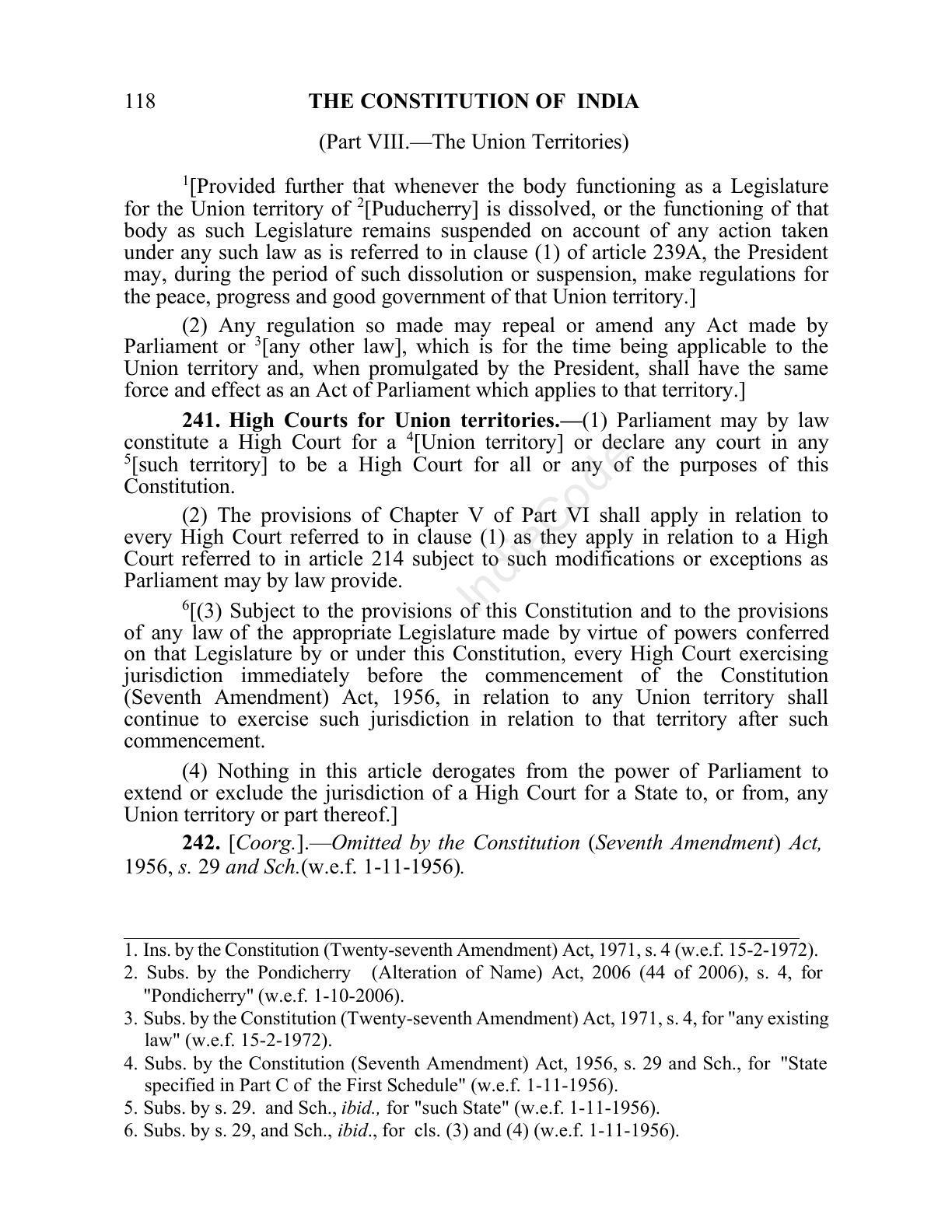
Full physical source page · unreviewed extraction
The Constitution of India in English 2026: page 149
The Constitution of India in English 2026, India Code delivered snapshot ed1820c0a1100c2c, physical page 149, typed edition 223d395df4de00897c78a4c0a752b32348d86f7c4f7013254fd4e03da46ceca0. Unreviewed extraction.
Source: official India Code PDF · catalog record. Fetched 2026-10-19T23:32:36Z. SHA-256 ed1820c0a1100c2c6aa8ece835a8c8a60f996ae7eba30cc1798233683c66cfba.
Legal currency, territorial applicability and extraction fidelity are unverified. Catalog checksum/size differs from the delivered PDF; both identities are retained. Articles, Schedule/appendix material and source footnotes share these physical pages. Compare the full original image.
Source cover/preface date: 10th September, 2026. Preface amendment statement: Constitution (One Hundred and Sixth Amendment) Act, 2023. Embedded PDF title: Constitution of India_ 20 MAY 2026 (final).pdf. These are distinct source labels, not currentness or commencement approval.
Retained layout text
118                    THE CONSTITUTION OF INDIA
                        (Part VIII.—The Union Territories)
       1
         [Provided further that whenever the body functioning as a Legislature
for the Union territory of 2[Puducherry] is dissolved, or the functioning of that
body as such Legislature remains suspended on account of any action taken
under any such law as is referred to in clause (1) of article 239A, the President
may, during the period of such dissolution or suspension, make regulations for
the peace, progress and good government of that Union territory.]
       (2) Any regulation so made may repeal or amend any Act made by
Parliament or 3[any other law], which is for the time being applicable to the
Union territory and, when promulgated by the President, shall have the same
force and effect as an Act of Parliament which applies to that territory.]
       241. High Courts for Union territories.—(1) Parliament may by law
constitute a High Court for a 4[Union territory] or declare any court in any
5
  [such territory] to be a High Court for all or any of the purposes of this
                                                          e
Constitution.                                        od
       (2) The provisions of Chapter V of Part VI shall apply in relation to
                                                aC
every High Court referred to in clause (1) as they apply in relation to a High
Court referred to in article 214 subject to such modifications or exceptions as
                                            di
Parliament may by law provide.
       6                                In
         [(3) Subject to the provisions of this Constitution and to the provisions
of any law of the appropriate Legislature made by virtue of powers conferred
on that Legislature by or under this Constitution, every High Court exercising
jurisdiction immediately before the commencement of the Constitution
(Seventh Amendment) Act, 1956, in relation to any Union territory shall
continue to exercise such jurisdiction in relation to that territory after such
commencement.
       (4) Nothing in this article derogates from the power of Parliament to
extend or exclude the jurisdiction of a High Court for a State to, or from, any
Union territory or part thereof.]
       242. [Coorg.].—Omitted by the Constitution (Seventh Amendment) Act,
1956, s. 29 and Sch.(w.e.f. 1-11-1956).


1. Ins. by the Constitution (Twenty-seventh Amendment) Act, 1971, s. 4 (w.e.f. 15-2-1972).
2. Subs. by the Pondicherry (Alteration of Name) Act, 2006 (44 of 2006), s. 4, for
   "Pondicherry" (w.e.f. 1-10-2006).
3. Subs. by the Constitution (Twenty-seventh Amendment) Act, 1971, s. 4, for "any existing
   law" (w.e.f. 15-2-1972).
4. Subs. by the Constitution (Seventh Amendment) Act, 1956, s. 29 and Sch., for "State
   specified in Part C of the First Schedule" (w.e.f. 1-11-1956).
5. Subs. by s. 29. and Sch., ibid., for "such State" (w.e.f. 1-11-1956).
6. Subs. by s. 29, and Sch., ibid., for cls. (3) and (4) (w.e.f. 1-11-1956).
Compare original page image