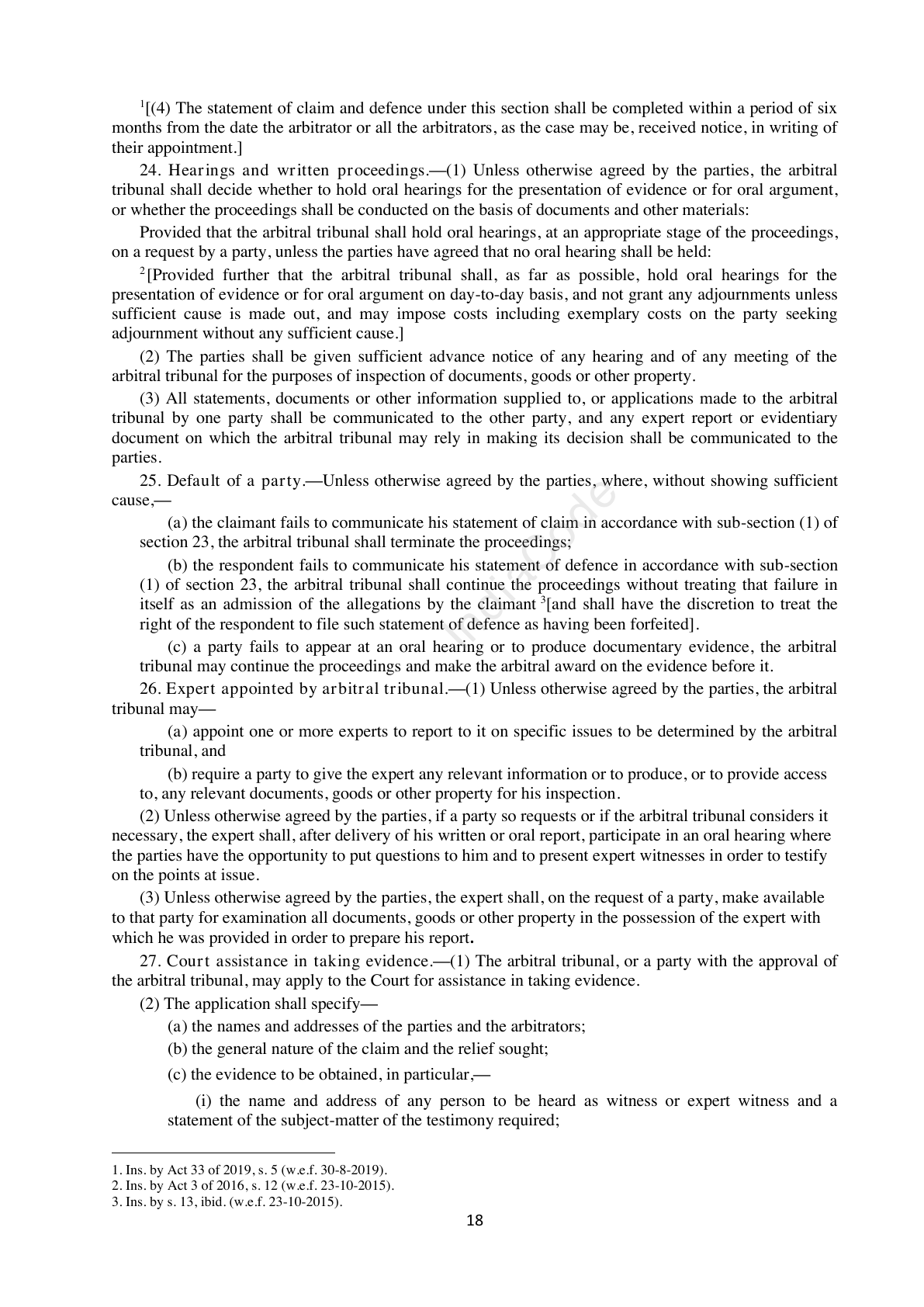
Full physical source page · unreviewed extraction
The Arbitration and Conciliation Act, 1996: page 18
The Arbitration and Conciliation Act, 1996, India Code delivered snapshot 6fb32e5ffe258174, physical page 18. Unreviewed extraction.
Source: official India Code PDF · catalog record. Fetched 2026-10-19T23:06:44Z. SHA-256 6fb32e5ffe2581740345d948c1e362bfbb5018ca7958932cde8ca92436485b6c.
Legal currency, territorial applicability and extraction fidelity are unverified. Catalog checksum/size differs from the delivered PDF; both identities are retained. Sections, state notes and footnotes share these physical pages. Compare the full original image.
Retained layout text
     1
       [(4) The statement of claim and defence under this section shall be completed within a period of six
months from the date the arbitrator or all the arbitrators, as the case may be, received notice, in writing of
their appointment.]
     24. Hearings and written proceedings.—(1) Unless otherwise agreed by the parties, the arbitral
tribunal shall decide whether to hold oral hearings for the presentation of evidence or for oral argument,
or whether the proceedings shall be conducted on the basis of documents and other materials:
     Provided that the arbitral tribunal shall hold oral hearings, at an appropriate stage of the proceedings,
on a request by a party, unless the parties have agreed that no oral hearing shall be held:
     2
       [Provided further that the arbitral tribunal shall, as far as possible, hold oral hearings for the
presentation of evidence or for oral argument on day-to-day basis, and not grant any adjournments unless
sufficient cause is made out, and may impose costs including exemplary costs on the party seeking
adjournment without any sufficient cause.]
     (2) The parties shall be given sufficient advance notice of any hearing and of any meeting of the
arbitral tribunal for the purposes of inspection of documents, goods or other property.
     (3) All statements, documents or other information supplied to, or applications made to the arbitral
tribunal by one party shall be communicated to the other party, and any expert report or evidentiary
document on which the arbitral tribunal may rely in making its decision shall be communicated to the
parties.
     25. Default of a party.—Unless otherwise agreed by the parties, where, without showing sufficient
cause,—                                                               e
                                                                od
          (a) the claimant fails to communicate his statement of claim in accordance with sub-section (1) of
     section 23, the arbitral tribunal shall terminate the proceedings;
                                                             aC
          (b) the respondent fails to communicate his statement of defence in accordance with sub-section
     (1) of section 23, the arbitral tribunal shall continue the proceedings without treating that failure in
                                                        di
     itself as an admission of the allegations by the claimant 3[and shall have the discretion to treat the
     right of the respondent to file such statement of defence as having been forfeited].
                                                       In
          (c) a party fails to appear at an oral hearing or to produce documentary evidence, the arbitral
     tribunal may continue the proceedings and make the arbitral award on the evidence before it.
     26. Expert appointed by arbitral tribunal.—(1) Unless otherwise agreed by the parties, the arbitral
tribunal may—
          (a) appoint one or more experts to report to it on specific issues to be determined by the arbitral
     tribunal, and
          (b) require a party to give the expert any relevant information or to produce, or to provide access
     to, any relevant documents, goods or other property for his inspection.
     (2) Unless otherwise agreed by the parties, if a party so requests or if the arbitral tribunal considers it
necessary, the expert shall, after delivery of his written or oral report, participate in an oral hearing where
the parties have the opportunity to put questions to him and to present expert witnesses in order to testify
on the points at issue.
     (3) Unless otherwise agreed by the parties, the expert shall, on the request of a party, make available
to that party for examination all documents, goods or other property in the possession of the expert with
which he was provided in order to prepare his report.
     27. Court assistance in taking evidence.—(1) The arbitral tribunal, or a party with the approval of
the arbitral tribunal, may apply to the Court for assistance in taking evidence.
     (2) The application shall specify—
          (a) the names and addresses of the parties and the arbitrators;
          (b) the general nature of the claim and the relief sought;
          (c) the evidence to be obtained, in particular,—
               (i) the name and address of any person to be heard as witness or expert witness and a
          statement of the subject-matter of the testimony required;

1. Ins. by Act 33 of 2019, s. 5 (w.e.f. 30-8-2019).
2. Ins. by Act 3 of 2016, s. 12 (w.e.f. 23-10-2015).
3. Ins. by s. 13, ibid. (w.e.f. 23-10-2015).
                                                        18
Compare original page image