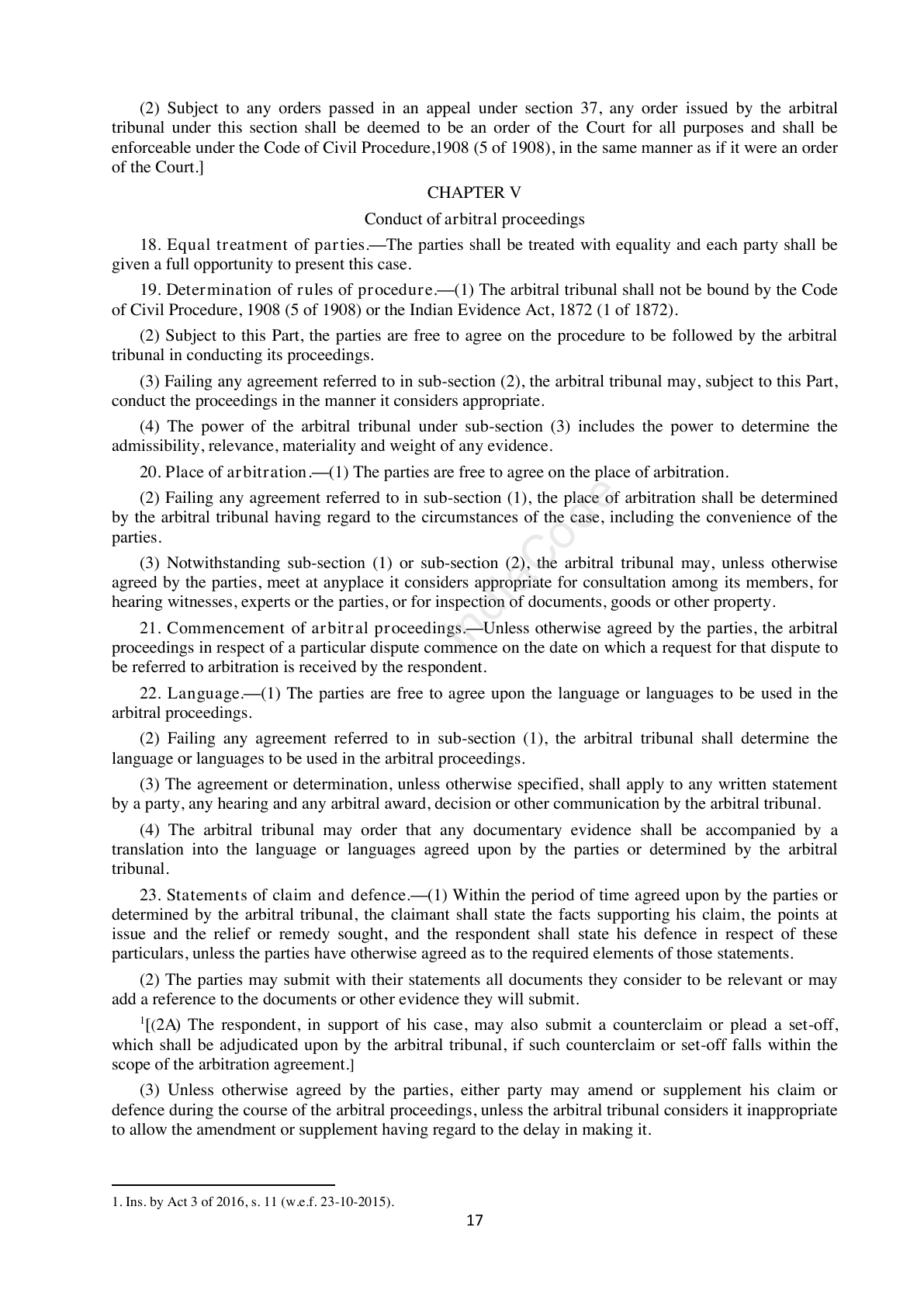
Full physical source page · unreviewed extraction
The Arbitration and Conciliation Act, 1996: page 17
The Arbitration and Conciliation Act, 1996, India Code delivered snapshot 6fb32e5ffe258174, physical page 17. Unreviewed extraction.
Source: official India Code PDF · catalog record. Fetched 2026-10-19T23:06:44Z. SHA-256 6fb32e5ffe2581740345d948c1e362bfbb5018ca7958932cde8ca92436485b6c.
Legal currency, territorial applicability and extraction fidelity are unverified. Catalog checksum/size differs from the delivered PDF; both identities are retained. Sections, state notes and footnotes share these physical pages. Compare the full original image.
Retained layout text
     (2) Subject to any orders passed in an appeal under section 37, any order issued by the arbitral
tribunal under this section shall be deemed to be an order of the Court for all purposes and shall be
enforceable under the Code of Civil Procedure,1908 (5 of 1908), in the same manner as if it were an order
of the Court.]
                                                       CHAPTER V
                                              Conduct of arbitral proceedings
    18. Equal treatment of parties.—The parties shall be treated with equality and each party shall be
given a full opportunity to present this case.
    19. Determination of rules of procedure.—(1) The arbitral tribunal shall not be bound by the Code
of Civil Procedure, 1908 (5 of 1908) or the Indian Evidence Act, 1872 (1 of 1872).
    (2) Subject to this Part, the parties are free to agree on the procedure to be followed by the arbitral
tribunal in conducting its proceedings.
   (3) Failing any agreement referred to in sub-section (2), the arbitral tribunal may, subject to this Part,
conduct the proceedings in the manner it considers appropriate.
   (4) The power of the arbitral tribunal under sub-section (3) includes the power to determine the
admissibility, relevance, materiality and weight of any evidence.
     20. Place of arbitration.—(1) The parties are free to agree on the place of arbitration.
    (2) Failing any agreement referred to in sub-section (1), the place of arbitration shall be determined
                                                                          e
by the arbitral tribunal having regard to the circumstances of the case, including the convenience of the
parties.
                                                                     od
                                                                 aC
    (3) Notwithstanding sub-section (1) or sub-section (2), the arbitral tribunal may, unless otherwise
agreed by the parties, meet at anyplace it considers appropriate for consultation among its members, for
                                                           di
hearing witnesses, experts or the parties, or for inspection of documents, goods or other property.
    21. Commencement of arbitral proceedings.—Unless otherwise agreed by the parties, the arbitral
                                                       In
proceedings in respect of a particular dispute commence on the date on which a request for that dispute to
be referred to arbitration is received by the respondent.
    22. Language.—(1) The parties are free to agree upon the language or languages to be used in the
arbitral proceedings.
    (2) Failing any agreement referred to in sub-section (1), the arbitral tribunal shall determine the
language or languages to be used in the arbitral proceedings.
    (3) The agreement or determination, unless otherwise specified, shall apply to any written statement
by a party, any hearing and any arbitral award, decision or other communication by the arbitral tribunal.
    (4) The arbitral tribunal may order that any documentary evidence shall be accompanied by a
translation into the language or languages agreed upon by the parties or determined by the arbitral
tribunal.
    23. Statements of claim and defence.—(1) Within the period of time agreed upon by the parties or
determined by the arbitral tribunal, the claimant shall state the facts supporting his claim, the points at
issue and the relief or remedy sought, and the respondent shall state his defence in respect of these
particulars, unless the parties have otherwise agreed as to the required elements of those statements.
    (2) The parties may submit with their statements all documents they consider to be relevant or may
add a reference to the documents or other evidence they will submit.
     1
    [(2A) The respondent, in support of his case, may also submit a counterclaim or plead a set-off,
which shall be adjudicated upon by the arbitral tribunal, if such counterclaim or set-off falls within the
scope of the arbitration agreement.]
     (3) Unless otherwise agreed by the parties, either party may amend or supplement his claim or
defence during the course of the arbitral proceedings, unless the arbitral tribunal considers it inappropriate
to allow the amendment or supplement having regard to the delay in making it.


1. Ins. by Act 3 of 2016, s. 11 (w.e.f. 23-10-2015).
                                                            17
Compare original page image