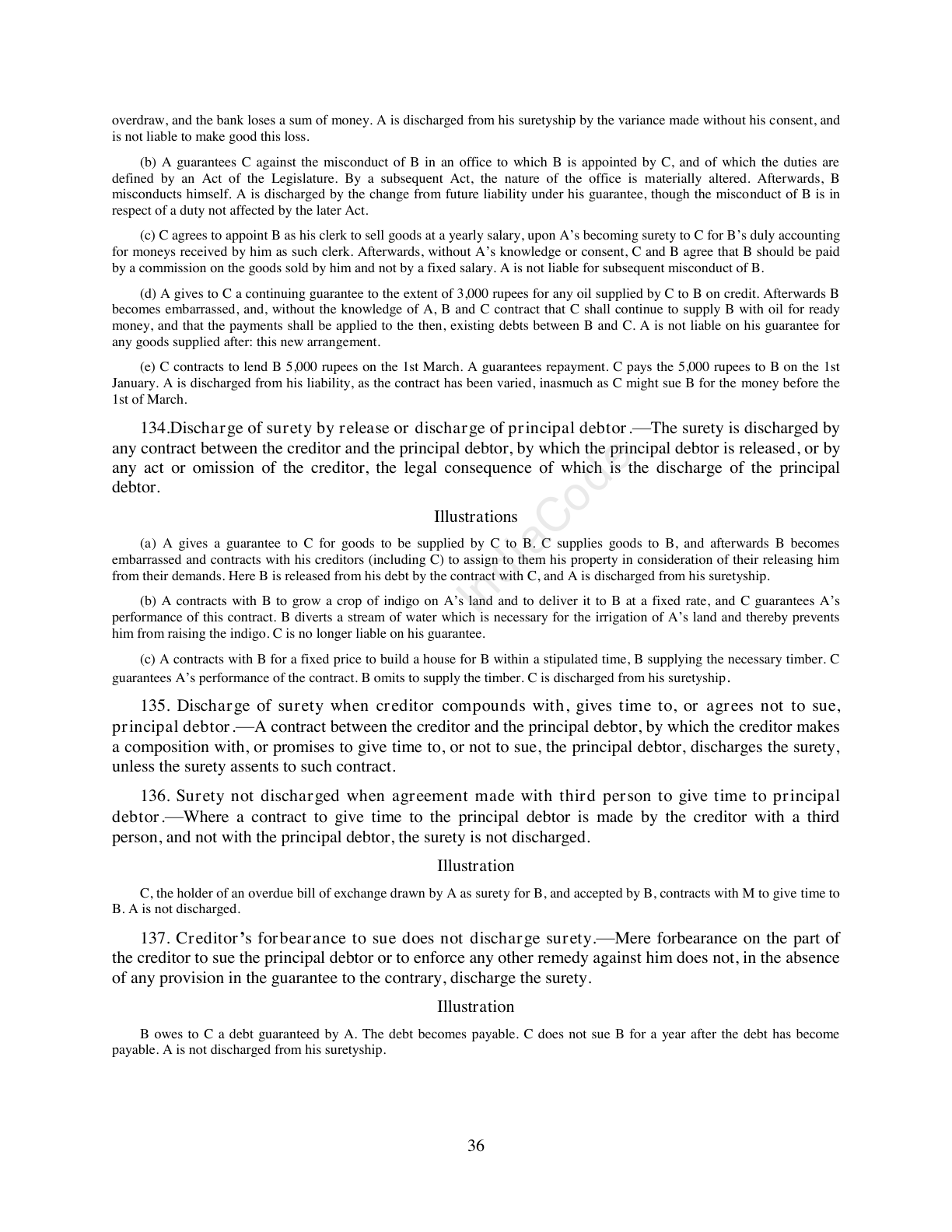
Full physical source page · unreviewed extraction
The Indian Contract Act, 1872: page 36
The Indian Contract Act, 1872, India Code delivered snapshot 85a7a066098255c9, physical page 36. Unreviewed extraction.
Source: official India Code PDF · catalog record. Fetched 2026-10-19T23:06:49Z. SHA-256 85a7a066098255c93001d678aeaf483f91d3080918363c03b78d40c3eeb8b386.
Legal currency, territorial applicability and extraction fidelity are unverified. Catalog checksum/size differs from the delivered PDF; both identities are retained. Sections, state notes and footnotes share these physical pages. Compare the full original image.
Retained layout text
overdraw, and the bank loses a sum of money. A is discharged from his suretyship by the variance made without his consent, and
is not liable to make good this loss.
     (b) A guarantees C against the misconduct of B in an office to which B is appointed by C, and of which the duties are
defined by an Act of the Legislature. By a subsequent Act, the nature of the office is materially altered. Afterwards, B
misconducts himself. A is discharged by the change from future liability under his guarantee, though the misconduct of B is in
respect of a duty not affected by the later Act.
     (c) C agrees to appoint B as his clerk to sell goods at a yearly salary, upon A’s becoming surety to C for B’s duly accounting
for moneys received by him as such clerk. Afterwards, without A’s knowledge or consent, C and B agree that B should be paid
by a commission on the goods sold by him and not by a fixed salary. A is not liable for subsequent misconduct of B.
     (d) A gives to C a continuing guarantee to the extent of 3,000 rupees for any oil supplied by C to B on credit. Afterwards B
becomes embarrassed, and, without the knowledge of A, B and C contract that C shall continue to supply B with oil for ready
money, and that the payments shall be applied to the then, existing debts between B and C. A is not liable on his guarantee for
any goods supplied after: this new arrangement.
     (e) C contracts to lend B 5,000 rupees on the 1st March. A guarantees repayment. C pays the 5,000 rupees to B on the 1st
January. A is discharged from his liability, as the contract has been varied, inasmuch as C might sue B for the money before the
1st of March.

    134.Discharge of surety by release or discharge of principal debtor.—The surety is discharged by
any contract between the creditor and the principal debtor, by which the principal debtor is released, or by
                                                                                    e
any act or omission of the creditor, the legal consequence of which is the discharge of the principal
debtor.                                                                      od
                                                         Illustrations
                                                                     aC
    (a) A gives a guarantee to C for goods to be supplied by C to B. C supplies goods to B, and afterwards B becomes
embarrassed and contracts with his creditors (including C) to assign to them his property in consideration of their releasing him
                                                                di
from their demands. Here B is released from his debt by the contract with C, and A is discharged from his suretyship.
                                                           In
     (b) A contracts with B to grow a crop of indigo on A’s land and to deliver it to B at a fixed rate, and C guarantees A’s
performance of this contract. B diverts a stream of water which is necessary for the irrigation of A’s land and thereby prevents
him from raising the indigo. C is no longer liable on his guarantee.
     (c) A contracts with B for a fixed price to build a house for B within a stipulated time, B supplying the necessary timber. C
guarantees A’s performance of the contract. B omits to supply the timber. C is discharged from his suretyship.

    135. Discharge of surety when creditor compounds with, gives time to, or agrees not to sue,
principal debtor.—A contract between the creditor and the principal debtor, by which the creditor makes
a composition with, or promises to give time to, or not to sue, the principal debtor, discharges the surety,
unless the surety assents to such contract.
    136. Surety not discharged when agreement made with third person to give time to principal
debtor.—Where a contract to give time to the principal debtor is made by the creditor with a third
person, and not with the principal debtor, the surety is not discharged.
                                                          Illustration
    C, the holder of an overdue bill of exchange drawn by A as surety for B, and accepted by B, contracts with M to give time to
B. A is not discharged.

    137. Creditor’s forbearance to sue does not discharge surety.—Mere forbearance on the part of
the creditor to sue the principal debtor or to enforce any other remedy against him does not, in the absence
of any provision in the guarantee to the contrary, discharge the surety.
                                                          Illustration
    B owes to C a debt guaranteed by A. The debt becomes payable. C does not sue B for a year after the debt has become
payable. A is not discharged from his suretyship.


                                                               36
Compare original page image