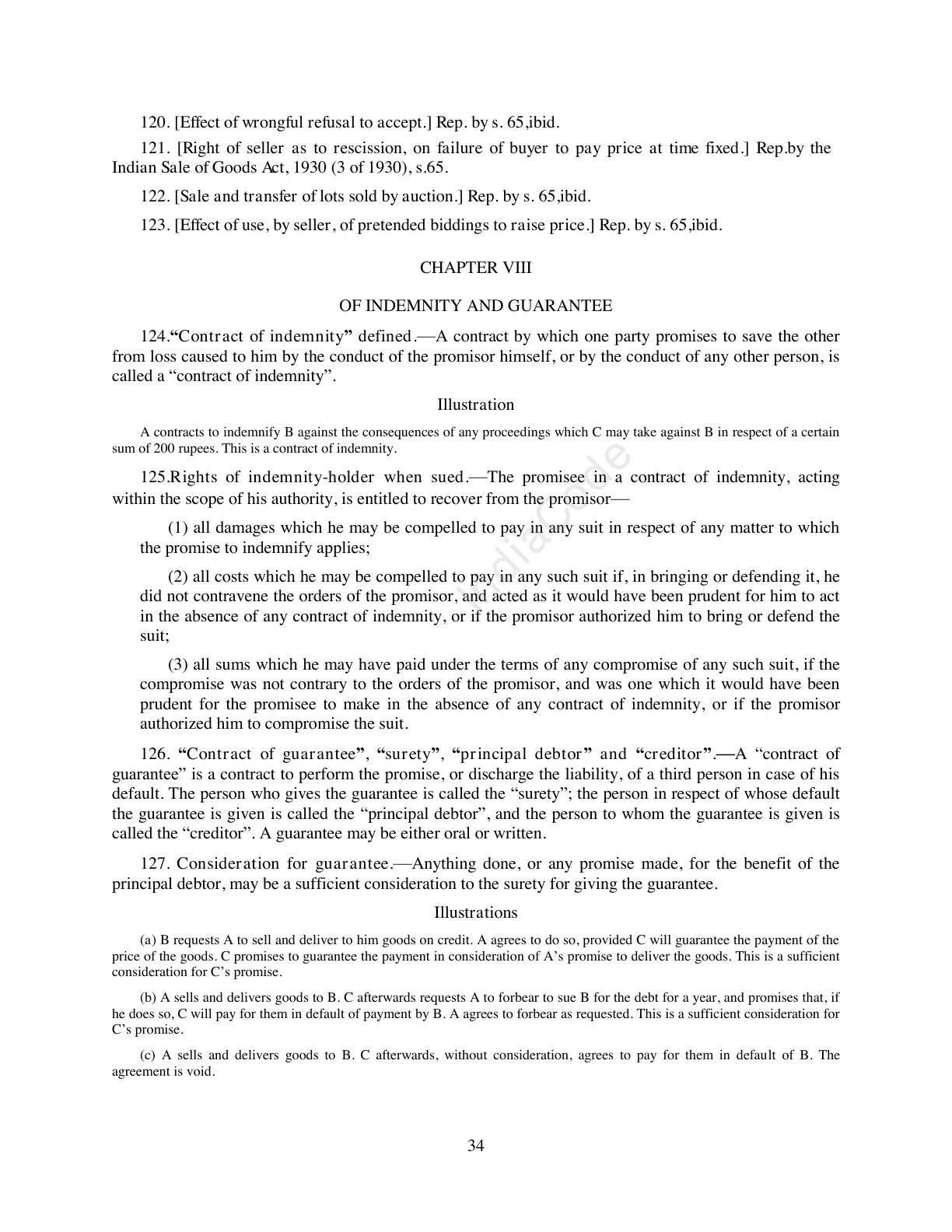
Full physical source page · unreviewed extraction
The Indian Contract Act, 1872: page 34
The Indian Contract Act, 1872, India Code delivered snapshot 85a7a066098255c9, physical page 34. Unreviewed extraction.
Source: official India Code PDF · catalog record. Fetched 2026-10-19T23:06:49Z. SHA-256 85a7a066098255c93001d678aeaf483f91d3080918363c03b78d40c3eeb8b386.
Legal currency, territorial applicability and extraction fidelity are unverified. Catalog checksum/size differs from the delivered PDF; both identities are retained. Sections, state notes and footnotes share these physical pages. Compare the full original image.
Retained layout text
    120. [Effect of wrongful refusal to accept.] Rep. by s. 65,ibid.
    121. [Right of seller as to rescission, on failure of buyer to pay price at time fixed.] Rep.by the
Indian Sale of Goods Act, 1930 (3 of 1930), s.65.
     122. [Sale and transfer of lots sold by auction.] Rep. by s. 65,ibid.
     123. [Effect of use, by seller, of pretended biddings to raise price.] Rep. by s. 65,ibid.

                                                       CHAPTER VIII

                                         OF INDEMNITY AND GUARANTEE
    124.“Contract of indemnity” defined.—A contract by which one party promises to save the other
from loss caused to him by the conduct of the promisor himself, or by the conduct of any other person, is
called a “contract of indemnity”.
                                                           Illustration
    A contracts to indemnify B against the consequences of any proceedings which C may take against B in respect of a certain
sum of 200 rupees. This is a contract of indemnity.
                                                                                     e
    125.Rights of indemnity-holder when sued.—The promisee in a contract of indemnity, acting
within the scope of his authority, is entitled to recover from the promisor—  od
                                                                      aC
         (1) all damages which he may be compelled to pay in any suit in respect of any matter to which
     the promise to indemnify applies;
                                                                 di
          (2) all costs which he may be compelled to pay in any such suit if, in bringing or defending it, he
                                                           In
     did not contravene the orders of the promisor, and acted as it would have been prudent for him to act
     in the absence of any contract of indemnity, or if the promisor authorized him to bring or defend the
     suit;
         (3) all sums which he may have paid under the terms of any compromise of any such suit, if the
     compromise was not contrary to the orders of the promisor, and was one which it would have been
     prudent for the promisee to make in the absence of any contract of indemnity, or if the promisor
     authorized him to compromise the suit.
    126. “Contract of guarantee”, “surety”, “principal debtor” and “creditor”.—A “contract of
guarantee” is a contract to perform the promise, or discharge the liability, of a third person in case of his
default. The person who gives the guarantee is called the “surety”; the person in respect of whose default
the guarantee is given is called the “principal debtor”, and the person to whom the guarantee is given is
called the “creditor”. A guarantee may be either oral or written.
    127. Consideration for guarantee.—Anything done, or any promise made, for the benefit of the
principal debtor, may be a sufficient consideration to the surety for giving the guarantee.
                                                          Illustrations
     (a) B requests A to sell and deliver to him goods on credit. A agrees to do so, provided C will guarantee the payment of the
price of the goods. C promises to guarantee the payment in consideration of A’s promise to deliver the goods. This is a sufficient
consideration for C’s promise.
     (b) A sells and delivers goods to B. C afterwards requests A to forbear to sue B for the debt for a year, and promises that, if
he does so, C will pay for them in default of payment by B. A agrees to forbear as requested. This is a sufficient consideration for
C’s promise.
     (c) A sells and delivers goods to B. C afterwards, without consideration, agrees to pay for them in default of B. The
agreement is void.


                                                                34
Compare original page image