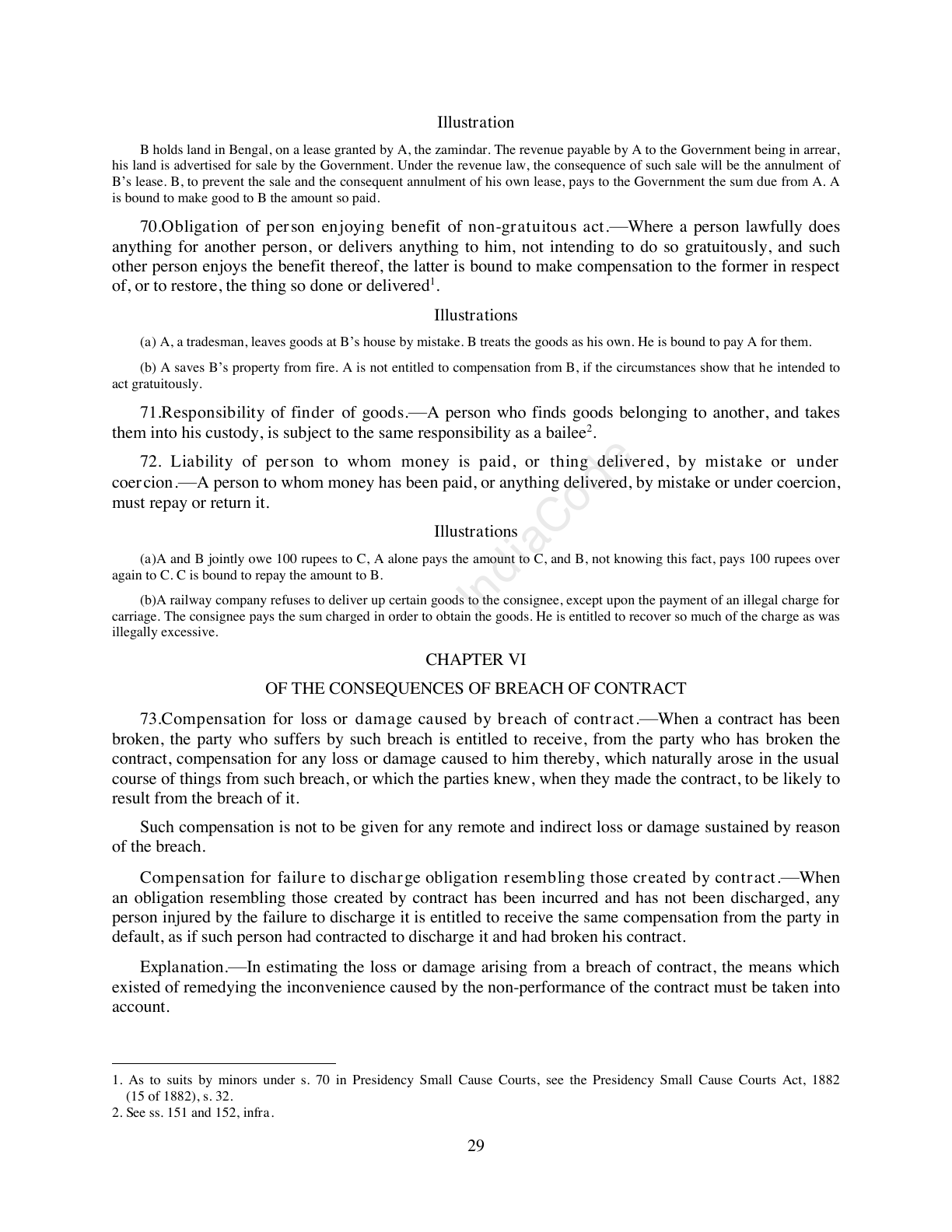
Full physical source page · unreviewed extraction
The Indian Contract Act, 1872: page 29
The Indian Contract Act, 1872, India Code delivered snapshot 85a7a066098255c9, physical page 29. Unreviewed extraction.
Source: official India Code PDF · catalog record. Fetched 2026-10-19T23:06:49Z. SHA-256 85a7a066098255c93001d678aeaf483f91d3080918363c03b78d40c3eeb8b386.
Legal currency, territorial applicability and extraction fidelity are unverified. Catalog checksum/size differs from the delivered PDF; both identities are retained. Sections, state notes and footnotes share these physical pages. Compare the full original image.
Retained layout text
                                                         Illustration
      B holds land in Bengal, on a lease granted by A, the zamindar. The revenue payable by A to the Government being in arrear,
his land is advertised for sale by the Government. Under the revenue law, the consequence of such sale will be the annulment of
B’s lease. B, to prevent the sale and the consequent annulment of his own lease, pays to the Government the sum due from A. A
is bound to make good to B the amount so paid.

     70.Obligation of person enjoying benefit of non-gratuitous act.—Where a person lawfully does
anything for another person, or delivers anything to him, not intending to do so gratuitously, and such
other person enjoys the benefit thereof, the latter is bound to make compensation to the former in respect
of, or to restore, the thing so done or delivered1.
                                                         Illustrations
    (a) A, a tradesman, leaves goods at B’s house by mistake. B treats the goods as his own. He is bound to pay A for them.
     (b) A saves B’s property from fire. A is not entitled to compensation from B, if the circumstances show that he intended to
act gratuitously.

    71.Responsibility of finder of goods.—A person who finds goods belonging to another, and takes
them into his custody, is subject to the same responsibility as a bailee2.
    72. Liability of person to whom money is paid, or thing delivered, by mistake or under
                                                                                   e
coercion.—A person to whom money has been paid, or anything delivered, by mistake or under coercion,
                                                                            od
must repay or return it.
                                                                    aC
                                                         Illustrations
     (a)A and B jointly owe 100 rupees to C, A alone pays the amount to C, and B, not knowing this fact, pays 100 rupees over
again to C. C is bound to repay the amount to B.               di
                                                          In
      (b)A railway company refuses to deliver up certain goods to the consignee, except upon the payment of an illegal charge for
carriage. The consignee pays the sum charged in order to obtain the goods. He is entitled to recover so much of the charge as was
illegally excessive.

                                                       CHAPTER VI
                           OF THE CONSEQUENCES OF BREACH OF CONTRACT
    73.Compensation for loss or damage caused by breach of contract.—When a contract has been
broken, the party who suffers by such breach is entitled to receive, from the party who has broken the
contract, compensation for any loss or damage caused to him thereby, which naturally arose in the usual
course of things from such breach, or which the parties knew, when they made the contract, to be likely to
result from the breach of it.
     Such compensation is not to be given for any remote and indirect loss or damage sustained by reason
of the breach.
    Compensation for failure to discharge obligation resembling those created by contract.—When
an obligation resembling those created by contract has been incurred and has not been discharged, any
person injured by the failure to discharge it is entitled to receive the same compensation from the party in
default, as if such person had contracted to discharge it and had broken his contract.
    Explanation.—In estimating the loss or damage arising from a breach of contract, the means which
existed of remedying the inconvenience caused by the non-performance of the contract must be taken into
account.


1. As to suits by minors under s. 70 in Presidency Small Cause Courts, see the Presidency Small Cause Courts Act, 1882
   (15 of 1882), s. 32.
2. See ss. 151 and 152, infra.

                                                              29
Compare original page image