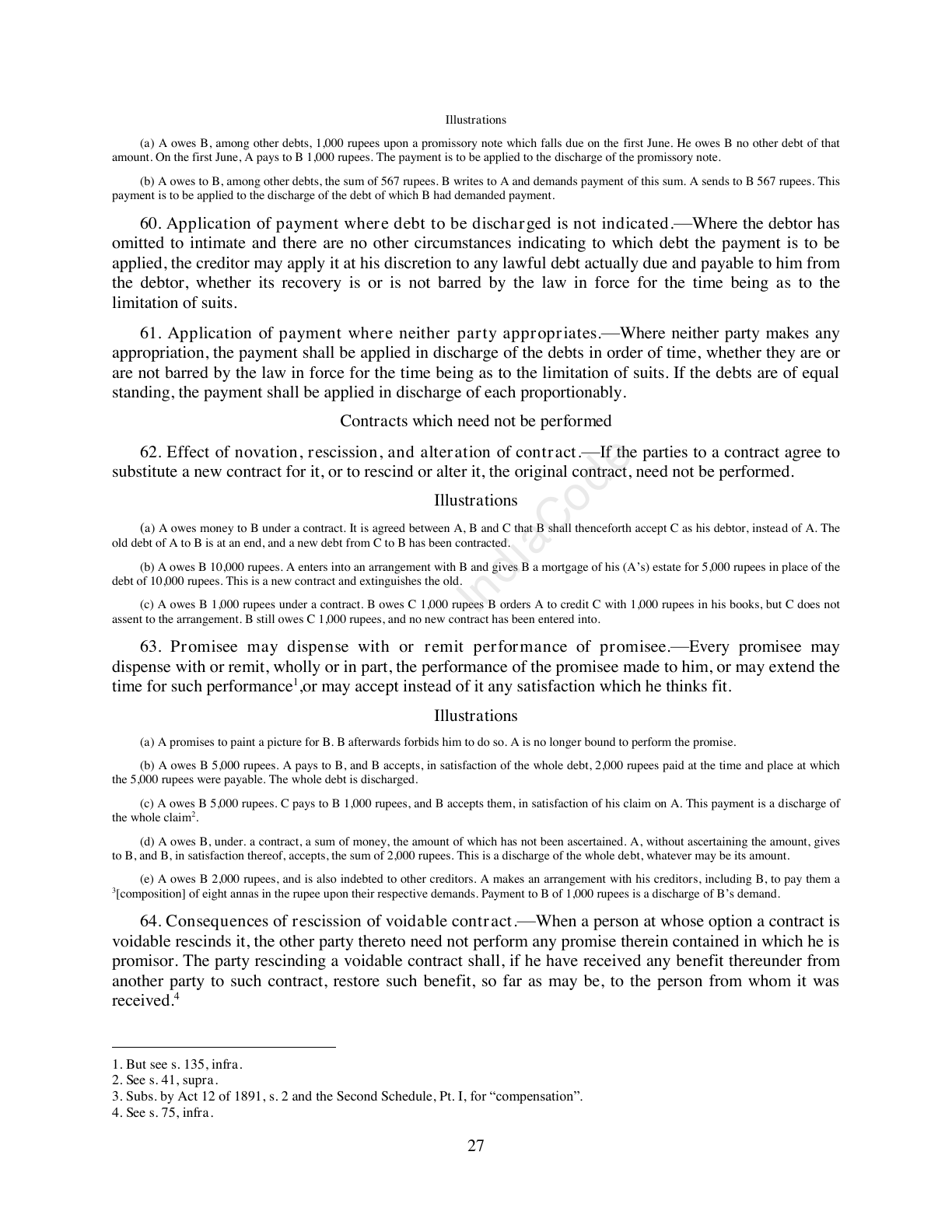
Full physical source page · unreviewed extraction
The Indian Contract Act, 1872: page 27
The Indian Contract Act, 1872, India Code delivered snapshot 85a7a066098255c9, physical page 27. Unreviewed extraction.
Source: official India Code PDF · catalog record. Fetched 2026-10-19T23:06:49Z. SHA-256 85a7a066098255c93001d678aeaf483f91d3080918363c03b78d40c3eeb8b386.
Legal currency, territorial applicability and extraction fidelity are unverified. Catalog checksum/size differs from the delivered PDF; both identities are retained. Sections, state notes and footnotes share these physical pages. Compare the full original image.
Retained layout text
                                                                     Illustrations
    (a) A owes B, among other debts, 1,000 rupees upon a promissory note which falls due on the first June. He owes B no other debt of that
amount. On the first June, A pays to B 1,000 rupees. The payment is to be applied to the discharge of the promissory note.
    (b) A owes to B, among other debts, the sum of 567 rupees. B writes to A and demands payment of this sum. A sends to B 567 rupees. This
payment is to be applied to the discharge of the debt of which B had demanded payment.

    60. Application of payment where debt to be discharged is not indicated.—Where the debtor has
omitted to intimate and there are no other circumstances indicating to which debt the payment is to be
applied, the creditor may apply it at his discretion to any lawful debt actually due and payable to him from
the debtor, whether its recovery is or is not barred by the law in force for the time being as to the
limitation of suits.
    61. Application of payment where neither party appropriates.—Where neither party makes any
appropriation, the payment shall be applied in discharge of the debts in order of time, whether they are or
are not barred by the law in force for the time being as to the limitation of suits. If the debts are of equal
standing, the payment shall be applied in discharge of each proportionably.
                                                Contracts which need not be performed
    62. Effect of novation, rescission, and alteration of contract.—If the parties to a contract agree to
                                                                                                 e
substitute a new contract for it, or to rescind or alter it, the original contract, need not be performed.
                                                                   Illustrations
                                                                                         od
                                                                                aC
     (a) A owes money to B under a contract. It is agreed between A, B and C that B shall thenceforth accept C as his debtor, instead of A. The
old debt of A to B is at an end, and a new debt from C to B has been contracted.

                                                                          di
      (b) A owes B 10,000 rupees. A enters into an arrangement with B and gives B a mortgage of his (A’s) estate for 5,000 rupees in place of the
debt of 10,000 rupees. This is a new contract and extinguishes the old.
                                                                    In
     (c) A owes B 1,000 rupees under a contract. B owes C 1,000 rupees B orders A to credit C with 1,000 rupees in his books, but C does not
assent to the arrangement. B still owes C 1,000 rupees, and no new contract has been entered into.

    63. Promisee may dispense with or remit performance of promisee.—Every promisee may
dispense with or remit, wholly or in part, the performance of the promisee made to him, or may extend the
time for such performance1,or may accept instead of it any satisfaction which he thinks fit.
                                                                   Illustrations
        (a) A promises to paint a picture for B. B afterwards forbids him to do so. A is no longer bound to perform the promise.
      (b) A owes B 5,000 rupees. A pays to B, and B accepts, in satisfaction of the whole debt, 2,000 rupees paid at the time and place at which
the 5,000 rupees were payable. The whole debt is discharged.
     (c) A owes B 5,000 rupees. C pays to B 1,000 rupees, and B accepts them, in satisfaction of his claim on A. This payment is a discharge of
the whole claim2.
      (d) A owes B, under. a contract, a sum of money, the amount of which has not been ascertained. A, without ascertaining the amount, gives
to B, and B, in satisfaction thereof, accepts, the sum of 2,000 rupees. This is a discharge of the whole debt, whatever may be its amount.
        (e) A owes B 2,000 rupees, and is also indebted to other creditors. A makes an arrangement with his creditors, including B, to pay them a
3
    [composition] of eight annas in the rupee upon their respective demands. Payment to B of 1,000 rupees is a discharge of B’s demand.

    64. Consequences of rescission of voidable contract.—When a person at whose option a contract is
voidable rescinds it, the other party thereto need not perform any promise therein contained in which he is
promisor. The party rescinding a voidable contract shall, if he have received any benefit thereunder from
another party to such contract, restore such benefit, so far as may be, to the person from whom it was
received.4


1. But see s. 135, infra.
2. See s. 41, supra.
3. Subs. by Act 12 of 1891, s. 2 and the Second Schedule, Pt. I, for “compensation”.
4. See s. 75, infra.

                                                                         27
Compare original page image